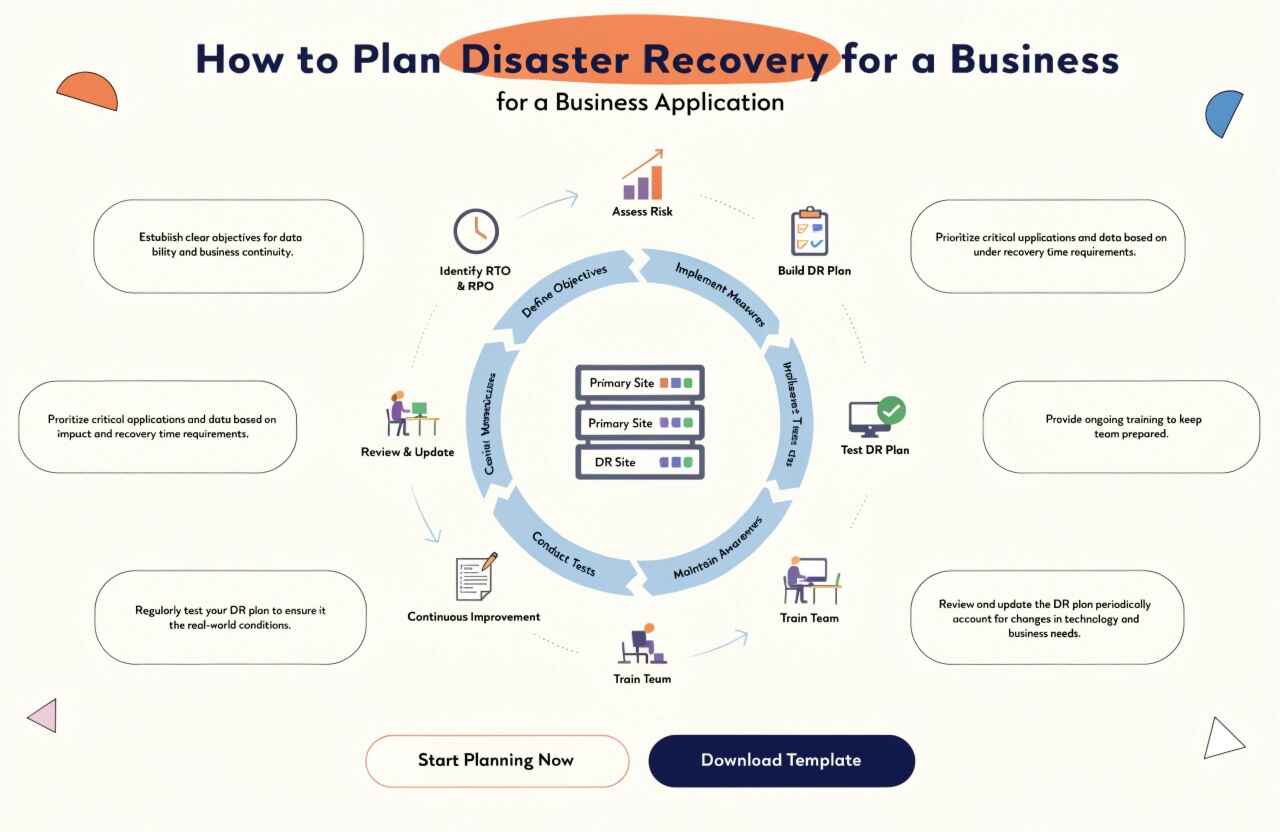
Discover how to plan disaster recovery for business applications through risk assessment, secure backups, recovery objectives, cloud solutions, documented procedures, and regular testing to minimize downtime and protect business operations.
Introduction
Business applications are essential for managing customer information, processing transactions, coordinating employees, and delivering digital services. From enterprise resource planning systems to e-commerce platforms and customer relationship management software, organizations depend on applications to maintain daily operations. However, unexpected incidents such as cyberattacks, hardware failures, human errors, natural disasters, and cloud service outages can interrupt these systems.
A disaster recovery plan helps businesses restore critical applications, protect valuable data, and minimize operational disruption. Instead of reacting to an emergency without preparation, organizations can follow a structured process to recover systems efficiently. Understanding how to plan disaster recovery for a business application is therefore essential for maintaining reliability, customer trust, and long-term business continuity.
1. Identify Critical Business Applications
The first step in disaster recovery planning is identifying which applications are essential to business operations. Not every system requires the same recovery priority.
For example, an e-commerce company may consider its payment processing system, product database, and online store critical. A service-based IT company may prioritize project management software, client databases, communication tools, and development infrastructure.
Evaluate each application according to its business importance, financial impact, customer dependency, and operational requirements. Identify the teams responsible for maintaining each system and document its dependencies, including databases, APIs, authentication services, third-party integrations, and cloud infrastructure.
This assessment helps organizations allocate recovery resources according to actual business needs rather than treating every application equally.
2. Conduct a Risk Assessment
After identifying critical applications, evaluate the threats that could affect their availability, integrity, or performance.
Common risks include server failures, accidental data deletion, ransomware attacks, software deployment errors, network outages, cloud region failures, and physical damage to infrastructure.
A business impact analysis can help determine the consequences of each disruption. Consider potential revenue loss, customer dissatisfaction, contractual obligations, regulatory requirements, and the time required to resume normal operations.
Document the likelihood and potential impact of each risk. Use this information to determine which applications need stronger protection, additional backups, redundant infrastructure, or more frequent recovery testing.
Regularly update the assessment because business requirements, application architecture, and security threats change over time.
3. Define Recovery Objectives
A successful disaster recovery strategy requires clear and measurable recovery objectives. Two important metrics are Recovery Time Objective (RTO) and Recovery Point Objective (RPO).
Recovery Time Objective (RTO) defines the maximum acceptable time required to restore an application after a disruption. For example, an online payment system might require recovery within one hour, while an internal reporting tool may tolerate a longer interruption.
Recovery Point Objective (RPO) defines how much data loss, measured in time, the business can tolerate. An RPO of 15 minutes means the organization aims to recover data to a point no more than 15 minutes before the disruption.
These objectives should reflect business priorities, technical feasibility, and budget. More demanding targets generally require additional investment in replication, automation, infrastructure, and monitoring.
4. Develop a Reliable Backup Strategy
Backups are a fundamental component of application recovery. Businesses should maintain regular copies of application data, databases, configuration files, infrastructure definitions, and other resources required to restore operations.
Depending on application requirements, backup options may include full backups, incremental backups, database transaction log backups, and continuous data replication.
Follow the 3-2-1 backup principle where practical: maintain three copies of important data, use two different storage types, and keep one copy off-site. For stronger ransomware protection, consider immutable backups, offline copies, and restricted backup credentials.
Encrypt backups both during transfer and while stored. Define retention periods according to business and legal requirements, and monitor backup jobs for failures.
Remember that a successful backup does not automatically guarantee successful recovery. Regular restoration tests are necessary to verify that the data is complete, accessible, and usable.
5. Choose the Right Disaster Recovery Architecture
The appropriate recovery architecture depends on application complexity, budget, RTO, and RPO.
Cloud-based disaster recovery can help organizations restore applications without maintaining an entirely separate physical data center. Cloud infrastructure may support backup storage, replicated databases, automated deployments, and geographically separate recovery environments.
Other approaches include:
- Backup and restore: Restore data and rebuild the application environment when required. This can be cost-effective but may involve longer recovery times.
- Pilot light: Maintain essential infrastructure and core data services, expanding capacity during recovery.
- Warm standby: Keep a partially operational environment ready for faster restoration.
- Hot standby or active-active architecture: Maintain continuously running environments for rapid failover, potentially across separate locations.
Select an approach based on realistic recovery requirements. Also evaluate vendor dependencies, network connectivity, identity management, regional availability, and the possibility of failures affecting multiple systems simultaneously.
6. Create a Documented Recovery Procedure
A disaster recovery plan should provide clear instructions that technical teams can follow during an emergency.
Document how to declare a disaster, contact responsible personnel, access backup environments, restore databases, deploy application services, validate functionality, and redirect traffic to recovered systems.
Assign responsibilities to developers, infrastructure engineers, security teams, management, and business stakeholders. Maintain emergency contact details and define who has the authority to initiate recovery.
The plan should also include communication procedures for employees, customers, vendors, and relevant authorities when necessary.
Store recovery documentation securely but ensure authorized responders can access it if the primary application environment becomes unavailable. Review the documentation whenever significant infrastructure or application changes occur.
7. Test and Improve the Recovery Plan
Testing is essential because an untested disaster recovery plan may fail when it is needed most.
Start with tabletop exercises in which stakeholders discuss how they would respond to different incidents. Progress to backup restoration tests, isolated recovery drills, application failover simulations, and full disaster recovery exercises where appropriate.
Verify that applications start correctly, databases remain consistent, integrations function properly, and users can access essential services. Measure actual recovery time and data loss against the established RTO and RPO.
Record any issues discovered during testing and assign corrective actions to responsible team members. Repeat testing after major application updates, infrastructure changes, or changes in recovery requirements.
8. Monitor, Secure, and Maintain the Plan
Disaster recovery planning is an ongoing responsibility rather than a one-time project. Monitor backup completion, replication delays, storage capacity, system health, and security alerts.
Protect recovery environments with multifactor authentication, least-privilege access, network segmentation, and secure credential management. Keep software patched and ensure recovery infrastructure can be deployed from trusted configurations.
Review recovery procedures periodically and update them when business priorities, compliance requirements, or technology platforms change. Training employees and conducting regular reviews helps teams respond confidently under pressure.
Conclusion
Planning disaster recovery for a business application requires a combination of risk assessment, clear recovery objectives, reliable backups, suitable infrastructure, documented procedures, and regular testing. Organizations that prepare in advance can reduce downtime, limit data loss, and maintain customer confidence during unexpected disruptions.
By treating disaster recovery as a continuous process, businesses can strengthen application resilience and support uninterrupted operations. A well-designed plan does more than restore technology; it helps protect business value, maintain service reliability, and prepare the organization for future challenges.
We build scalable web, mobile, and game products for clients worldwide — combining modern frameworks, cloud infrastructure, and best engineering practices.
.jpg)
.jpg)
.jpg)