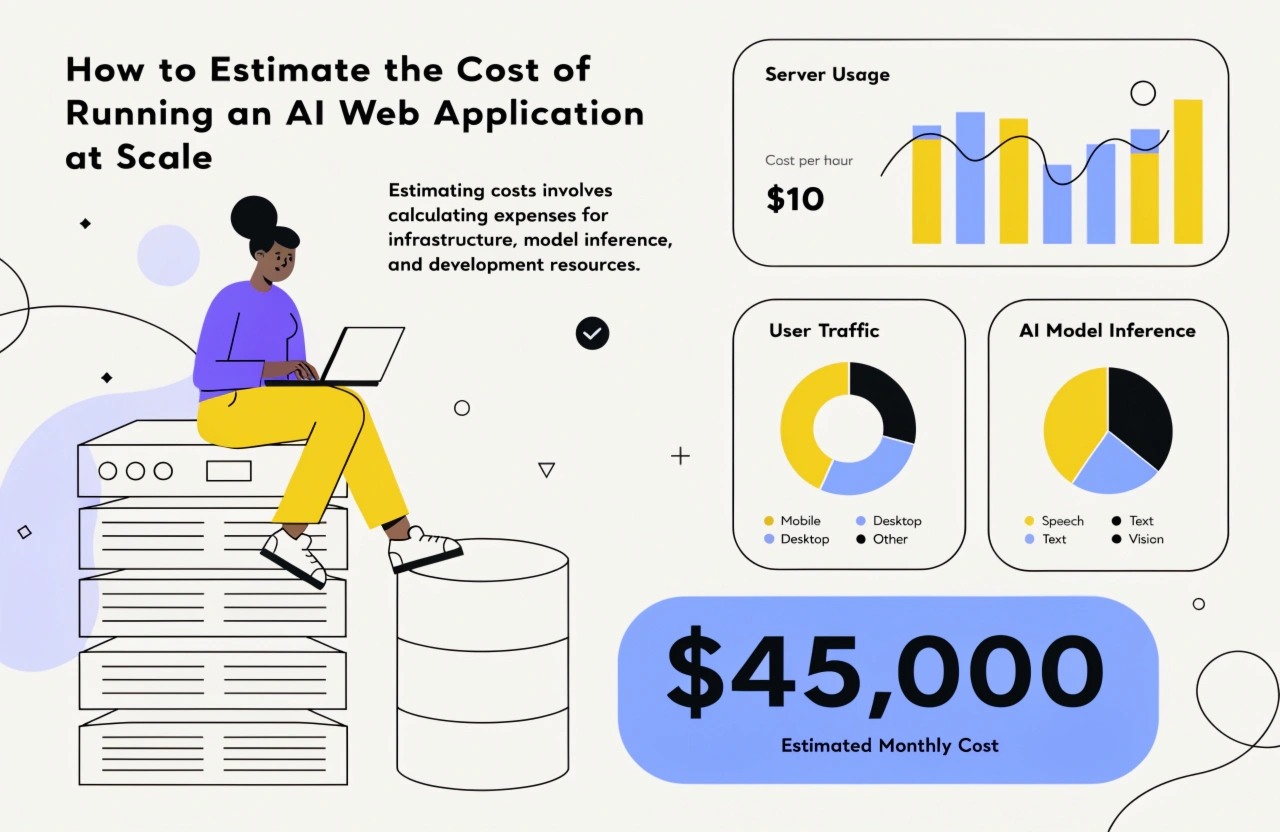
Discover how to estimate the cost of running an AI-powered web application at scale by evaluating cloud infrastructure, AI API usage, databases, storage, security, monitoring, and maintenance while applying practical strategies to optimize spending and support sustainable growth.
How to Estimate the Cost of Running an AI Web Application at Scale
Artificial intelligence is transforming modern web applications through intelligent chatbots, personalized recommendations, automated workflows, predictive analytics, and content generation. However, launching an AI-powered web application is only the beginning. As the number of users increases, infrastructure requirements, AI processing, storage, and maintenance expenses can grow significantly.
For businesses planning to scale their applications, understanding these costs early is essential. A realistic budget helps prevent unexpected bills, maintain performance, and support long-term growth. Here is how to estimate the cost of running an AI web application at scale.
1. Understand Your Application's Expected Workload
The first step is estimating how your application will be used. An AI-powered customer support chatbot has different infrastructure requirements from an application that generates images, analyzes documents, or processes large datasets.
Identify the following metrics:
- Monthly active users: The number of people regularly using your application.
- Daily requests: The number of actions or queries submitted by users.
- AI requests per user: How frequently users interact with AI features.
- Average processing time: How long each request takes to complete.
- Data volume: The amount of information stored, retrieved, or processed.
- Peak traffic: The maximum number of simultaneous users during busy periods.
For example, an application serving 10,000 users who each make 20 AI requests monthly processes approximately 200,000 AI requests per month.
These estimates provide a starting point for calculating infrastructure and AI service expenses.
2. Calculate Cloud Infrastructure Costs
Cloud infrastructure provides the computing power required to run your application. Typical expenses include virtual servers, containers, serverless functions, networking, load balancers, and content delivery networks.
Costs depend on the provider, selected region, computing resources, and workload.
Applications with predictable traffic may benefit from reserved cloud capacity or committed-use discounts. Applications with fluctuating demand may be better suited to autoscaling or serverless architectures.
When preparing your budget, consider:
- Application servers and compute instances.
- Load balancing and traffic distribution.
- Network bandwidth and data transfer.
- Development, testing, and production environments.
- Backup infrastructure and disaster recovery.
Instead of estimating server costs using current traffic alone, calculate the resources required at expected future demand. Allow additional capacity for traffic spikes and unexpected growth.
3. Estimate AI Model and API Expenses
AI processing can become one of the largest operating expenses, particularly when an application depends on large language models, image generation, speech recognition, or other computationally intensive services.
For API-based AI services, calculate the expected monthly cost using the provider's current pricing.
For language models, a basic estimate is:
Monthly AI cost = Total input tokens × input price per token + total output tokens × output price per token
For example, suppose an application processes 200,000 requests monthly, averaging 1,000 input tokens and 300 output tokens per request. This results in approximately 200 million input tokens and 60 million output tokens.
Multiply these quantities by the selected model's published token rates to estimate the monthly expense. The actual amount depends on the model, provider, pricing unit, caching, and any additional charges.
For self-hosted AI models, estimate GPU or accelerator rental, memory requirements, idle capacity, inference throughput, and model maintenance instead.
Using smaller models for straightforward tasks and reserving more capable models for complex requests can help reduce expenses without compromising important user experiences.
4. Include Database and Storage Expenses
AI applications often store user profiles, conversation histories, uploaded files, embeddings, logs, and application records.
Your database budget should account for database hosting, storage capacity, query volume, backups, replication, and data transfer.
If your application uses retrieval-augmented generation (RAG), you may also need a vector database to store and search embeddings. Its cost depends on the number of vectors, vector dimensions, indexing requirements, query volume, and performance expectations.
Estimate storage growth monthly and determine how long historical data must be retained. Archiving older records, removing unnecessary files, and applying retention policies can help control long-term expenses.
5. Budget for Security, Monitoring, and Maintenance
Running an AI web application at scale involves more than hosting and model inference.
Operational costs can include application monitoring, error tracking, security testing, identity management, rate limiting, logging, and compliance requirements.
AI-specific monitoring is also important. Track response quality, latency, failed requests, token consumption, and unusual usage patterns. These metrics help identify performance issues and unexpected cost increases.
Include ongoing engineering work for dependency updates, model changes, bug fixes, performance improvements, and infrastructure maintenance.
The required budget depends on the application's complexity, industry, availability requirements, and internal team's capabilities.
6. Build a Monthly Cost Estimation Model
Once individual expenses are identified, combine them into a single operating budget.
Cost category What to estimate
Cloud computing Servers, containers, GPUs, and functions
AI services Model APIs or self-hosted inference
Database Queries, storage, replication, and backups
Storage Files, datasets, embeddings, and logs
Networking Bandwidth, load balancing, and data transfer
Monitoring and security Observability, protection, and compliance
Maintenance Engineering, testing, and operational support
Calculate the monthly total, then multiply it by 12 for an annual estimate. Add a contingency allowance based on workload uncertainty and business risk.
For a more useful forecast, prepare three scenarios: expected usage, high growth, and peak demand. This reveals how costs may change as the application expands.
7. Optimize Costs Without Sacrificing Performance
Cost optimization should begin with measurement rather than arbitrary reductions.
Consider implementing these practices:
- Cache repeated AI responses when appropriate.
- Use smaller models for simple tasks.
- Limit unnecessary prompt and response tokens.
- Apply rate limits to prevent abusive usage.
- Scale infrastructure automatically according to demand.
- Schedule nonproduction resources to shut down when unused.
- Monitor cloud bills and set budget alerts.
- Review unused resources and excessive data retention.
- Test model quality before switching to a cheaper alternative.
Measure cost per user, cost per AI request, and cost per successful business outcome. These metrics help determine whether your application is becoming more efficient as usage grows.
Conclusion
Estimating the cost of running an AI web application at scale requires a complete view of infrastructure, AI processing, databases, storage, security, and ongoing maintenance. The most reliable estimates begin with realistic usage assumptions and are refined through monitoring and regular reviews.
By forecasting multiple growth scenarios, choosing suitable AI models, optimizing cloud resources, and tracking cost-related metrics, businesses can build scalable applications with more predictable operating expenses.
A well-planned cost strategy enables organizations to deliver reliable AI-powered experiences while balancing performance, user satisfaction, and long-term business sustainability.
We build scalable web, mobile, and game products for clients worldwide — combining modern frameworks, cloud infrastructure, and best engineering practices.
.jpg)
.jpg)
.jpg)