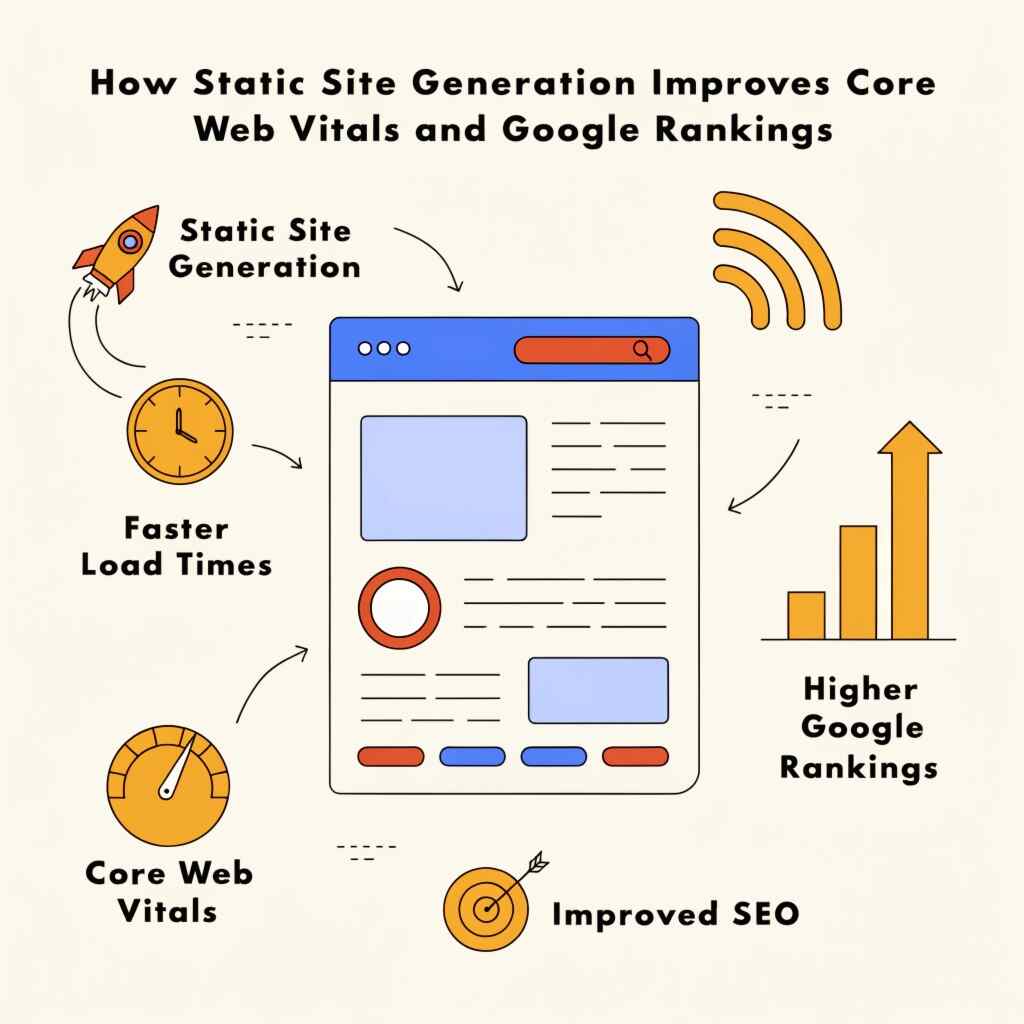
How Static Site Generation Improves Core Web Vitals and Google Rankings
Website performance has become one of the most important ranking factors for search engines. Google now evaluates websites not only based on content quality but also on user experience. Faster websites keep visitors engaged, reduce bounce rates, and increase conversions. This is where Static Site Generation (SSG) plays a significant role.
Unlike traditional server-rendered websites that generate pages every time a visitor requests them, Static Site Generation creates HTML pages during the build process. These pre-built pages are then served instantly through Content Delivery Networks (CDNs), resulting in lightning-fast load times.
Let's understand how SSG directly impacts Core Web Vitals and improves Google rankings.
What is Static Site Generation (SSG)?
Static Site Generation is a web development technique where web pages are generated before users visit the website. Instead of processing database queries and rendering HTML dynamically on every request, the website serves already-built HTML files.
Popular frameworks supporting SSG include:
- Next.js
- Nuxt.js
- Gatsby
- Astro
- Hugo
- Jekyll
These frameworks combine modern JavaScript development with outstanding website performance.
Understanding Core Web Vitals
Core Web Vitals are Google's performance metrics used to evaluate user experience.
1. Largest Contentful Paint (LCP)
Measures how quickly the main content loads.
Ideal Score:
- Under 2.5 seconds
SSG improves LCP because HTML is already generated and delivered immediately without waiting for server-side rendering.
2. Interaction to Next Paint (INP)
Measures how responsive the website feels after users interact with it.
Ideal Score:
- Less than 200 milliseconds
Since SSG reduces unnecessary JavaScript execution and server processing, interactions become significantly faster.
3. Cumulative Layout Shift (CLS)
Measures unexpected movement of page elements while loading.
Ideal Score:
- Less than 0.1
Static pages provide stable layouts because content is predetermined before delivery.
Why Faster Websites Rank Better
Google aims to provide users with the best possible experience.
When a website loads quickly:
- Visitors stay longer.
- Bounce rates decrease.
- Engagement increases.
- Conversion rates improve.
- Search engines can crawl pages more efficiently.
These factors collectively contribute to improved SEO performance.
Benefits of Static Site Generation
Lightning-Fast Loading
Static HTML files can be served directly from global CDNs without waiting for backend processing.
This drastically reduces:
- Time to First Byte (TTFB)
- Server response time
- Initial page load
Better SEO Performance
Search engines can easily crawl static HTML.
Benefits include:
- Faster indexing
- Cleaner page structure
- Improved crawl efficiency
- Better metadata rendering
Enhanced Website Security
Since there is little or no server-side processing during requests, SSG minimizes many common attack vectors such as SQL injection and server-side exploits.
Lower Hosting Costs
Static websites consume fewer server resources because they don't generate pages dynamically.
Hosting providers can serve millions of requests using inexpensive CDN infrastructure.
Improved Scalability
Traffic spikes rarely impact static websites.
Whether 100 users or one million users visit simultaneously, static files can be distributed efficiently through CDNs.
How SSG Improves Google Rankings
Better Page Experience
Google rewards websites that provide excellent user experiences.
SSG helps achieve this by:
- Fast loading pages
- Stable layouts
- Smooth interactions
Mobile Performance
Most users browse from smartphones.
Static websites perform exceptionally well on slower mobile networks, helping improve mobile SEO rankings.
Faster Crawling
Googlebot spends a crawl budget on every website.
Static HTML pages reduce unnecessary processing, allowing search engines to discover and index more content efficiently.
Lower Bounce Rate
Slow websites frustrate visitors.
Fast-loading static pages encourage users to continue exploring, sending positive engagement signals to search engines.
Popular Frameworks for Static Site Generation
Next.js
One of the most popular React frameworks offering:
- Static Site Generation
- Incremental Static Regeneration
- Server-Side Rendering
- Image Optimization
Nuxt.js
Built on Vue.js and provides:
- Static generation
- Excellent SEO
- Hybrid rendering
- Easy deployment
Gatsby
Ideal for blogs, documentation, and marketing websites with extensive plugin support.
Astro
Astro delivers minimal JavaScript by default, making websites incredibly fast while maintaining modern development practices.
Is Static Site Generation Right for Every Website?
SSG is an excellent choice for:
- Company websites
- Landing pages
- Blogs
- Portfolio websites
- Documentation
- Marketing websites
- News portals
However, applications requiring real-time dashboards, user authentication, or frequently changing personalized data may benefit from hybrid rendering or Server-Side Rendering (SSR).
Best Practices for Maximizing SSG Performance
To get the best results:
- Optimize images using modern formats like WebP or AVIF.
- Compress CSS and JavaScript files.
- Use lazy loading for images and videos.
- Minify HTML assets.
- Deploy using a global CDN.
- Implement proper caching strategies.
- Monitor Core Web Vitals regularly using Google PageSpeed Insights and Lighthouse.
Conclusion
Static Site Generation has become one of the most effective approaches for building fast, secure, and SEO-friendly websites. By pre-generating pages during the build process, SSG dramatically improves Core Web Vitals, reduces loading times, enhances user experience, and helps websites achieve better Google rankings.
Whether you're developing a business website, blog, portfolio, or marketing platform, adopting frameworks like Next.js, Nuxt.js, Gatsby, or Astro can significantly improve performance while creating a seamless experience for users. As Google's focus on speed and usability continues to grow, investing in Static Site Generation is a smart strategy for long-term digital success