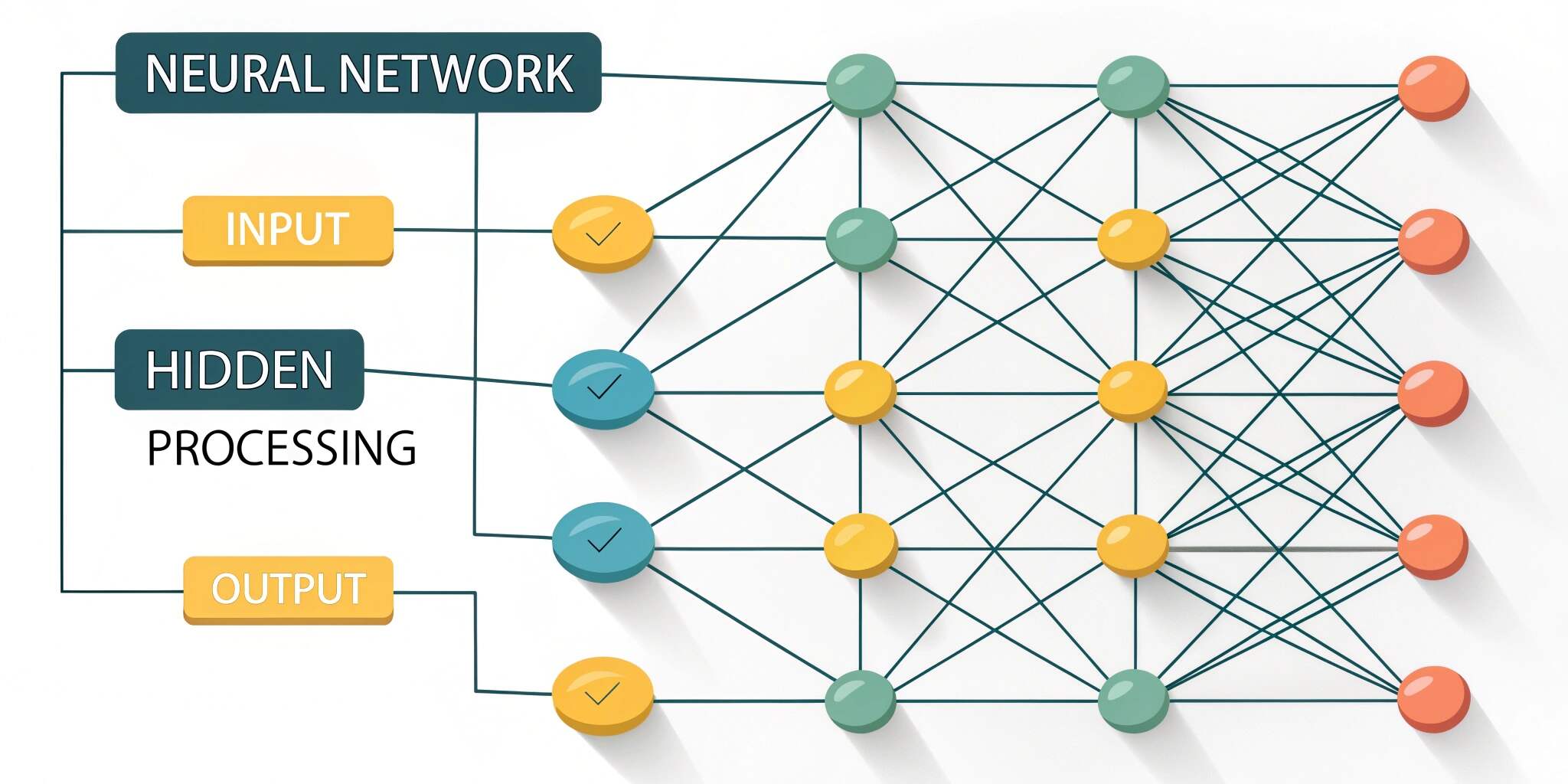
Neural networks are at the core of many advanced AI applications—from recognizing faces to generating human-like text. But how exactly do these systems work? In simple terms, a neural network is a computational model inspired by the human brain. It is made up of layers of interconnected units called neurons that work together to identify patterns, make decisions, and learn from data.
What is a Neural Network?
A neural network is a type of machine learning algorithm designed to recognize patterns. It takes input data, processes it through interconnected layers of artificial neurons, and produces an output. It’s called a “network” because these neurons are connected like a web—much like the neurons in our brain.
Core Components of a Neural Network
1. Neurons (Nodes)
Each neuron receives input, processes it, and passes it on. Think of it as a mini decision-maker.
2. Layers
Neural networks are organized into three main types of layers:
- Input Layer: Takes the raw data.
- Hidden Layers: Perform computations and transformations.
- Output Layer: Produces the final prediction or result.
3. Weights and Biases
- Weights determine the importance of inputs.
- Biases allow shifting the activation function, improving flexibility.
4. Activation Function
An activation function decides whether a neuron should "fire" or not. Common ones include ReLU, Sigmoid, and Tanh. These introduce non-linearity, helping the network handle complex tasks.
How Does Learning Happen?
Neural networks learn by adjusting the weights and biases during training. Here’s how it works:
- Forward Propagation: Data moves from input to output, producing a prediction.
- Loss Calculation: The difference between the prediction and actual value is measured.
- Backward Propagation: The network adjusts weights using techniques like gradient descent to minimize the loss.
- Iteration: This process is repeated over many data samples (epochs) until the network learns the patterns accurately.
Real-World Applications of Neural Networks
- Image Recognition: Identifying objects or faces in photos.
- Speech Recognition: Converting spoken words to text.
- Text Generation: Powering AI chatbots and writing assistants.
- Medical Diagnosis: Predicting diseases from scans or patient records.
- Self-driving Cars: Interpreting traffic signs and obstacles.
Why Are Neural Networks Powerful?
- They can learn from data: No need for hard-coded rules.
- They generalize well: Once trained, they can make accurate predictions on new data.
- They handle complexity: Perfect for tasks with non-linear relationships or vast inputs.
Conclusion
Neural networks mimic how the human brain works—by learning from data, recognizing patterns, and making decisions. Though the underlying math can get complex, the fundamental idea remains simple: layers of interconnected nodes working together to solve a problem. Understanding how they function is the first step toward unlocking the true potential of AI.