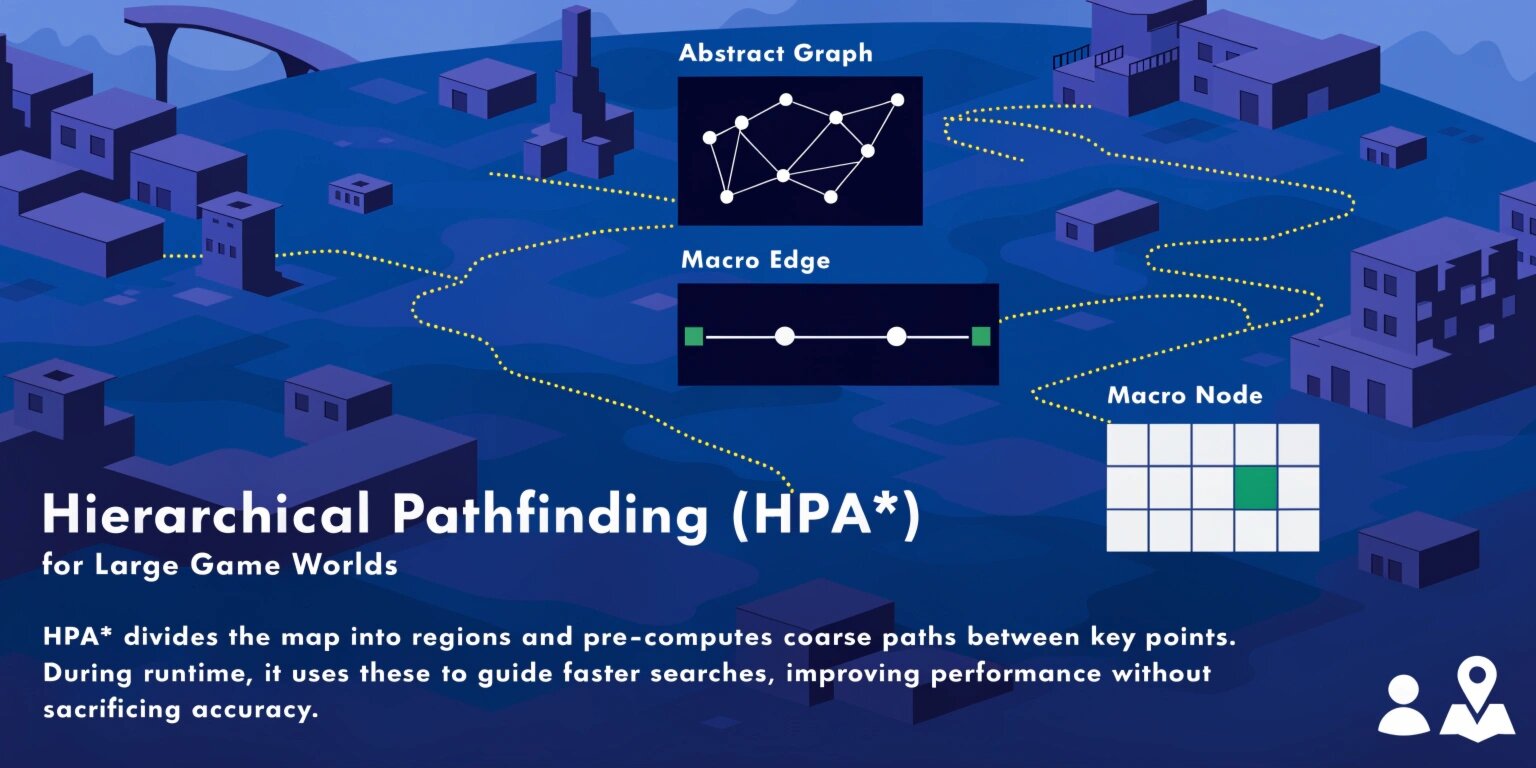
As game worlds continue to grow in size and complexity, efficient navigation has become one of the biggest challenges in modern game development. Open-world RPGs, large-scale strategy games, MMORPGs, and simulation titles often feature expansive maps containing thousands of interactive elements and hundreds of AI-controlled characters.
Traditional pathfinding techniques such as the A* algorithm work exceptionally well on smaller maps. However, as game worlds expand, the computational cost of calculating paths across massive environments increases dramatically.
To solve this problem, developers use Hierarchical Pathfinding A* (HPA*), an optimization technique that enables AI agents to navigate large worlds efficiently without sacrificing movement quality. HPA* reduces pathfinding complexity by organizing maps into hierarchical structures, making it one of the most widely adopted solutions for large-scale game environments.
Understanding Traditional A* Pathfinding
Before exploring HPA*, it's important to understand the limitations of the standard A* algorithm.
A* is a graph-search algorithm that calculates the shortest path between two points.
It works by evaluating:
- Current node cost
- Estimated distance to destination
- Neighboring nodes
- Total path cost
A* is highly effective because it balances accuracy and performance.
However, problems emerge when:
- Maps contain millions of nodes
- Hundreds of NPCs require simultaneous navigation
- Dynamic environments constantly change
- Real-time path updates become necessary
In these situations, computational requirements increase significantly.
What Is Hierarchical Pathfinding (HPA*)?
Hierarchical Pathfinding A* is an extension of the traditional A* algorithm designed to improve scalability.
Instead of searching through every node in a massive map, HPA* organizes the environment into multiple abstraction levels.
The core concept is simple:
- Divide the map into clusters or regions.
- Create connections between neighboring clusters.
- Build a higher-level graph representing cluster relationships.
- Perform pathfinding at the abstract level first.
- Refine the path locally within each cluster.
This significantly reduces the search space and improves performance.
How HPA* Works
Step 1: Map Partitioning
The game world is divided into smaller regions called clusters.
For example:
A 10,000-node map may be divided into:
- 100 clusters
- 100 nodes per cluster
This immediately reduces the complexity of global path searches.
Step 2: Entrance Identification
Developers identify gateways or entrances connecting neighboring clusters.
Examples include:
- Roads
- Doorways
- Bridges
- Terrain openings
These entrances become connection points within the abstract graph.
Step 3: Abstract Graph Creation
Each cluster is represented by a simplified node.
The resulting graph contains significantly fewer nodes than the original map.
Instead of searching 10,000 nodes, the algorithm may only search 100 abstract nodes.
Step 4: High-Level Path Search
A* first computes a path through the abstract graph.
This determines which clusters the AI must traverse.
Step 5: Local Path Refinement
Once the cluster route is known, detailed pathfinding occurs only within the relevant regions.
This produces an accurate final path while minimizing computation.
Benefits of HPA* in Large Game Worlds
Improved Performance
The primary advantage of HPA* is reduced processing time.
By searching fewer nodes, path calculations become significantly faster.
Scalability
Large open-world games can support thousands of AI agents simultaneously.
Reduced Memory Usage
Abstract graphs require fewer resources than full-world navigation structures.
Faster Real-Time Updates
Dynamic path recalculations can be performed more efficiently.
Better Multiplayer Performance
Online games benefit from reduced server-side pathfinding workloads.
Applications in Modern Games
Open-World RPGs
Games with vast landscapes use HPA* to manage:
- NPC travel
- Quest navigation
- Companion AI
- Enemy movement
Real-Time Strategy (RTS) Games
RTS games may control hundreds or thousands of units simultaneously.
HPA* helps maintain responsive gameplay even during large battles.
MMORPGs
Massively multiplayer games require efficient navigation across enormous worlds.
Hierarchical pathfinding reduces server load while supporting large player populations.
Simulation Games
City builders and life simulations use HPA* for:
- Citizen movement
- Vehicle routing
- Logistics systems
Survival Games
Large procedurally generated environments often rely on hierarchical navigation systems.
Comparison: A* vs HPA*
FeatureTraditional A*HPA*Search SpaceLargeReducedPerformanceSlower on huge mapsFasterScalabilityLimitedExcellentMemory UsageHigherLowerMulti-Agent SupportModerateStrongLarge Open WorldsChallengingIdeal
While traditional A* remains useful for smaller environments, HPA* provides substantial advantages for large-scale games.
Challenges of HPA*
Despite its benefits, HPA* introduces certain complexities.
Preprocessing Overhead
Building cluster structures requires initial computation during development or map generation.
Path Accuracy Trade-Offs
Abstract paths may occasionally produce routes that are slightly less optimal than full A* searches.
Dynamic World Changes
Major environmental modifications may require cluster updates.
Implementation Complexity
Developers must manage multiple graph layers and synchronization between abstraction levels.
Best Practices for Implementing HPA*
Choose Appropriate Cluster Sizes
Clusters that are too large reduce optimization benefits.
Clusters that are too small increase abstraction overhead.
Use Navigation Meshes
Combining HPA* with navigation meshes improves movement realism.
Cache Frequently Used Paths
Frequently traveled routes can be stored for faster retrieval.
Support Dynamic Updates
Modern games should allow clusters to adapt when environments change.
Profile AI Performance
Regular testing helps identify bottlenecks and optimization opportunities.
Future of Hierarchical Pathfinding
As game worlds continue to expand, pathfinding systems are evolving alongside advances in AI and computing power.
Emerging trends include:
- Machine learning-assisted navigation
- Dynamic hierarchical graphs
- Procedural pathfinding optimization
- Cloud-based AI processing
- Multi-layer navigation systems
- Hybrid HPA* and navigation mesh approaches
Future game engines are expected to integrate increasingly intelligent navigation solutions capable of handling even larger virtual environments.
Conclusion
Hierarchical Pathfinding A* (HPA*) has become a foundational technology for modern game AI. By organizing large environments into manageable clusters and performing path searches at multiple abstraction levels, HPA* dramatically improves navigation efficiency without sacrificing path quality.
From open-world RPGs and MMORPGs to strategy games and simulations, HPA* enables developers to build expansive worlds populated by intelligent AI agents. As gaming experiences continue to scale in size and complexity, hierarchical pathfinding will remain a critical tool for delivering smooth, responsive, and realistic navigation systems.