Introduction
Large game worlds offer players freedom to explore expansive landscapes, detailed cities, underground dungeons, and complex environments. However, these environments create a major technical challenge: helping non-player characters (NPCs), enemies, and other intelligent agents find efficient paths without consuming excessive processing resources.
Traditional pathfinding algorithms, such as A*, can work effectively in smaller environments. As maps grow larger, however, searching through thousands or millions of possible locations can become computationally expensive. This challenge becomes more significant when multiple characters need to calculate routes simultaneously.
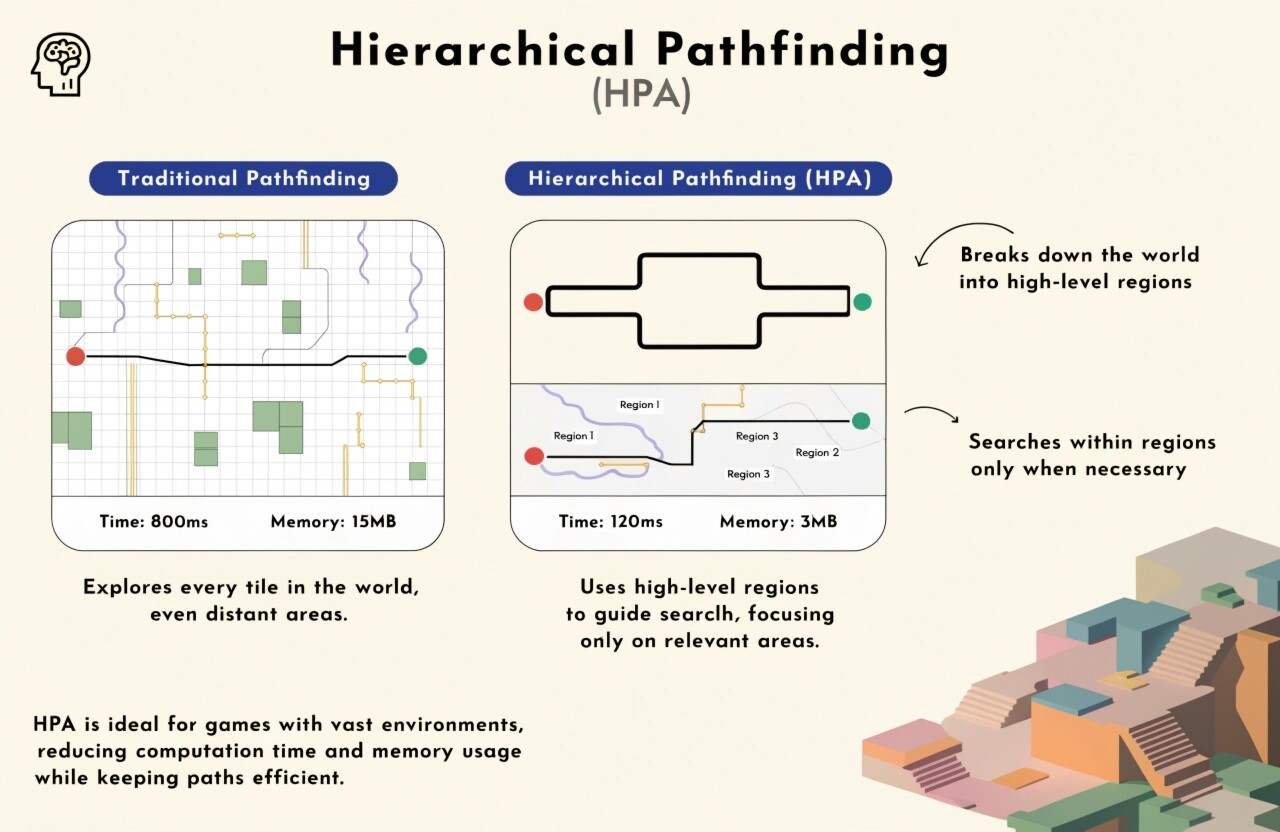
Hierarchical Pathfinding, commonly known as HPA*, addresses this problem by organizing the game world into smaller regions and using an abstract representation for high-level route planning. This approach can significantly reduce search effort while maintaining practical navigation quality.
What Is Hierarchical Pathfinding (HPA*)?
Hierarchical Pathfinding A* is a pathfinding technique that combines hierarchical map abstraction with the A* search algorithm. Instead of searching the entire map at the same level of detail, it divides the environment into clusters and identifies important connections between them.
Each cluster represents a smaller section of the world. The system identifies entrances, exits, and connections that allow characters to move between neighboring clusters. These connections form an abstract graph that represents the larger environment.
When an NPC needs to travel to a destination, HPA* first searches this abstract graph to identify a suitable sequence of clusters. It then calculates detailed paths within the relevant regions to connect the starting position, intermediate entrances, and final destination.
This two-level approach makes navigation more manageable, particularly in large environments with many interconnected areas.
How HPA* Works
HPA* generally follows several important steps.
1. Divide the Map into Clusters
The first step is splitting the game map into smaller regions. For a grid-based environment, each cluster may contain a fixed number of cells. In a three-dimensional game, regions can instead represent sections of a navigation graph or navigable space.
For example, a large strategy-game map could be divided into forest regions, villages, open fields, and mountain passages. Each cluster provides a manageable area for local pathfinding.
2. Identify Entrances and Exits
Next, the algorithm identifies locations where characters can move between neighboring clusters. These locations are called entrances or gateways.
A narrow doorway, bridge, tunnel, or opening between two map regions could become a gateway. These points are important because they determine how characters travel between different parts of the world.
3. Build an Abstract Graph
The system creates a high-level graph representing connections between clusters. Its nodes may represent gateway locations, while its edges represent traversable routes between them.
The cost of each edge can represent distance, movement time, or another gameplay-specific measure. Local routes and their costs can be calculated in advance and reused when the environment remains unchanged.
4. Search for a High-Level Route
When an NPC receives a movement command, HPA* uses A* to search the abstract graph. Rather than exploring every location across the complete map, it focuses on the connections needed to reach the destination.
5. Refine the Route
After identifying the high-level route, the system calculates or retrieves detailed paths through the selected clusters. These local paths connect the NPC's starting location to the first gateway, continue through intermediate regions, and eventually reach the destination.
The result is a practical route that combines efficient high-level planning with detailed local navigation.
Benefits of HPA* in Large Game Worlds
Improved Pathfinding Performance
One of the main advantages of HPA* is that it reduces the amount of detailed search required for many long-distance navigation queries. Abstract graphs contain fewer nodes than the complete underlying map, allowing the high-level search to operate more efficiently.
The actual performance improvement depends on map structure, cluster size, gateway density, and how much preprocessing can be reused.
Better Support for Multiple NPCs
Large games may contain hundreds of moving characters, including enemies, villagers, traders, and allied units. Repeated full-map searches can increase CPU usage.
HPA* can reduce this burden by reusing cluster-level information and local route costs. This makes it a useful option for real-time strategy games, simulation environments, and crowded open-world scenes.
Scalable World Design
Hierarchical pathfinding allows developers to organize large environments into manageable sections. When the map grows, developers can extend the abstraction system rather than relying exclusively on detailed searches across the entire world.
This can be especially useful for games featuring large cities, interconnected dungeons, extensive terrain, and procedurally generated environments.
Reusable Navigation Data
When parts of the world remain unchanged, gateways, local connections, and route costs can often be cached. Reusing this information reduces repeated computation and supports more responsive AI behavior.
HPA* Compared with Traditional A*
Traditional A* searches a graph representing the navigable environment and prioritizes locations using the estimated total cost of reaching the destination.
HPA* introduces an additional abstraction layer. It uses a smaller graph to identify a route through the environment before performing detailed searches within selected regions.
Traditional A* may be simpler for small maps or short-distance movement. HPA* can be more effective when many long-distance queries are performed across large, structured environments.
However, HPA* is not automatically faster in every situation. Building and maintaining the abstract graph introduces additional complexity. Furthermore, standard HPA* can produce routes that are slightly longer than the globally optimal path because the abstraction limits which alternatives are considered.
Practical Applications in Game Development
HPA* is useful across several game genres.
In real-time strategy games, units can navigate large battlefields while reducing the need for repeated searches across every map cell. In role-playing games, NPCs can travel between towns, dungeons, and distant landmarks. Open-world games can use hierarchical navigation to support long-distance movement through interconnected regions.
Simulation games can also benefit when many agents must travel between facilities, roads, buildings, or resource locations.
Developers working with Unity or Unreal Engine can explore hierarchical pathfinding alongside grid-based navigation, navigation meshes, and custom AI systems. The implementation should match the game's world representation and movement requirements.
Challenges and Optimization Techniques
Although HPA* provides important advantages, developers must consider several challenges.
Choosing cluster sizes requires careful testing. Very large clusters may increase local search costs, while very small clusters can produce too many gateways and an oversized abstract graph.
Dynamic environments introduce another challenge. When doors close, bridges collapse, or obstacles appear, affected connections and route costs may need to be updated. Updating only the relevant clusters can reduce unnecessary recalculation.
Developers should also account for moving obstacles, character collision avoidance, terrain costs, and special movement abilities. Hierarchical route planning does not automatically solve local steering or dynamic obstacle avoidance; these systems often work alongside HPA*.
Useful optimization techniques include caching local routes, updating only modified regions, selecting meaningful gateways, and profiling representative navigation scenarios. Developers should measure search time, memory usage, route length, and performance under simultaneous NPC movement.
Conclusion
Hierarchical Pathfinding (HPA*) offers a practical approach to building scalable AI navigation for large game worlds. By dividing environments into clusters, identifying gateways, and searching an abstract graph, developers can reduce repeated detailed pathfinding work while supporting efficient long-distance movement.
Although cluster design, dynamic updates, and route quality require careful consideration, HPA* can be a valuable solution for open-world adventures, strategy games, RPGs, and large-scale simulations.
As game environments become increasingly complex, hierarchical navigation techniques will remain important tools for creating responsive AI systems and maintaining performance across expansive virtual worlds.