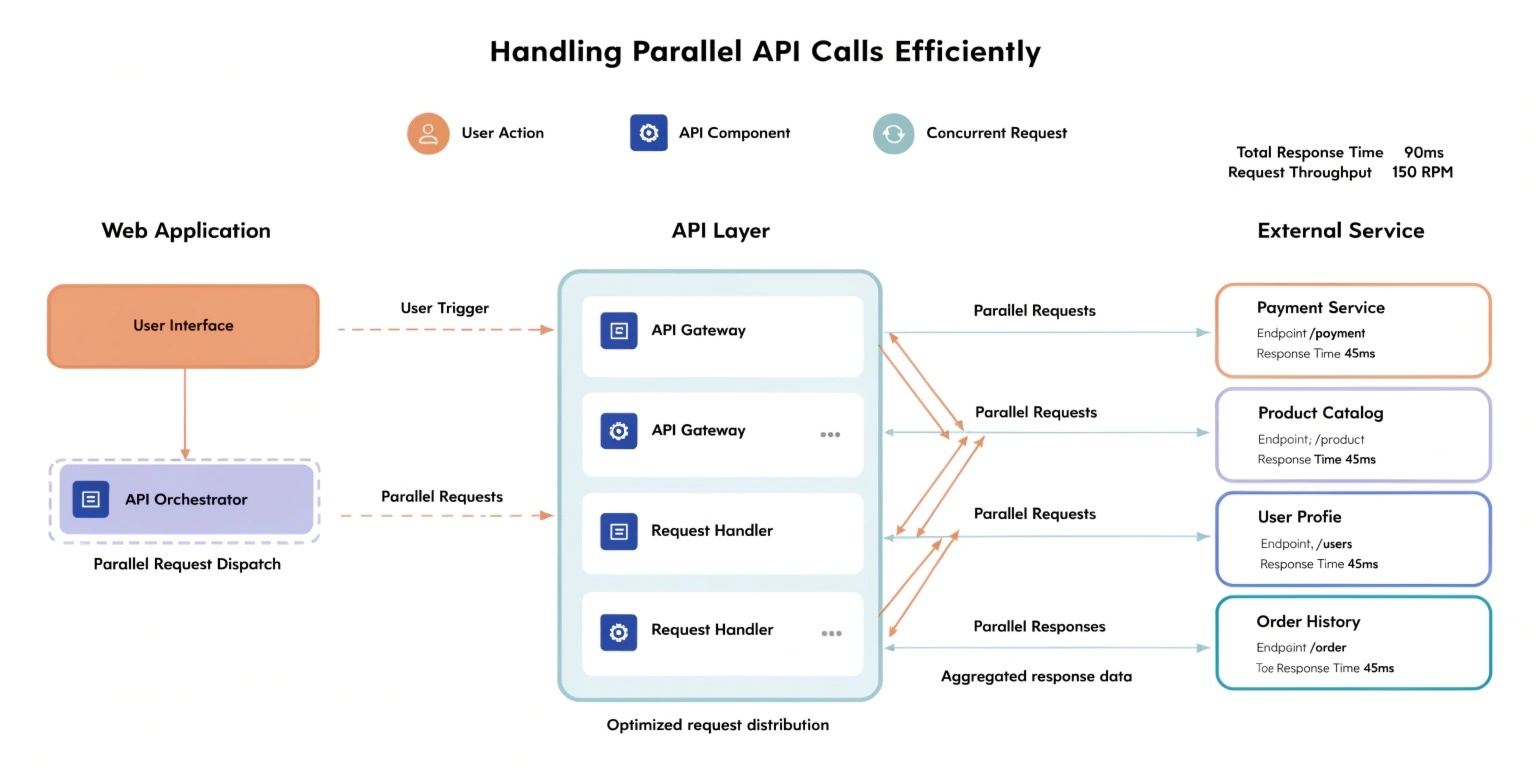
In today’s fast-paced digital world, applications rely heavily on APIs to fetch and process data. Whether it's loading dashboards, fetching user data, or integrating third-party services, multiple API calls often need to be executed simultaneously. Handling parallel API calls efficiently is crucial for improving performance, reducing latency, and delivering a seamless user experience.
Understanding Parallel API Calls
Parallel API calls refer to executing multiple API requests simultaneously rather than sequentially. Instead of waiting for one request to complete before starting another, parallel execution reduces overall waiting time and speeds up application performance.
For example, a dashboard application may need to fetch user details, notifications, and analytics data. Executing these requests in parallel ensures faster page loading.
Why Efficiency Matters
While parallel API calls improve speed, improper handling can lead to several issues:
- Increased server load
- API rate limit violations
- Unhandled errors
- Memory and resource exhaustion
Therefore, efficient handling is essential to maintain system stability and scalability.
Techniques to Handle Parallel API Calls Efficiently
1. Use Async/Await and Promises
Modern JavaScript provides powerful tools like Promise.all() to handle multiple API calls concurrently.
const [users, posts, comments] = await Promise.all([
fetch('/api/users'),
fetch('/api/posts'),
fetch('/api/comments')
]);
This ensures all requests run simultaneously, reducing total execution time.
2. Implement Concurrency Control
Sending too many API requests at once can overwhelm servers. Use concurrency limits to control how many requests are executed simultaneously.
Libraries like p-limit or custom queue systems help manage this effectively.
Example:
- Limit requests to 5 at a time instead of 50
- Prevents server crashes and throttling
3. API Batching
Batching combines multiple API requests into a single request. This reduces network overhead and improves efficiency.
Example:
Instead of:
- /user/1
- /user/2
- /user/3
Use:
- /users?ids=1,2,3
Batching is widely used in GraphQL and REST APIs for optimization.
4. Caching Responses
Caching avoids redundant API calls by storing previously fetched data.
Common caching strategies:
- Browser caching
- In-memory caching
- Redis caching (for backend systems)
Example:
If user data rarely changes, cache it instead of fetching it repeatedly.
5. Handle Errors Gracefully
When multiple API calls run in parallel, one failure shouldn’t break everything.
Use Promise.allSettled() instead of Promise.all() when partial success is acceptable.
const results = await Promise.allSettled(apiCalls);
This allows handling each response individually without failing the entire process.
6. Rate Limiting and Throttling
APIs often have rate limits. Exceeding them can result in blocked requests.
Solutions:
- Implement retry mechanisms
- Use exponential backoff
- Queue requests when limits are reached
This ensures smooth interaction with third-party APIs.
7. Use Background Processing
For heavy or non-critical API calls, use background jobs instead of blocking the main process.
Examples:
- Sending emails
- Logging analytics
- Processing uploads
Tools like message queues (RabbitMQ, Kafka) help manage background processing efficiently.
8. Optimize Network Requests
Reduce unnecessary data transfer by:
- Using pagination
- Requesting only required fields
- Compressing responses
This minimizes load time and improves performance.
Best Practices
- Always monitor API performance
- Use logging and tracing tools
- Avoid duplicate API calls
- Design APIs with scalability in mind
- Use CDN for static content
Real-World Example
Consider an e-commerce website loading a product page. It may need:
- Product details
- Reviews
- Recommendations
- Inventory status
Instead of loading them one by one, parallel API calls fetch all data at once, reducing load time significantly. However, applying caching and batching ensures the system remains efficient even under heavy traffic.
Conclusion
Handling parallel API calls efficiently is a key factor in building high-performance applications. While parallelism improves speed, it must be balanced with proper control mechanisms like batching, caching, and rate limiting.
By implementing these strategies, developers can build scalable, responsive, and reliable systems that deliver exceptional user experiences.