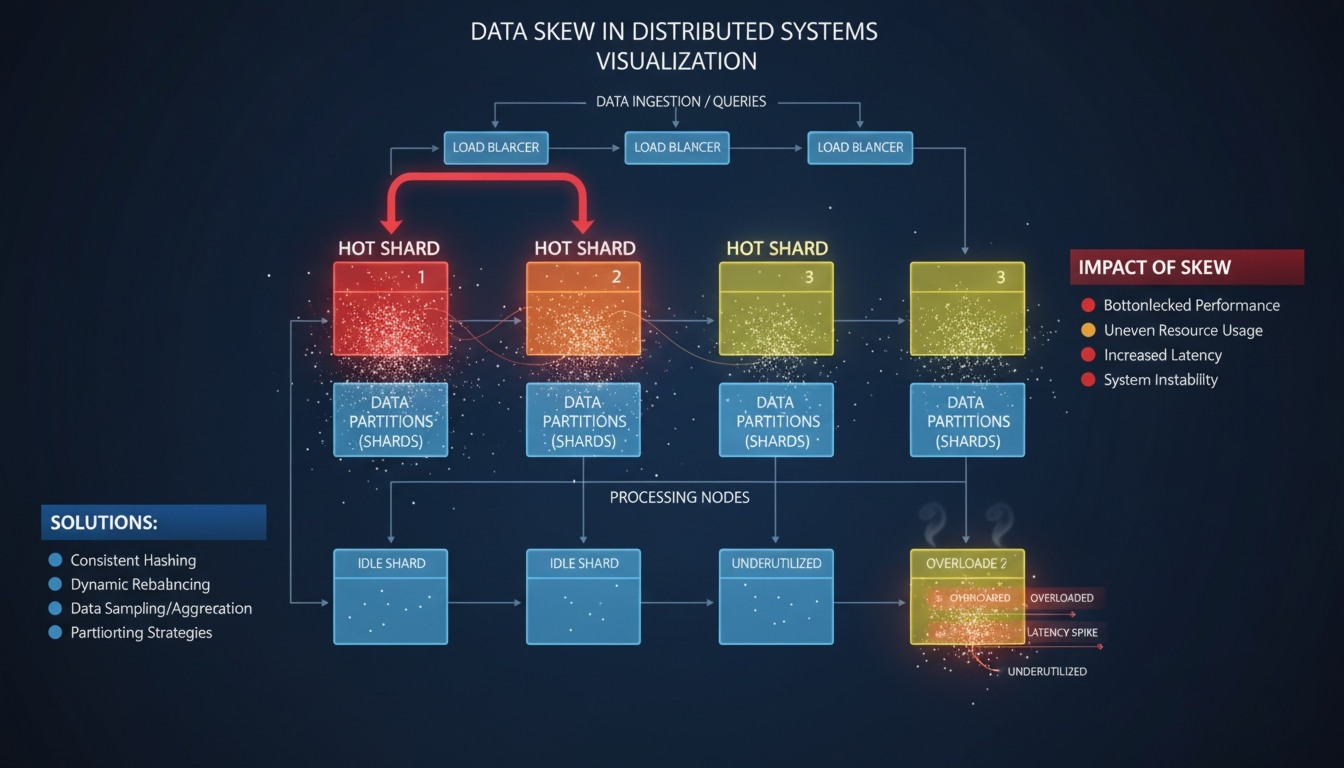
Data skew can cause uneven workload distribution in distributed systems, leading to performance issues. Learn how to identify and handle skew using partitioning, load balancing, and optimization techniques.
Distributed systems are designed to handle large-scale data processing efficiently. However, one common challenge that can significantly degrade performance is data skew.
Data skew occurs when data is unevenly distributed across nodes, causing some machines to handle more workload than others. This imbalance leads to bottlenecks, slower processing, and inefficient resource utilization.
Understanding and handling data skew is essential for building scalable and high-performance distributed systems.
What is Data Skew?
Data skew refers to an uneven distribution of data or workload across nodes in a distributed system.
In an ideal scenario:
- Data is evenly distributed
- Each node processes equal workloads
But in reality:
- Some nodes receive more data
- Others remain underutilized
This imbalance creates performance issues.
Why Data Skew Happens
1. Uneven Key Distribution
Certain keys appear more frequently than others (e.g., popular users or products).
2. Poor Partitioning Strategy
Improper hashing or partitioning leads to uneven data allocation.
3. Real-World Data Patterns
User behavior and real-world data are rarely uniform.
4. Join Operations
Large joins in systems like Apache Spark or Hadoop often create skew.
Impact of Data Skew
- Increased processing time
- Node overloading
- Reduced parallelism
- Higher resource consumption
- System instability
Even a small skew can drastically affect performance in large systems.
How to Detect Data Skew
1. Monitor Task Execution Time
If some tasks take significantly longer, skew may exist.
2. Analyze Data Distribution
Check how data is distributed across partitions.
3. Use Metrics & Logs
Tools in Apache Spark provide insights into partition sizes and execution patterns.
Techniques to Handle Data Skew
1. Better Partitioning Strategies
Use techniques like:
- Hash partitioning
- Range partitioning
- Custom partitioning
Choose a method that distributes data evenly.
2. Salting Technique
Add random values (salt) to skewed keys to distribute them across multiple partitions.
Example:
Instead of using key user_id, use user_id + random_suffix.
3. Data Sampling & Analysis
Analyze data before processing to identify skew patterns and adjust strategies accordingly.
4. Load Balancing
Distribute workload dynamically across nodes to avoid overloading.
5. Broadcast Joins
In frameworks like Apache Spark, broadcast smaller datasets to all nodes instead of shuffling large data.
6. Split Heavy Keys
Break large data associated with a single key into smaller chunks.
7. Adaptive Query Execution (AQE)
Modern systems automatically optimize queries at runtime to handle skew.
Best Practices
- Design systems with skew in mind
- Monitor data distribution regularly
- Use scalable partitioning strategies
- Test with real-world datasets
- Optimize joins and aggregations
Real-World Example
Consider an e-commerce platform:
- Popular products generate more transactions
- These transactions create skew in processing
By using salting or better partitioning, the workload can be distributed evenly across nodes.
Challenges in Handling Data Skew
- Increased complexity in system design
- Additional processing overhead
- Difficulty in predicting skew patterns
- Trade-offs between performance and cost
Future Trends
- AI-driven workload balancing
- Smarter distributed frameworks
- Automated skew detection and correction
- Improved real-time analytics systems
Conclusion
Data skew is an inevitable challenge in distributed systems, but it can be effectively managed with the right strategies. By understanding its causes and applying techniques like partitioning, salting, and load balancing, developers can ensure efficient and scalable systems.
Handling data skew is not just about fixing performance issues—it’s about designing systems that can adapt to real-world data patterns and scale seamlessly.
We build scalable web, mobile, and game products for clients worldwide — combining modern frameworks, cloud infrastructure, and best engineering practices.
.jpg)
.jpg)
.jpg)