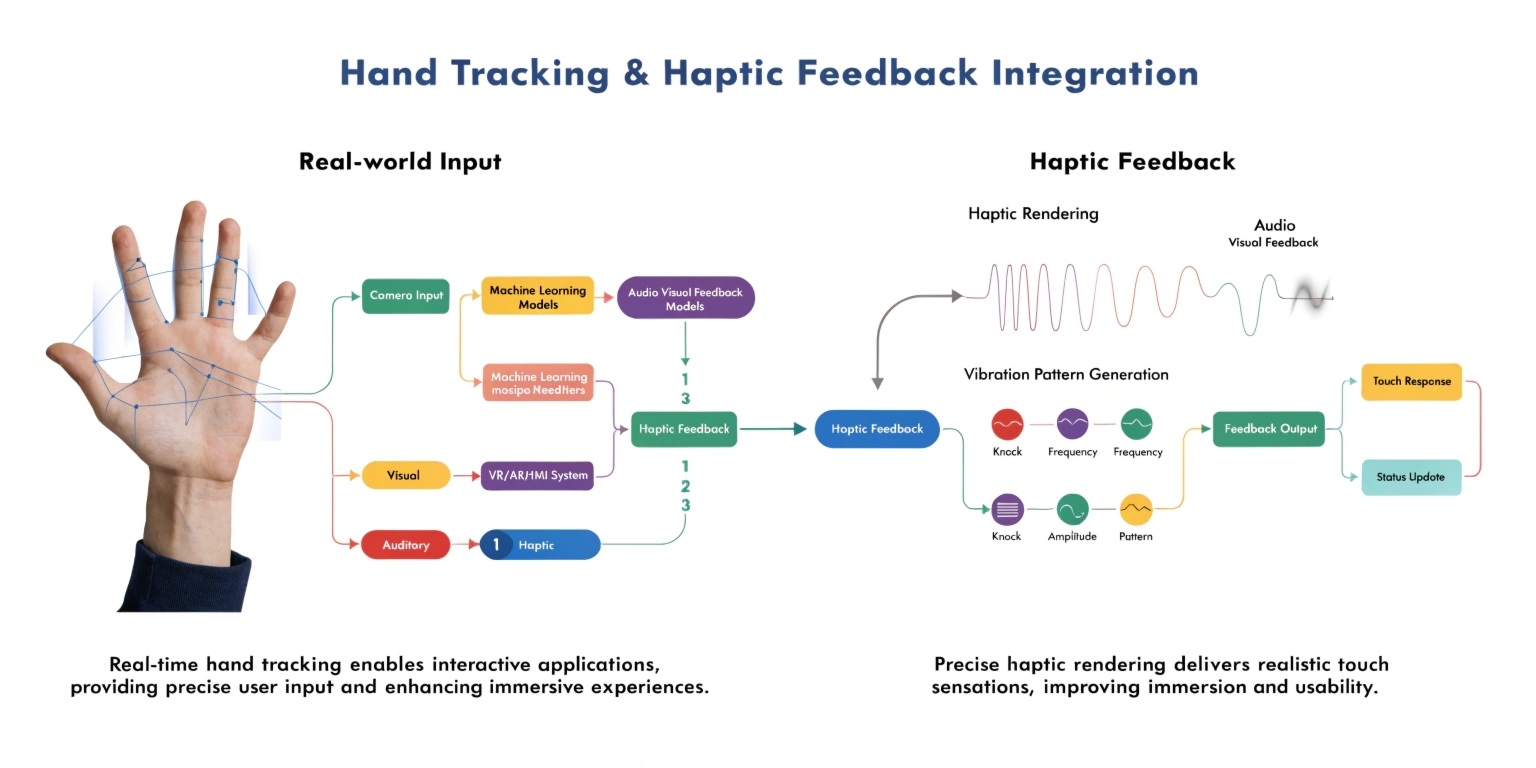
The digital world is rapidly evolving toward more immersive and intuitive user experiences. Among the most transformative innovations are hand tracking and haptic feedback technologies. Together, they are redefining how users interact with virtual environments by combining natural motion control with realistic tactile sensations.
From gaming and virtual reality (VR) to healthcare and industrial training, integrating these technologies is unlocking new possibilities for engagement and realism.
What is Hand Tracking?
Hand tracking technology allows systems to detect and interpret human hand movements without the need for physical controllers. Using cameras, sensors, and advanced algorithms, it captures gestures such as grabbing, pointing, or swiping and translates them into digital commands.
This creates a more natural and intuitive interaction model, eliminating the learning curve associated with traditional input devices.
Key Benefits of Hand Tracking
- Controller-free interaction
- Enhanced realism and immersion
- Improved accessibility and ease of use
- Real-time gesture recognition
Technologies like computer vision and AI play a critical role in enabling accurate hand tracking, making it a cornerstone of modern AR/VR systems.
What is Haptic Feedback?
Haptic feedback refers to the use of tactile sensations—such as vibrations, pressure, or motion—to simulate the sense of touch in digital environments. It allows users to “feel” virtual objects, creating a multi-sensory experience.
For example, when a user picks up a virtual object in VR, haptic feedback can simulate its texture, weight, or resistance.
Types of Haptic Feedback
- Vibrotactile Feedback: Common in controllers and wearables
- Force Feedback: Simulates resistance or pressure
- Thermal Feedback: Mimics temperature changes
Key Benefits of Haptic Feedback
- Enhanced realism
- Improved user engagement
- Better spatial awareness
- Increased precision in interactions
Why Integrate Hand Tracking with Haptics?
Individually, both technologies are powerful. However, their integration creates a truly immersive experience.
Hand tracking enables natural interaction, while haptic feedback provides physical confirmation of those interactions. Together, they bridge the gap between the digital and physical worlds.
Imagine reaching out to grab a virtual object. Hand tracking allows you to perform the gesture, while haptic feedback lets you feel the object—making the experience far more convincing.
Applications Across Industries
1. Gaming and Entertainment
In game development, this integration enhances player immersion. Players can interact with the environment using natural gestures and feel in-game elements, creating a deeper emotional connection.
2. AR/VR Experiences
In augmented and virtual reality, hand tracking combined with haptics enables realistic simulations, from virtual meetings to immersive storytelling.
3. Healthcare and Training
Medical simulations use these technologies to train professionals in a risk-free environment. Surgeons can practice procedures while feeling realistic resistance and textures.
4. Industrial and Manufacturing
Workers can interact with virtual prototypes, improving design accuracy and reducing production costs.
5. Education and Learning
Interactive learning experiences become more engaging when students can physically interact with digital content.
Technical Considerations for Integration
Successfully integrating hand tracking and haptic feedback requires careful planning and execution.
1. Hardware Requirements
Devices such as depth cameras, motion sensors, and haptic wearables are essential. Compatibility between hardware components is crucial.
2. Software and Frameworks
Developers often use platforms like Unity or Unreal Engine along with SDKs that support gesture recognition and haptic feedback.
3. Latency and Performance
Low latency is critical for maintaining immersion. Delays between action and feedback can break the user experience.
4. Accuracy and Calibration
Precise hand tracking and synchronized haptic responses are necessary to ensure realism.
Challenges in Implementation
Despite its potential, integration comes with challenges:
- High development and hardware costs
- Complexity in synchronizing motion and feedback
- Limited standardization across devices
- User fatigue during prolonged use
Overcoming these challenges requires continuous innovation and optimization.
Future Trends
The future of hand tracking and haptic feedback is incredibly promising. Advancements in AI, wearable technology, and sensor accuracy will further enhance these systems.
Emerging trends include:
- Lightweight and wireless haptic devices
- AI-driven gesture prediction
- Full-body tracking integration
- More realistic tactile simulations
As these technologies mature, they will become more accessible and widely adopted across industries.
Final Thoughts
Hand tracking and haptic feedback integration is a game-changer in the world of immersive technology. By enabling natural interaction and realistic touch, it transforms how users experience digital environments.
For developers and businesses, investing in these technologies is not just about innovation—it’s about staying ahead in a competitive digital landscape.
As user expectations continue to evolve, creating immersive, intuitive, and engaging experiences will be key to success—and hand tracking with haptics is leading the way.