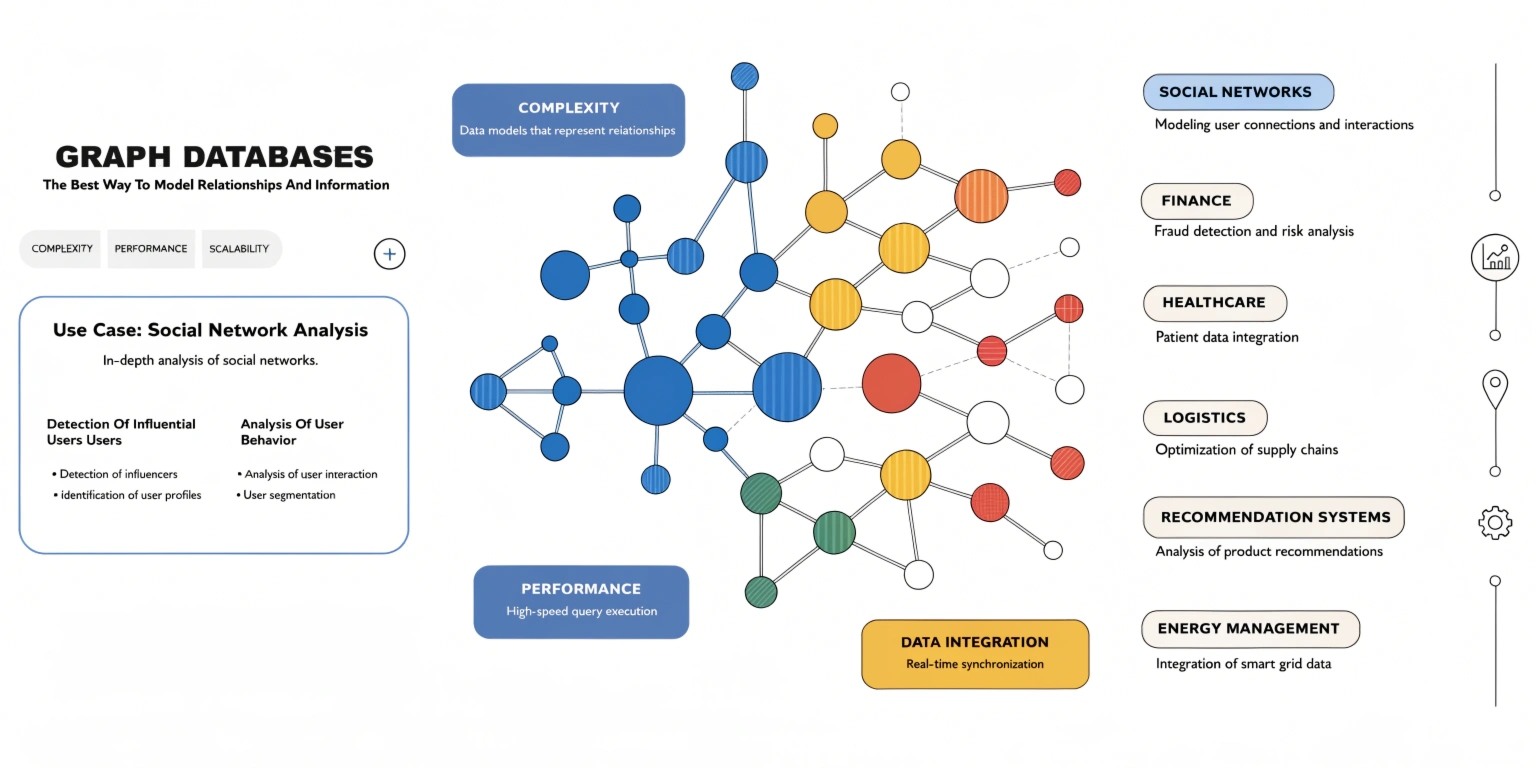
A detailed guide to graph databases and how they simplify complex relationship systems, enabling faster queries, better insights, and scalable data management for modern applications.
In today’s data-driven world, many applications rely heavily on relationships—connections between users, products, transactions, or systems. Traditional relational databases often struggle to efficiently handle such interconnected data at scale. This is where graph databases shine.
Graph databases are designed specifically to store and process relationships, making them ideal for complex systems where connections matter as much as the data itself.
What is a Graph Database?
A graph database is a type of NoSQL database that represents data as nodes, edges, and properties:
- Nodes: Entities such as users, products, or accounts
- Edges: Relationships between nodes
- Properties: Attributes of nodes and edges
Unlike relational databases that use tables and joins, graph databases directly store relationships, enabling faster and more intuitive queries.
Why Traditional Databases Fall Short
Relational databases use joins to connect data across tables. As relationships grow more complex, queries become:
- Slower
- More resource-intensive
- Difficult to maintain
For example, finding mutual connections in a social network may require multiple joins, leading to performance bottlenecks.
Graph databases eliminate this issue by storing relationships as first-class entities, allowing direct traversal between connected nodes.
Key Advantages of Graph Databases
1. Efficient Relationship Handling
Graph databases are optimized for relationship queries. Traversing connections is fast, even with millions of nodes.
2. Flexible Schema
Unlike rigid schemas in relational databases, graph databases allow dynamic and evolving data models, making them suitable for rapidly changing applications.
3. High Performance at Scale
As datasets grow, graph databases maintain performance because they avoid expensive join operations.
4. Intuitive Data Modeling
Representing real-world relationships becomes easier and more natural, improving developer productivity.
Popular Graph Database Technologies
Some widely used graph databases include:
- Neo4j
- Amazon Neptune
- ArangoDB
- TigerGraph
Among these, Neo4j is one of the most popular, known for its powerful query language called Cypher and strong community support.
Use Cases of Graph Databases
1. Social Networks
Graph databases are ideal for modeling relationships between users:
- Friend connections
- Followers
- Recommendations
Platforms like Facebook and LinkedIn rely on graph-like structures to manage connections and suggest new relationships.
2. Recommendation Engines
Graph databases analyze relationships between users and items to provide personalized recommendations. For example:
- “Users who bought this also bought…”
- Content recommendations on streaming platforms
By traversing connections, systems can deliver highly relevant suggestions.
3. Fraud Detection
Financial institutions use graph databases to detect suspicious patterns:
- Identifying unusual transaction paths
- Detecting networks of fraudulent accounts
Graph analysis helps uncover hidden relationships that traditional systems might miss.
4. Knowledge Graphs
Search engines and AI systems use graph databases to organize and connect information. Knowledge graphs enable:
- Better search results
- Context-aware responses
- Semantic understanding
5. Supply Chain Management
Graph databases help track relationships between suppliers, manufacturers, and distributors, improving visibility and efficiency.
Querying Graph Databases
Graph databases use specialized query languages. For example, Cypher (used in Neo4j) allows developers to write queries like:
- Find connections between users
- Identify shortest paths
- Analyze network structures
These queries are more intuitive compared to complex SQL joins.
Graph Databases in AI and Machine Learning
Graph databases play a crucial role in AI applications:
- Enhancing recommendation systems
- Supporting natural language processing
- Powering knowledge graphs
They are also used in graph-based machine learning techniques such as node classification and link prediction.
Challenges of Graph Databases
While powerful, graph databases come with challenges:
- Learning curve for new query languages
- Limited support in some ecosystems
- Not ideal for simple tabular data
Choosing the right database depends on the specific use case.
When to Use a Graph Database
Consider using a graph database when:
- Relationships are complex and deeply interconnected
- Query performance depends on traversing connections
- Data structure evolves frequently
Avoid them for simple CRUD applications with minimal relationships.
Final Thoughts
Graph databases are transforming how we handle connected data. By focusing on relationships rather than just entities, they provide a powerful solution for complex systems that traditional databases struggle to manage.
From social networks to fraud detection and AI-driven applications, graph databases enable faster insights, better performance, and more intuitive data modeling. As data continues to grow in complexity, adopting graph databases can give organizations a significant competitive advantage.
We build scalable web, mobile, and game products for clients worldwide — combining modern frameworks, cloud infrastructure, and best engineering practices.
.jpg)
.jpg)
.jpg)