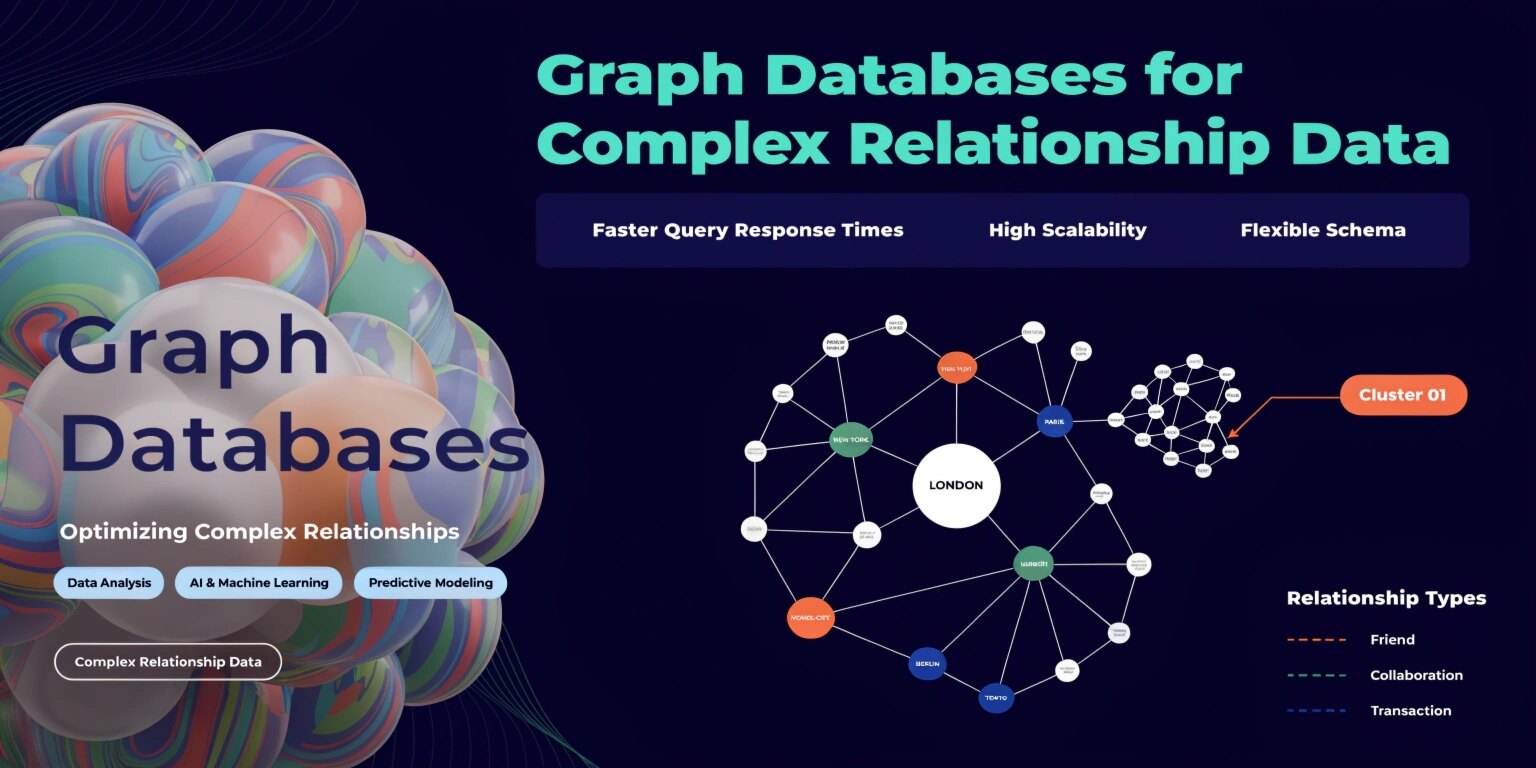
Modern applications increasingly rely on highly connected data. Whether it's social networks, recommendation engines, fraud detection systems, or supply chain networks, relationships between data entities are often more important than the entities themselves. Traditional relational databases struggle to efficiently process such complex relationships.
Graph databases provide a powerful solution by modeling and storing data based on relationships. Instead of focusing solely on tables and rows, graph databases represent data as nodes, edges, and properties, allowing applications to explore complex connections efficiently.
What Is a Graph Database?
A graph database is a type of NoSQL database designed to represent and query relationships between data points.
The graph data model consists of three main components:
Nodes
Nodes represent entities or objects such as users, products, locations, or devices.
Edges (Relationships)
Edges define how nodes are connected. Relationships have direction and meaning.
Example relationships include:
- User FRIENDS_WITH another user
- Customer PURCHASED a product
- Employee WORKS_AT a company
Properties
Both nodes and relationships can store additional attributes.
Example:
User node:
{
name: "John",
age: 28
}
Relationship:
FRIENDS_WITH
since: 2022
This flexible structure allows developers to represent real-world relationships naturally.
Why Traditional Databases Struggle with Relationships
Relational databases store data in tables connected by foreign keys. While this works well for structured datasets, complex queries involving multiple relationships require JOIN operations.
For example, in a social network application, finding "friends of friends" may require multiple joins across several tables. As data grows, these queries become slower and more resource-intensive.
Graph databases eliminate this problem by storing relationships directly with the data. Instead of performing joins, the database simply traverses connected nodes.
This approach drastically improves query performance for relationship-heavy datasets.
Key Features of Graph Databases
Relationship-First Design
Unlike relational systems, graph databases treat relationships as first-class citizens. This makes them ideal for applications where connections matter more than isolated data points.
Efficient Traversal Queries
Graph databases excel at queries involving multiple levels of relationships.
Example query:
- Find friends of friends
- Identify shortest paths between nodes
- Discover influence networks
These operations are extremely efficient in graph structures.
Flexible Schema
Graph databases are schema-optional, meaning developers can evolve the data model without strict migrations.
This flexibility makes them suitable for rapidly changing systems.
Pattern-Based Querying
Many graph databases support specialized query languages designed for exploring relationships.
For example, Cypher queries allow developers to express patterns like:
MATCH (user)-[:FRIENDS_WITH]->(friend)
RETURN friend
This makes querying complex relationships far more intuitive.
Popular Graph Database Technologies
Several graph database platforms are widely used in modern systems.
Neo4j
One of the most popular graph databases, Neo4j provides strong performance, a powerful query language (Cypher), and enterprise-grade scalability.
Amazon Neptune
A managed graph database service designed for large-scale graph applications.
ArangoDB
A multi-model database supporting graph, document, and key-value data.
TigerGraph
A high-performance graph analytics platform designed for deep relationship analysis.
Each of these platforms supports large-scale graph processing and advanced data exploration.
Real-World Use Cases
Graph databases are increasingly used across many industries.
Social Networks
Social media platforms rely heavily on relationship data. Graph databases efficiently manage connections such as:
- Followers
- Friends
- Groups
- Content interactions
This allows platforms to recommend friends, content, and communities.
Recommendation Engines
Companies like streaming platforms and e-commerce businesses use graph databases to build recommendation systems.
Examples include:
- "Customers who bought this also bought..."
- Movie recommendations based on viewing history
- Product suggestions based on network relationships
Fraud Detection
Financial institutions use graph databases to detect fraudulent activities.
Suspicious patterns such as:
- Multiple accounts connected to a single device
- Transaction loops
- Hidden relationships between entities
can be discovered quickly using graph analysis.
Knowledge Graphs
Search engines and AI systems use graph databases to build knowledge graphs that represent relationships between concepts, entities, and information.
This allows systems to provide more intelligent search results and contextual answers.
Supply Chain Management
Graph databases can model complex supply chain networks, allowing companies to analyze dependencies between suppliers, manufacturers, distributors, and retailers.
This helps organizations identify risks and optimize logistics.
Graph Databases vs Relational Databases
Understanding when to use graph databases is important.
Relational databases are ideal for:
- Structured data
- Financial transactions
- Traditional business systems
Graph databases are best for:
- Relationship-heavy data
- Network analysis
- Recommendation engines
- Fraud detection
- Knowledge graphs
Many modern architectures combine both relational and graph databases depending on the use case.
The Future of Graph Databases
As data relationships become more complex, graph databases are gaining popularity in areas such as artificial intelligence, machine learning, and real-time analytics.
Organizations are increasingly building data-driven ecosystems where relationships between users, services, devices, and content must be analyzed in real time.
Graph technology enables businesses to uncover insights that traditional databases struggle to reveal.
Conclusion
Graph databases represent a powerful paradigm for managing complex relationship data. By modeling connections directly within the database, they enable faster queries, deeper insights, and more natural data representations.
As modern applications become more interconnected, graph databases will continue to play a critical role in powering recommendation systems, fraud detection platforms, social networks, and intelligent knowledge systems.
Organizations that leverage graph data technology gain the ability to explore and understand relationships at scale—unlocking valuable insights hidden within their data.