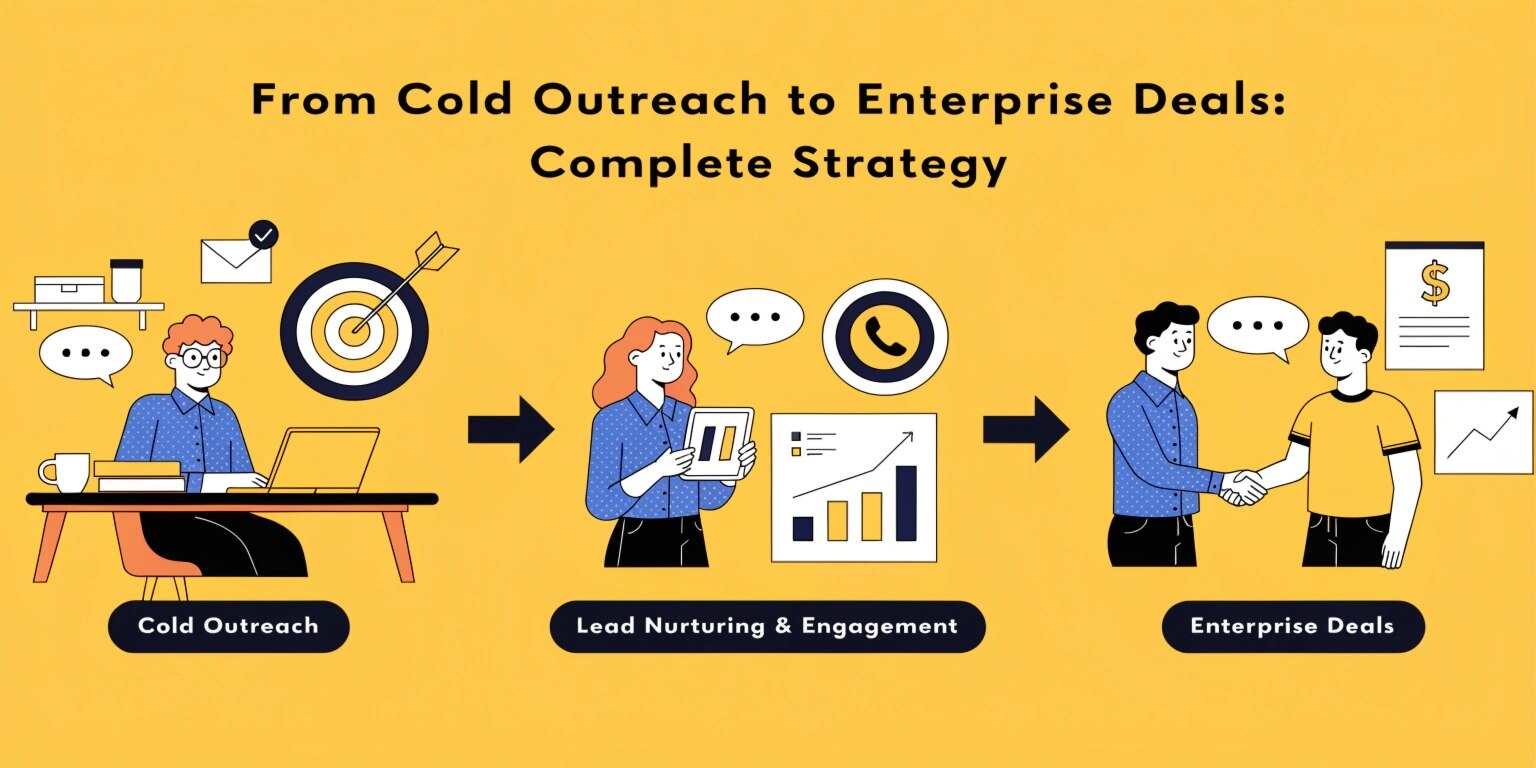
Many successful IT companies dream of landing enterprise clients, but few understand the journey required to get there. Enterprise deals rarely happen after a single email or one sales call. Instead, they result from a carefully designed process that begins with cold outreach and evolves into trusted business partnerships.
For software development firms, IT consulting companies, SaaS providers, and technology service agencies, mastering this process can unlock larger projects, recurring revenue, and long-term growth.
This guide outlines a complete strategy for transforming cold prospects into enterprise-level clients.
Understanding Enterprise Buyers
Before launching any outreach campaign, it is important to understand how enterprise organizations make purchasing decisions.
Unlike small businesses, enterprise companies often involve multiple stakeholders, including:
- Department Heads
- Technical Managers
- Procurement Teams
- Finance Departments
- C-Level Executives
- Legal Teams
As a result, enterprise sales cycles are typically longer and more complex.
Success depends on building trust across multiple decision-makers rather than convincing a single individual.
Step 1: Build an Ideal Customer Profile (ICP)
One of the biggest mistakes IT sales teams make is targeting everyone.
Enterprise outreach works best when focused on a clearly defined Ideal Customer Profile (ICP).
Consider factors such as:
- Industry
- Company size
- Annual revenue
- Geographic location
- Technology stack
- Business challenges
For example:
A software development company specializing in healthcare applications should focus on hospitals, healthcare startups, medical technology companies, and health insurance providers rather than sending generic outreach to every industry.
A focused strategy produces better response rates and higher-quality opportunities.
Step 2: Research Before Outreach
Enterprise decision-makers receive hundreds of emails every week.
Generic messages are often ignored.
Before reaching out, research:
- Company objectives
- Recent funding announcements
- Expansion plans
- Technology initiatives
- Leadership changes
- Industry trends
The more relevant your outreach, the higher the chance of engagement.
Personalization demonstrates professionalism and genuine interest in the prospect's business.
Step 3: Create High-Value Cold Outreach Campaigns
Cold outreach should focus on solving problems rather than selling services.
Many companies begin with messages like:
"We provide web development services."
Enterprise buyers rarely respond to such generic pitches.
Instead, focus on business outcomes.
For example:
"We helped a logistics company reduce operational delays by 30% through workflow automation. I noticed your organization is expanding globally and thought similar solutions may be valuable."
This approach immediately creates relevance and sparks curiosity.
Effective outreach channels include:
- Cold Email
- LinkedIn Messaging
- Industry Events
- Webinars
- Referral Networks
Combining multiple channels often generates stronger results than relying on a single platform.
Step 4: Establish Authority and Credibility
Enterprise buyers prefer working with trusted experts.
To build credibility:
Publish Thought Leadership Content
Share:
- Technical blogs
- Industry reports
- Whitepapers
- Case studies
- Research findings
Showcase Success Stories
Highlight measurable outcomes such as:
- Revenue growth
- Cost savings
- Process automation
- User acquisition improvements
Display Certifications
Certifications and partnerships demonstrate technical competence and reduce perceived risk.
Authority-building helps prospects feel confident about engaging with your organization.
Step 5: Conduct Discovery Calls
Once a prospect shows interest, avoid jumping directly into sales presentations.
The discovery phase is critical.
Ask questions about:
- Business objectives
- Current challenges
- Existing systems
- Budget expectations
- Project timelines
- Success metrics
Enterprise clients appreciate consultants who seek to understand their business before proposing solutions.
The information gathered during discovery becomes the foundation of a customized proposal.
Step 6: Nurture Leads Strategically
Enterprise deals often require months of follow-up.
Not every prospect is ready to buy immediately.
Lead nurturing may include:
- Educational content
- Industry insights
- Product demonstrations
- Webinar invitations
- Success stories
- Personalized recommendations
Consistent communication keeps your company visible and strengthens trust over time.
Many enterprise opportunities are lost simply because sales teams stop following up too early.
Step 7: Develop Business-Focused Proposals
A common mistake in IT sales is creating overly technical proposals.
Enterprise decision-makers care about business value.
Effective proposals should include:
Business Challenges
Clearly define the problem.
Recommended Solution
Explain how your approach addresses the issue.
Expected Outcomes
Highlight measurable benefits.
ROI Analysis
Demonstrate financial value.
Implementation Plan
Outline project milestones and timelines.
Risk Management
Address potential concerns and mitigation strategies.
A proposal that speaks to business goals often performs better than one focused solely on technical specifications.
Step 8: Manage Multiple Stakeholders
Enterprise deals involve numerous decision-makers.
Sales professionals should identify:
- Economic buyers
- Technical evaluators
- Project sponsors
- Procurement teams
- Executive champions
Each stakeholder has different priorities.
Technical teams may focus on scalability and security, while executives prioritize revenue growth and operational efficiency.
Tailor communication accordingly.
Step 9: Negotiate and Close Effectively
Negotiation should focus on value rather than price.
Instead of immediately offering discounts, emphasize:
- Expertise
- Industry experience
- Long-term support
- Project quality
- Reduced business risk
Organizations investing in enterprise technology solutions are often willing to pay premium rates when the value is clear.
Successful negotiations create win-win outcomes that establish the foundation for long-term partnerships.
Step 10: Focus on Post-Sale Growth
Closing the contract is only the beginning.
Enterprise clients often generate additional opportunities through:
- Upselling
- Cross-selling
- Maintenance contracts
- Support agreements
- New project initiatives
Exceptional delivery strengthens relationships and increases customer lifetime value.
Many of the largest IT accounts begin with a single project and expand over time.
Conclusion
Converting cold outreach into enterprise deals requires patience, strategy, and consistency. The process involves far more than sending emails—it requires understanding client challenges, building credibility, nurturing relationships, and demonstrating measurable business value.
IT companies that combine personalized outreach, thought leadership, strategic lead nurturing, and value-based selling position themselves for long-term success in the enterprise market. By following a structured approach, organizations can transform cold prospects into trusted clients and secure the high-value projects that drive sustainable growth.