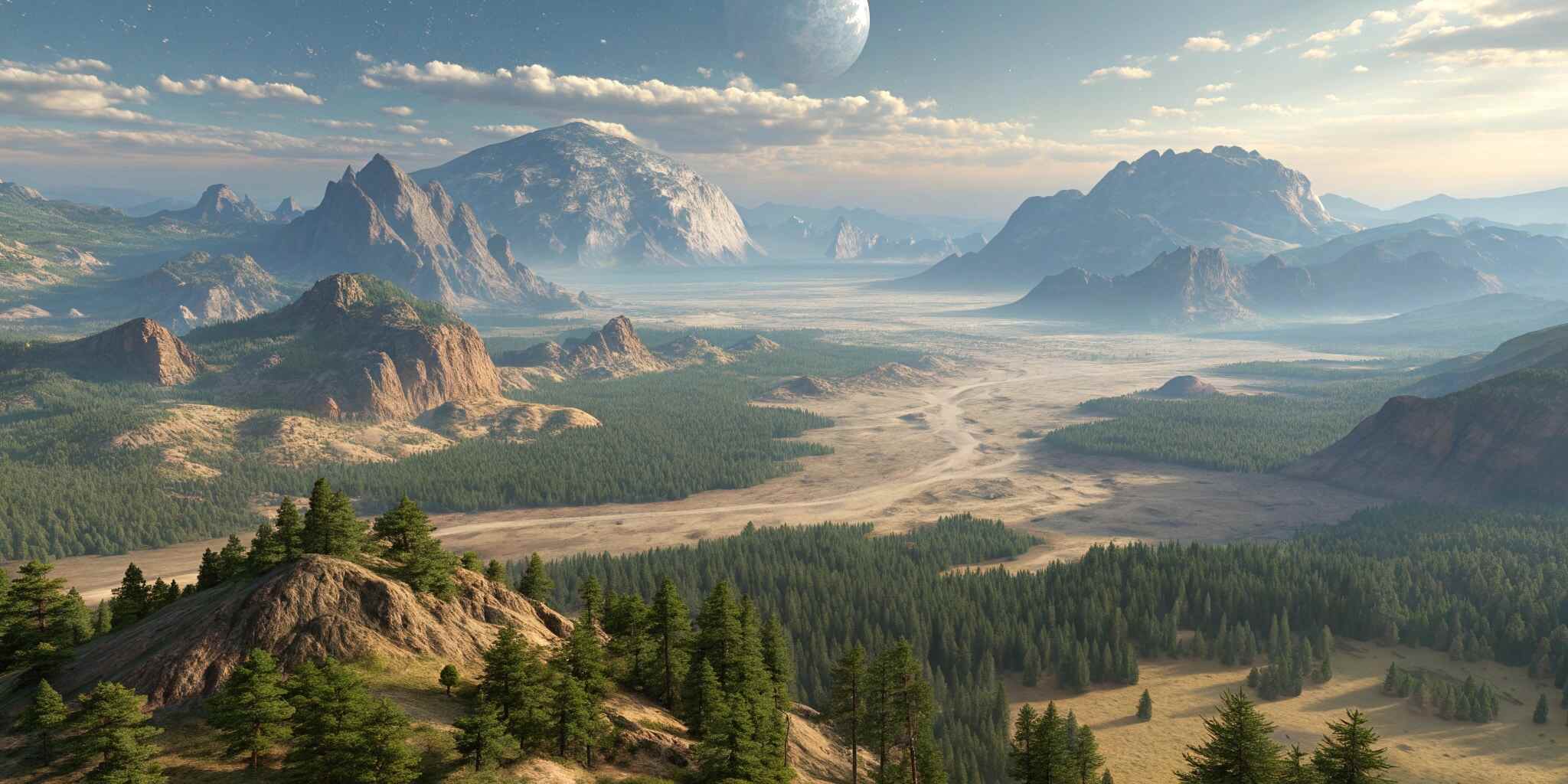
Creating infinite planetary worlds presents a unique challenge in game development. Planets must appear coherent from orbit to ground level, maintain visual consistency, and support exploration without visible seams or repetition. Fractal-based terrain generation provides a mathematical foundation for solving these challenges by producing natural variation that scales infinitely while remaining deterministic and efficient.
Fractals are mathematical patterns that exhibit self-similarity across different scales. In terrain generation, this property allows developers to define landscapes using noise functions that add detail recursively. At a distance, terrain appears smooth and continuous, while closer inspection reveals increasing complexity such as ridges, valleys, and surface variation. This scale-independent detail is essential for planetary worlds where players can traverse vast distances without loading boundaries.
Noise functions such as Perlin noise, Simplex noise, and fractal Brownian motion form the backbone of fractal terrain systems. These functions generate pseudo-random values that are spatially coherent, meaning nearby points produce similar values. By layering multiple noise octaves with varying frequencies and amplitudes, developers can create realistic terrain features that resemble mountains, plains, and erosion patterns.
For planetary worlds, fractal terrain generation must operate on curved surfaces rather than flat planes. Many engines project fractal noise onto spherical or cube-mapped geometry to avoid distortion near the poles. This approach ensures uniform detail distribution across the entire planet while maintaining mathematical continuity. The result is a seamless planet that can be explored from any direction without visual artifacts.
Level-of-detail management is critical when rendering fractal terrain at planetary scale. Fractal systems naturally support LOD because detail is generated procedurally rather than stored explicitly. Terrain can be subdivided into patches that refine recursively as the player approaches. Distant terrain uses low-frequency noise for broad shapes, while nearby terrain adds higher-frequency detail dynamically. This allows infinite worlds to render efficiently without exhausting memory or processing resources.
Biome generation builds on fractal terrain by combining multiple noise layers to control climate, moisture, temperature, and elevation. These parameters influence terrain shape, vegetation, and surface materials. Because fractal noise is deterministic, biomes transition smoothly across the planet rather than appearing as hard boundaries. This continuity enhances immersion and reinforces the illusion of a living world shaped by natural processes.
Performance optimization plays a major role in fractal-based planetary systems. Terrain data is often generated on demand using GPU compute shaders or background threads, reducing load times and memory usage. Because the terrain is defined mathematically, only small seeds and parameters need to be stored, allowing virtually unlimited world sizes. This makes fractal terrain generation particularly attractive for space exploration games and sandbox simulations.
Fractal systems also support gameplay-driven modification. Developers can layer erosion simulations, impact craters, or player-driven changes on top of the base fractal terrain. These modifications can be stored as deltas rather than full terrain data, preserving the benefits of procedural generation while allowing persistent world changes.
Despite its strengths, fractal terrain generation requires careful artistic control. Pure fractal noise can produce unrealistic or repetitive patterns if not guided by design constraints. Successful implementations combine fractals with handcrafted rules, masks, and erosion models to achieve believable landscapes. Balancing mathematical generation with artistic intent is essential for maintaining visual quality.
In conclusion, fractal-based terrain generation is a foundational technology for infinite planetary worlds. Its ability to produce consistent detail across vast scales, support efficient level-of-detail systems, and enable seamless exploration makes it ideal for modern large-scale games. When combined with biome systems, performance optimizations, and artistic guidance, fractal terrain generation transforms mathematical noise into living, explorable planets that feel both endless and natural.