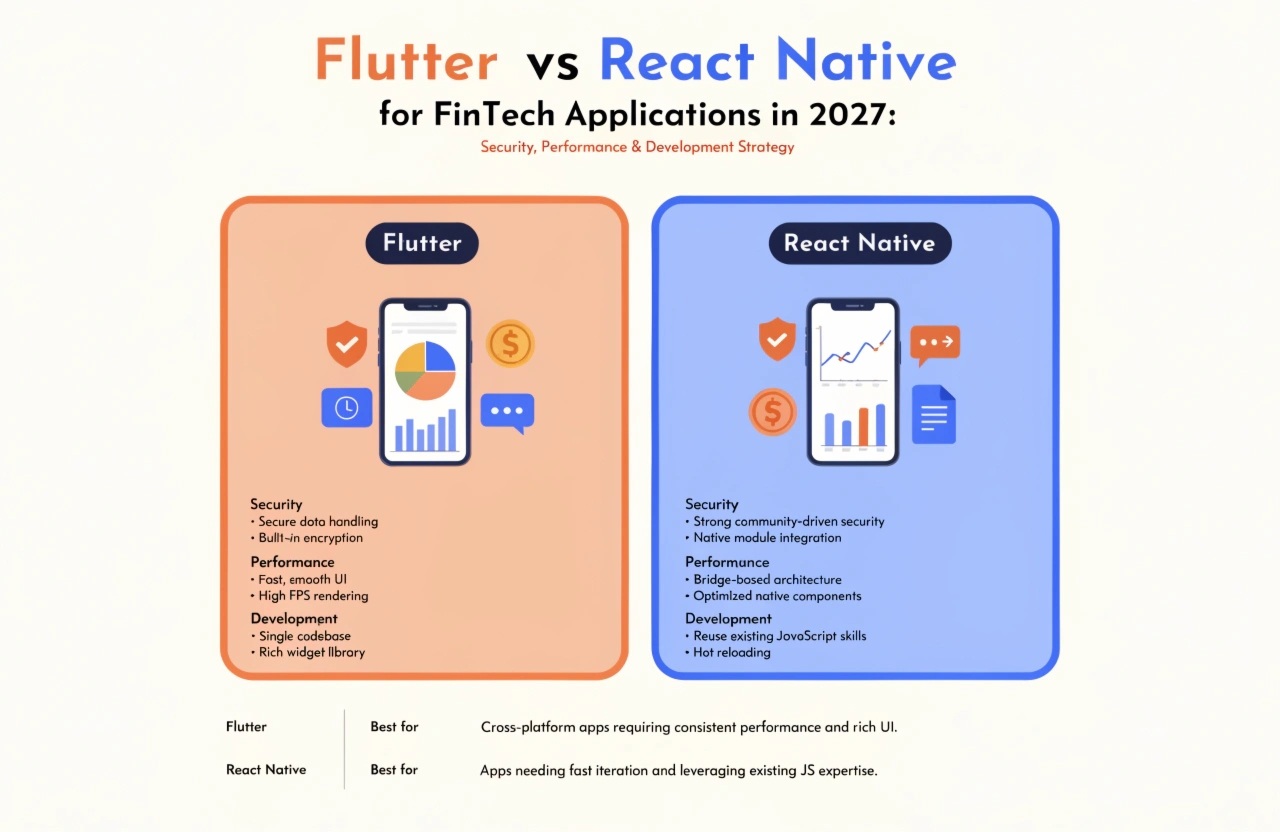
Flutter vs React Native for FinTech Applications in 2027
The FinTech industry is becoming increasingly dependent on mobile applications for digital banking, payments, investment management, insurance, lending, wealth management, and financial analytics. As businesses look for faster cross-platform development without compromising security or performance, Flutter and React Native remain two important technology choices for 2027.
However, developing a FinTech application is different from building a standard consumer application. Financial applications handle sensitive information, authentication credentials, transaction data, personal details, and potentially large transaction volumes. Therefore, framework selection must consider security, performance, scalability, maintainability, compliance requirements, and long-term development strategy.
Flutter for FinTech Applications
Flutter, developed by Google, uses the Dart programming language and provides a widget-based architecture for creating applications across multiple platforms. One of Flutter's biggest advantages is its consistent UI and rendering approach.
For FinTech companies, this can help create polished banking dashboards, payment interfaces, investment screens, transaction histories, calculators, and financial visualization components with a consistent experience across Android and iOS.
Flutter's architecture can also provide predictable rendering performance because the framework uses its own rendering engine. This can be useful when applications contain animations, charts, dashboards, and complex financial interfaces.
Another advantage is development productivity. Teams can maintain a shared codebase for multiple platforms, potentially reducing duplicated development work and simplifying application maintenance.
React Native for FinTech Applications
React Native uses JavaScript or TypeScript and allows developers to build mobile applications using React-based development practices. This makes it particularly attractive for organizations that already have JavaScript, TypeScript, or React expertise.
For FinTech companies with existing web development teams, React Native can simplify talent allocation and knowledge sharing between web and mobile projects.
React Native is also well suited for applications that communicate heavily with backend APIs. Banking applications frequently require integrations with authentication systems, payment gateways, financial APIs, customer-management platforms, notification services, and analytics systems.
Its ecosystem and compatibility with JavaScript and TypeScript tooling can therefore be valuable for organizations building larger digital financial platforms.
Security: A Critical FinTech Requirement
Security should be one of the first considerations when selecting a framework for a financial application. Neither Flutter nor React Native automatically makes an application secure. Security depends heavily on application architecture, backend infrastructure, authentication, encryption, dependency management, and development practices.
A secure FinTech application should consider technologies and practices such as encrypted communication, secure API authentication, token management, secure local storage, biometric authentication, certificate validation, strong session management, code obfuscation where appropriate, and regular security testing.
Developers should also minimize sensitive information stored on the device. Financial transactions should be validated on secure backend systems rather than relying solely on mobile-side logic.
Performance Comparison
Performance is another major consideration. Financial applications may need to process real-time account information, transaction histories, charts, notifications, market information, and complex dashboards.
Flutter's rendering architecture can provide highly consistent UI performance, particularly for visually rich interfaces. React Native has also evolved significantly, with modern architecture improvements designed to enhance communication between JavaScript and native components.
The actual performance of a FinTech application, however, depends on much more than the framework. API response times, database queries, network architecture, caching, application state management, image optimization, background processing, and backend scalability can have a greater impact on user experience.
Development Strategy in 2027
The best framework should be selected according to the organization's existing technology ecosystem and product requirements.
Flutter may be a strong choice when:
- Consistent UI across platforms is a priority.
- The project requires highly customized interfaces.
- The team is comfortable with Dart.
- The company wants a unified cross-platform development approach.
- Rich dashboards and visual components are important.
React Native may be preferable when:
- The organization already has React or TypeScript developers.
- Web and mobile development need to share knowledge.
- Integration with an existing JavaScript ecosystem is important.
- The application relies heavily on API-driven functionality.
- The business wants to leverage an established React development workflow.
Scalability and Architecture
FinTech applications should be designed with scalability from the beginning. A mobile framework is only one part of the complete architecture.
A typical architecture may include a mobile application, API gateway, authentication service, business-logic layer, database systems, payment services, monitoring infrastructure, and cloud services.
Both Flutter and React Native can work with modern backend technologies and cloud platforms. The development team should therefore focus on clean architecture, modular code, secure API design, automated testing, observability, and reliable deployment pipelines.
Testing and Maintenance
Testing is especially important for financial applications because functional errors can directly affect transactions and customer trust.
Teams should combine unit testing, integration testing, API testing, UI testing, security testing, performance testing, and automated regression testing. Critical transaction workflows should receive particularly strong test coverage.
Dependency updates should also be managed carefully. Third-party packages can introduce security vulnerabilities, so development teams should regularly review dependencies and remove unnecessary libraries.
Which One Should You Choose?
There is no universal winner between Flutter and React Native for FinTech development in 2027.
Flutter can be an excellent choice for businesses prioritizing consistent design, customized interfaces, and cross-platform UI performance.
React Native can be a strong option for organizations already invested in React, JavaScript, and TypeScript, particularly when mobile applications are part of a broader web-based technology ecosystem.
Ultimately, FinTech companies should select the framework based on their security architecture, developer expertise, product complexity, backend infrastructure, scalability requirements, and long-term maintenance strategy.
Final Thoughts
Flutter and React Native can both support modern FinTech applications when implemented with a strong engineering and security strategy. The framework alone does not determine whether an application will be secure, scalable, or successful.
For 2027 and beyond, FinTech companies should prioritize security-first architecture, reliable APIs, scalable cloud infrastructure, automated testing, performance optimization, compliance requirements, and excellent user experience.
The right technology decision is therefore not simply about choosing Flutter or React Native. It is about selecting the ecosystem that best aligns with the application's business objectives, technical requirements, development team, and long-term growth strategy.