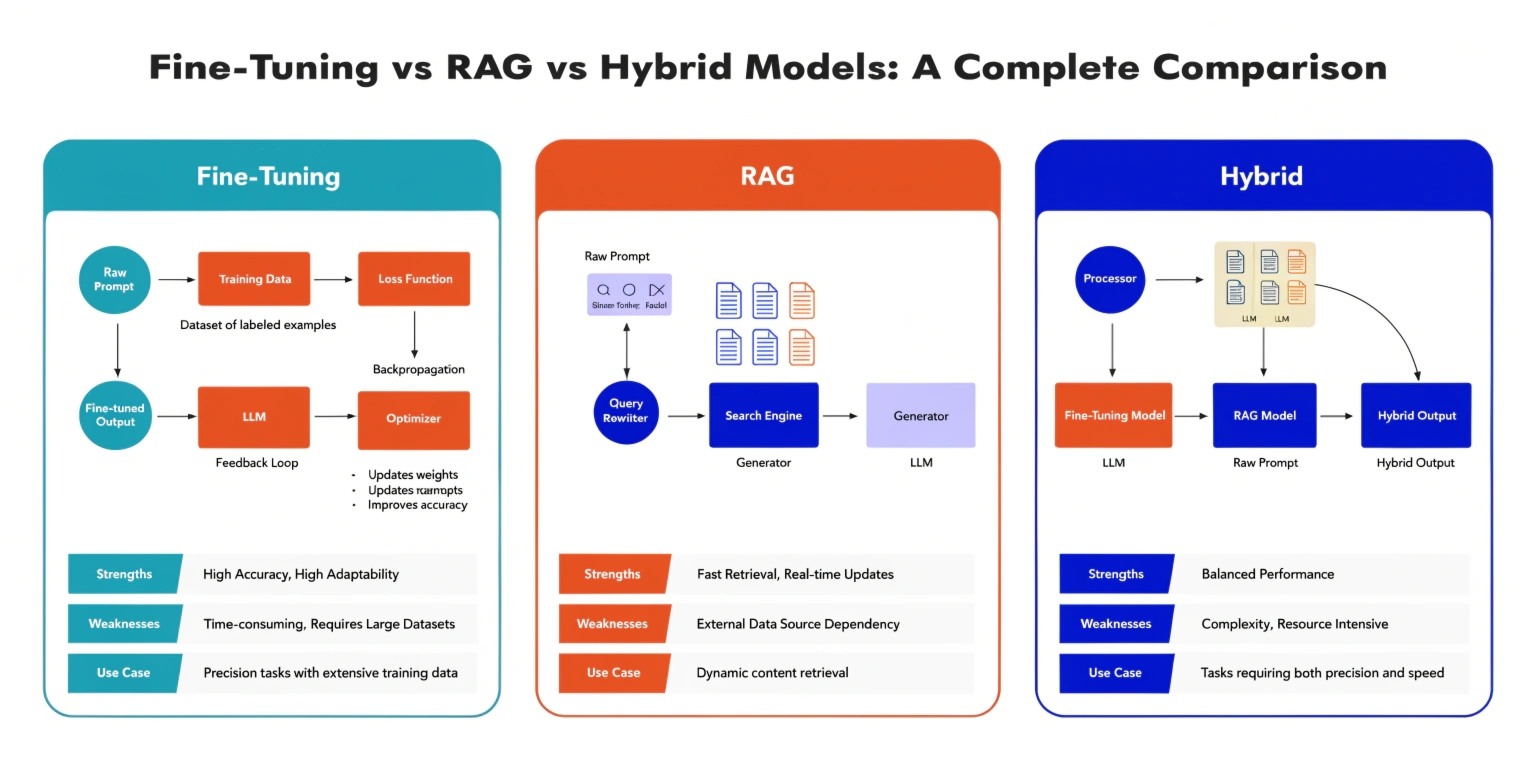
As AI applications powered by large language models (LLMs) continue to evolve, choosing the right approach to optimize performance is critical. Three popular strategies dominate the landscape: Fine-Tuning, Retrieval-Augmented Generation (RAG), and Hybrid Models. Each comes with its own strengths, limitations, and ideal use cases.
Understanding these approaches can help businesses build more accurate, scalable, and cost-efficient AI solutions.
What is Fine-Tuning?
Fine-tuning involves training a pre-trained model on a specific dataset to adapt it to a particular task or domain. This method modifies the model’s internal weights, enabling it to learn domain-specific language, tone, and patterns.
Advantages of Fine-Tuning
- High accuracy for specialized tasks
- Better contextual understanding within a domain
- Consistent output formatting and tone
Limitations of Fine-Tuning
- Expensive and time-consuming
- Requires high-quality labeled data
- Needs retraining for updates
Fine-tuning is ideal for applications like legal document analysis, medical diagnosis support, or brand-specific chatbots where precision and consistency are critical.
What is RAG (Retrieval-Augmented Generation)?
RAG combines information retrieval with text generation. Instead of relying solely on pre-trained knowledge, the model retrieves relevant data from external sources (like databases or documents) in real-time and uses it to generate responses.
Advantages of RAG
- Access to up-to-date information
- No need for frequent retraining
- Scalable and cost-effective
Limitations of RAG
- Dependent on the quality of the retrieval system
- Latency due to retrieval step
- Possible inconsistency in responses
RAG is widely used in knowledge-based systems, customer support bots, and enterprise search solutions where real-time information is essential.
What are Hybrid Models?
Hybrid models combine Fine-Tuning and RAG to leverage the strengths of both approaches. The base model is fine-tuned for domain expertise, while RAG provides real-time, dynamic data retrieval.
Advantages of Hybrid Models
- Best of both worlds: accuracy + real-time data
- Improved response relevance
- Reduced hallucinations
Limitations of Hybrid Models
- More complex architecture
- Higher implementation and maintenance effort
- Requires expertise in both techniques
Hybrid models are ideal for enterprise-grade applications such as financial advisory systems, healthcare assistants, and advanced SaaS platforms.
Key Differences at a Glance
FeatureFine-TuningRAGHybrid ModelData SourceStatic training dataExternal real-time dataBothCostHighModerateHighAccuracyHigh (domain-specific)Moderate to HighVery HighScalabilityLimitedHighly scalableScalableMaintenanceRequires retrainingEasy updatesModerate complexityUse CaseSpecialized tasksDynamic knowledge systemsEnterprise-level solutions
When to Choose What?
Choose Fine-Tuning When:
- You need consistent, domain-specific outputs
- Data does not change frequently
- Accuracy is more important than real-time updates
Choose RAG When:
- You require real-time or frequently updated information
- You want a cost-effective and scalable solution
- Your use case involves large knowledge bases
Choose Hybrid Models When:
- You need both high accuracy and real-time data
- You’re building complex, enterprise-level applications
- You want to minimize hallucinations in responses
Real-World Use Cases
- Fine-Tuning:
- AI writing assistants tailored to a brand’s voice
- RAG:
- Customer support bots retrieving answers from FAQs or documentation
- Hybrid:
- Healthcare AI combining trained medical knowledge with real-time research data
Challenges and Considerations
While these approaches are powerful, selecting the wrong strategy can lead to inefficiencies. Key factors to consider include:
- Budget constraints
- Data availability
- Infrastructure capabilities
- Latency requirements
- Security and compliance
For example, sensitive industries like finance and healthcare may prefer hybrid models to ensure both accuracy and updated information.
Final Thoughts
There is no one-size-fits-all solution when it comes to optimizing AI models. Fine-Tuning, RAG, and Hybrid approaches each serve different purposes, and the right choice depends on your specific business needs.
If your goal is precision, go for Fine-Tuning. If you need real-time knowledge, RAG is your best bet. And if you want the ultimate performance, Hybrid models offer a powerful combination.
As AI continues to evolve, businesses that strategically choose and implement these approaches will gain a significant competitive advantage in building intelligent, reliable, and scalable applications.