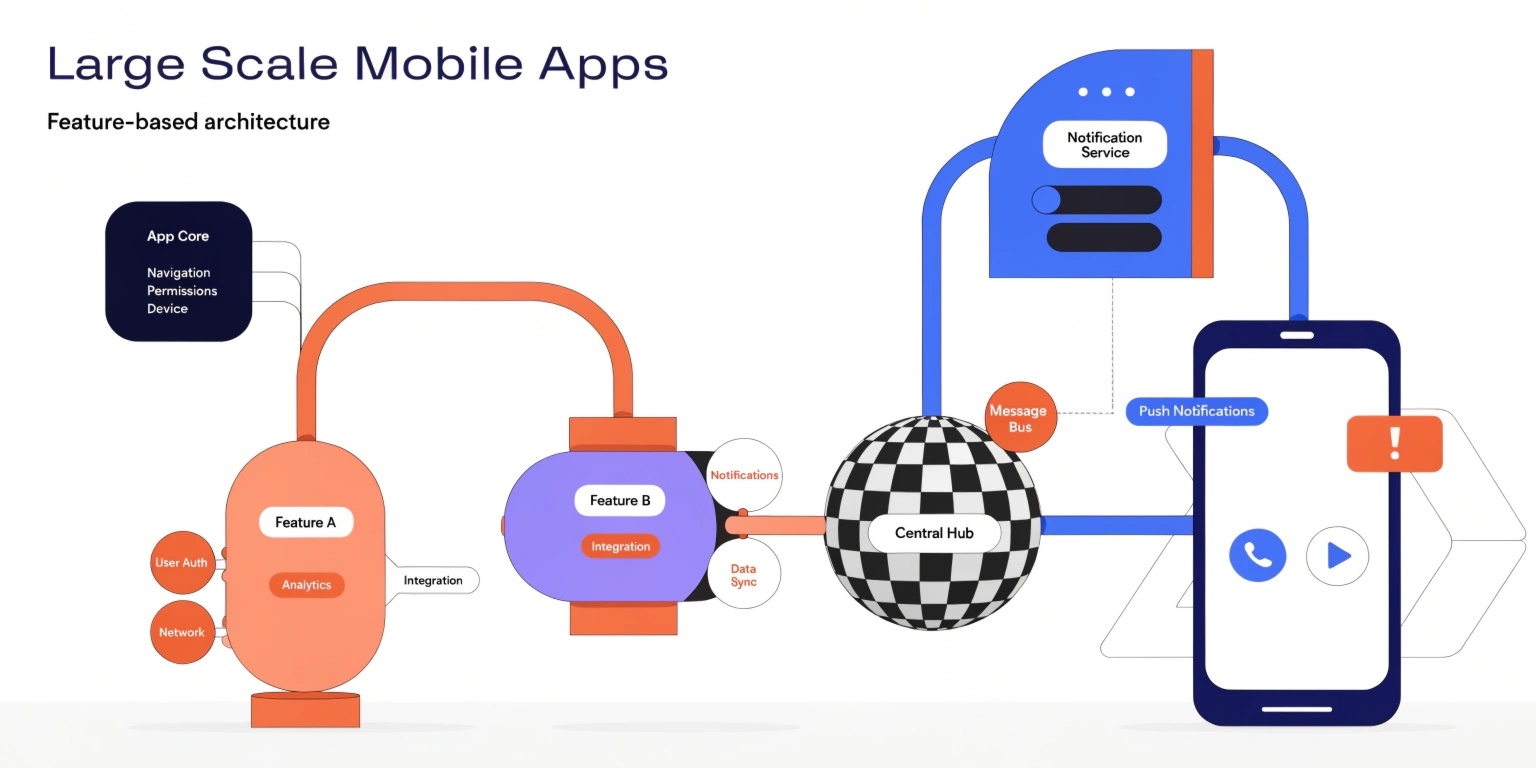
As mobile applications evolve from simple utilities into large digital ecosystems, architectural thinking must evolve as well. The traditional methods of organizing code are often insufficient when applications scale in size, team count, and business complexity. Feature-Based Architecture emerges as a structural philosophy designed to address these long-term scalability challenges.
At its core, Feature-Based Architecture is not merely a folder structure — it is a way of thinking about software organization.
Architectural Philosophy
Traditional mobile architectures often organize code by technical responsibility: presentation, data handling, networking, utilities, and domain logic. This approach groups similar technical components together regardless of which business capability they serve.
Feature-Based Architecture takes the opposite perspective.
Instead of asking:
“How should we group similar technical responsibilities?”
It asks:
“How should we organize the system around business capabilities?”
This shift reflects a fundamental architectural principle:
Software systems scale better when structured around domain concerns rather than technical layers.
Conceptual Foundation
The theoretical foundation of Feature-Based Architecture rests on three key principles:
- High Cohesion Within Features
- All elements required to implement a specific business capability are grouped together. This increases internal coherence.
- Low Coupling Between Features
- Features are designed to interact minimally with each other. Clear boundaries reduce ripple effects when changes occur.
- Domain Alignment
- The structure mirrors business functionality rather than technical abstractions.
This alignment improves long-term clarity because business requirements evolve around features — not around technical layers.
Structural Perspective
In theory, a feature represents a complete vertical slice of functionality.
It contains:
- User interaction logic
- Business rules
- Data coordination
This “vertical slicing” contrasts with horizontal layering, where each layer serves multiple unrelated features.
The advantage of vertical structuring is conceptual isolation. Each feature becomes a semi-autonomous unit within the larger application.
This resembles modular thinking but does not necessarily imply microservices or distributed systems. It remains within a unified application boundary.
Scalability Logic
Scalability in software is not only about performance. It also concerns:
- Organizational scalability
- Cognitive scalability
- Evolutionary scalability
Feature-Based Architecture supports all three.
1. Organizational Scalability
When multiple teams work on a single application, clear boundaries reduce coordination overhead. Teams can focus on specific business areas rather than navigating global layers.
2. Cognitive Scalability
As applications grow, understanding the system becomes harder. Structuring by feature reduces mental load because developers reason about complete business flows instead of fragmented layers.
3. Evolutionary Scalability
Applications change over time. Features may expand, split, or be replaced. When structured independently, these changes cause fewer architectural disruptions.
Theoretical Comparison with Layer-Based Architecture
Layer-Based Architecture emphasizes separation of concerns at the technical level.
Feature-Based Architecture emphasizes separation of concerns at the business level.
Layer-based systems optimize for technical clarity.
Feature-based systems optimize for business adaptability.
Neither approach is universally superior. The suitability depends on system scale and longevity.
For small systems, technical layering may be sufficient.
For long-lived, feature-rich systems, domain-based grouping becomes more sustainable.
Modularity Without Distribution
Feature-Based Architecture is sometimes described as a “modular monolith” concept within mobile development.
Theoretically, it promotes modular thinking without introducing distributed system complexity.
It supports:
- Encapsulation
- Clear dependency boundaries
- Controlled integration points
However, it does not require separate deployments or network boundaries. The modularity is conceptual and structural rather than infrastructural.
Dependency Management Philosophy
From a theoretical standpoint, Feature-Based Architecture encourages directional dependencies.
Features should depend on shared abstractions, not on each other directly. This prevents cyclic dependencies and architectural entanglement.
Shared resources, when necessary, are minimized and abstracted to avoid centralizing logic in a “common” module that undermines modular clarity.
The principle is simple:
Shared code should enable features — not dominate them.
Maintainability Theory
Maintainability increases when change impact is localized.
If a modification to one feature affects multiple unrelated components across the system, maintainability decreases.
Feature-Based Architecture reduces the surface area of change.
When business logic changes within a feature, most modifications remain inside that boundary. This containment property is critical for long-term sustainability.
Architectural Trade-Offs
No architecture is free of trade-offs.
Feature-Based Architecture may introduce:
- Repetition across modules
- Slightly increased abstraction layers
- More deliberate dependency planning
However, these trade-offs are intentional. They prioritize clarity and scalability over minimal file count.
Theoretical architecture always balances simplicity with future-proofing.
Alignment with Domain-Driven Thinking
Feature-Based Architecture aligns closely with domain-driven design principles.
Both emphasize:
- Business capabilities
- Clear boundaries
- Context separation
In large systems, aligning code structure with domain language improves communication between technical and non-technical stakeholders.
Architecture becomes an extension of business understanding.
Long-Term Vision
Mobile applications today often function as digital platforms rather than static products. They evolve continuously, integrate multiple services, and serve diverse user journeys.
Feature-Based Architecture prepares systems for:
- Continuous expansion
- Team growth
- Product diversification
It is a forward-looking strategy rather than a short-term optimization.
Conclusion
Feature-Based Architecture is a structural philosophy grounded in domain alignment, modular thinking, and scalability theory.
It organizes applications around business capabilities rather than technical categories.
While simple projects may not require such structuring, large-scale and long-term mobile systems benefit from its clarity and adaptability.
Ultimately, architecture should reflect how the business evolves.
And businesses evolve around features — not layers.