Main Content
Artificial Intelligence is increasingly being used to support decisions that can have significant financial, operational, legal, or human consequences. Businesses use AI to evaluate credit applications, detect fraud, assess insurance risks, identify cybersecurity threats, prioritize medical cases, and automate important operational decisions. However, highly accurate AI models can sometimes operate like “black boxes,” making it difficult to understand why a particular decision was produced.
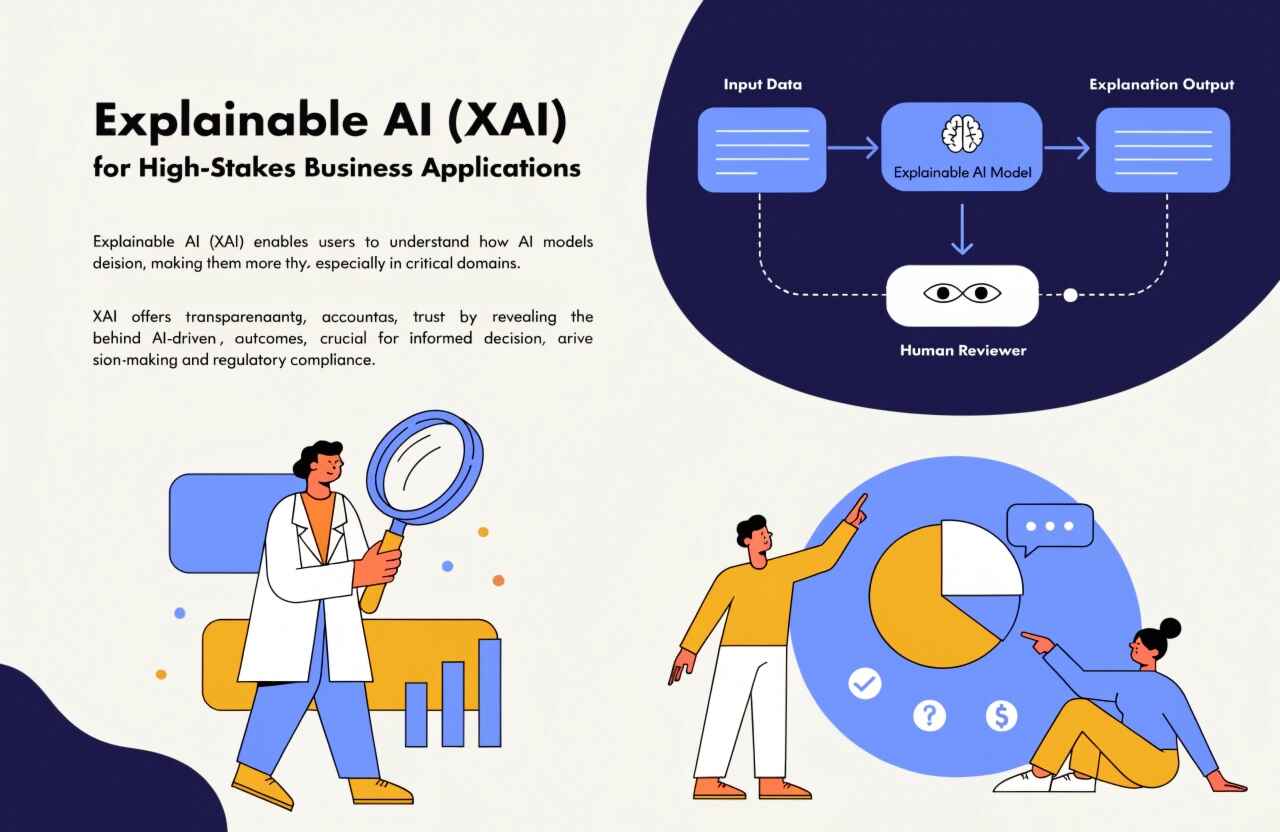
This is where Explainable AI (XAI) becomes important. XAI refers to methods and techniques that help people understand how an AI system reaches its predictions or recommendations. For high-stakes business applications, explainability is not simply a technical feature. It can become an important part of transparency, governance, risk management, and responsible AI.
Why Explainability Matters
Traditional machine learning models can identify complex patterns that humans may struggle to interpret. While this can improve prediction accuracy, businesses may face challenges when stakeholders need to understand the reasoning behind a model's output.
For example, if an AI-powered lending system rejects an application, a customer or compliance team may need to know which factors influenced the decision. Similarly, if an insurance model identifies a customer as high-risk, business teams may need evidence supporting that assessment.
Explainability provides greater visibility into these decisions. It can help organizations identify unexpected model behavior, investigate errors, detect potential bias, and communicate AI-assisted decisions more effectively.
XAI in High-Stakes Industries
Financial services are one of the most important areas for explainable AI. Banks and financial institutions increasingly use machine learning for fraud detection, credit scoring, risk assessment, and transaction monitoring. When an AI model makes a high-impact decision, employees may need to understand the factors contributing to the result.
Healthcare is another major application area. AI can assist with diagnosis, medical image analysis, patient risk prediction, and resource allocation. Explainability can help healthcare professionals evaluate whether an AI recommendation is consistent with relevant evidence before making a final decision.
Insurance companies can use XAI for underwriting, claims assessment, fraud detection, and risk prediction. Explainable models can make it easier for business teams to investigate unusual predictions and provide appropriate reasoning when decisions are reviewed.
In cybersecurity, AI systems can identify suspicious network activity, malicious behavior, or potential attacks. Security teams need to understand why an event was classified as suspicious so they can prioritize investigations and respond appropriately.
Common Explainability Techniques
Several techniques are available for making machine learning models more understandable.
SHAP (SHapley Additive exPlanations) can show how individual features contributed to a model prediction. For example, a business could use SHAP to identify which factors had the greatest influence on a particular risk score.
LIME (Local Interpretable Model-Agnostic Explanations) provides local explanations by approximating a complex model around a specific prediction. This can help teams understand why a model produced a particular result.
Feature importance methods can provide a broader view of which variables are most influential across a model. Visualization techniques can also transform complex model behavior into charts or other understandable formats.
The appropriate technique depends on the model, business requirement, risk level, and audience. A data scientist may require a technically detailed explanation, while an executive or customer may need a simpler explanation.
Human Oversight Remains Essential
Explainability should not mean that businesses completely trust AI-generated explanations. Human oversight remains essential, particularly when decisions can significantly affect people or business outcomes.
Organizations should establish clear processes for reviewing questionable predictions, handling exceptions, and allowing qualified employees to override AI recommendations when necessary.
A human-in-the-loop approach can combine the speed and pattern-recognition capabilities of AI with human judgment, domain expertise, and accountability.
XAI and AI Governance
Explainability is closely connected with broader AI governance. Businesses need processes for monitoring models, documenting their development, evaluating performance, managing risks, and reviewing changes over time.
An effective XAI strategy should consider explainability from the beginning of the AI development lifecycle rather than adding it after deployment. Teams should identify which decisions require explanations, who will consume those explanations, and what level of detail is appropriate.
Organizations should also maintain documentation about training data, model objectives, limitations, performance metrics, and known risks. This creates a stronger foundation for audits and responsible AI management.
Building Trust Through Explainable AI
Trust is one of the biggest benefits of explainability. Employees are more likely to use AI systems when they understand how those systems support their decisions. Customers and business partners can also have greater confidence when organizations can provide clear and meaningful explanations.
However, explainability should be balanced with security, privacy, and intellectual property considerations. Revealing too much information about a model could potentially expose sensitive data or proprietary techniques.
The Future of XAI
As AI becomes more deeply integrated into enterprise operations, explainability will become increasingly important. Businesses will need AI systems that are not only accurate but also understandable, accountable, and manageable.
Future XAI solutions are likely to combine automated explanations, interactive dashboards, model monitoring, fairness analysis, and human review workflows. This can help organizations create AI systems that are easier to evaluate and govern throughout their lifecycle.
Ultimately, Explainable AI enables businesses to move beyond simply asking “What did the AI predict?” and start asking “Why did it make this prediction, how reliable is it, and should we act on it?” For high-stakes applications, that difference can be critical to building responsible, trustworthy, and sustainable AI systems.