Modern web applications are expected to be fast, scalable, and highly responsive. Traditional architectures often struggle to meet these demands, especially under high traffic and complex workflows. This is where Event-Driven Architecture (EDA) comes into play.
EDA is a design paradigm that allows systems to communicate through events—signals that indicate something has happened. Instead of tightly coupling components, EDA promotes loose coupling and asynchronous communication, making applications more flexible and scalable.
What is Event-Driven Architecture?
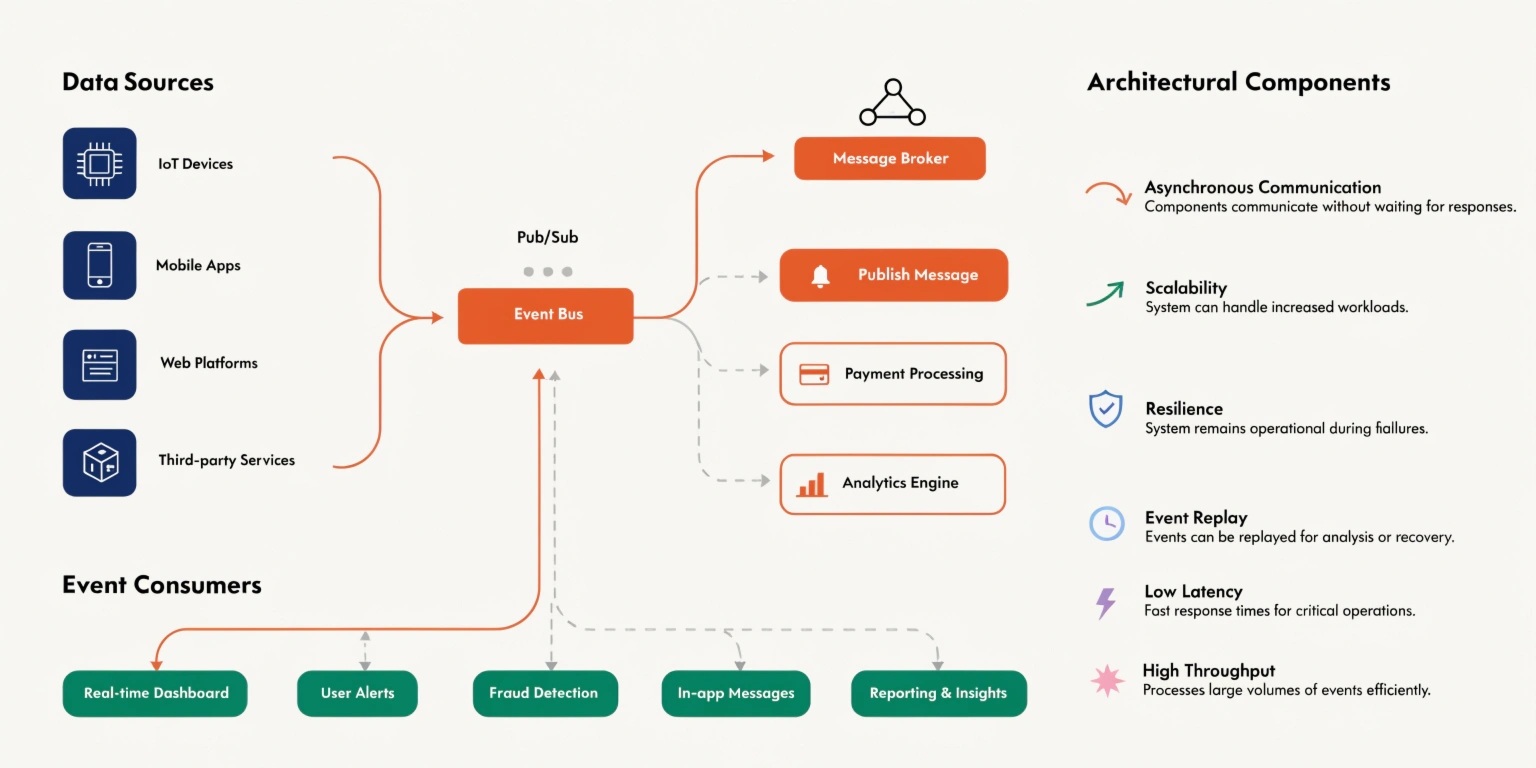
Event-Driven Architecture is a software design pattern in which components interact by producing and consuming events. An event can be anything from a user action (like clicking a button) to a system-generated trigger (like a payment confirmation).
The core components of EDA include:
- Event Producers: Generate events when something happens
- Event Consumers: React to those events
- Event Brokers: Manage the flow of events between producers and consumers
Popular tools like Apache Kafka and RabbitMQ act as event brokers in modern systems.
How EDA Works in Web Applications
In a traditional request-response model, a client sends a request and waits for a response. This can create bottlenecks, especially when multiple services are involved.
In contrast, EDA works asynchronously:
- A user performs an action (e.g., places an order)
- The system emits an event (Order Created)
- Multiple services listen to this event
- Each service processes the event independently
For example:
- Payment service processes the payment
- Inventory service updates stock
- Notification service sends confirmation
All of this happens without blocking the main application flow.
Benefits of Event-Driven Architecture
1. Scalability
EDA allows systems to scale easily by adding more consumers to handle events. Each component can scale independently based on demand.
2. Loose Coupling
Services don’t need to know about each other directly. They only need to understand events, making the system more flexible and easier to maintain.
3. Real-Time Processing
EDA enables real-time data processing, which is essential for applications like live notifications, analytics dashboards, and streaming platforms.
4. Fault Tolerance
If one service fails, others can continue processing events. Events can also be stored and retried, improving system reliability.
5. Flexibility and Extensibility
New features can be added by introducing new event consumers without modifying existing services.
Common Event-Driven Patterns
1. Event Notification
A simple pattern where an event signals that something has changed, and consumers decide how to react.
2. Event-Carried State Transfer
Events contain all the necessary data, reducing the need for additional API calls.
3. Event Sourcing
Instead of storing the current state, the system stores a sequence of events. The current state can be reconstructed from these events.
4. Command Query Responsibility Segregation (CQRS)
Separates read and write operations, often used with EDA for better performance and scalability.
Use Cases in Modern Web Applications
EDA is widely used in various domains:
- E-commerce Platforms: Order processing, payment handling, and notifications
- Social Media Apps: Real-time updates, feeds, and messaging
- Financial Systems: Fraud detection and transaction processing
- IoT Applications: Handling data from multiple devices in real time
- Streaming Services: Content recommendations and user activity tracking
For instance, when a user uploads a video, an event can trigger multiple processes like encoding, thumbnail generation, and notifications.
Challenges of Event-Driven Architecture
While EDA offers many benefits, it also comes with challenges:
1. Complexity
Managing multiple events and services can become complex, especially in large systems.
2. Debugging Difficulty
Tracing issues across asynchronous workflows is harder compared to traditional architectures.
3. Data Consistency
Ensuring consistency across distributed systems requires careful design.
4. Event Management
Handling event schemas, versioning, and storage adds additional overhead.
Best Practices for Implementing EDA
To successfully adopt EDA:
- Use reliable message brokers like Kafka or RabbitMQ
- Design clear and consistent event schemas
- Implement monitoring and logging for event flows
- Ensure idempotency to handle duplicate events
- Use dead-letter queues for failed events
The Future of EDA
With the rise of microservices and serverless computing, EDA is becoming a cornerstone of modern application design. Technologies like event streaming and real-time analytics are further enhancing its capabilities.
Cloud providers now offer managed event services, making it easier than ever to implement EDA without heavy infrastructure management.
Conclusion
Event-Driven Architecture is a powerful approach for building modern web applications that are scalable, responsive, and resilient. By embracing asynchronous communication and loose coupling, developers can create systems that adapt quickly to changing demands.
While it introduces some complexity, the long-term benefits make EDA an essential architecture for the future of web development.