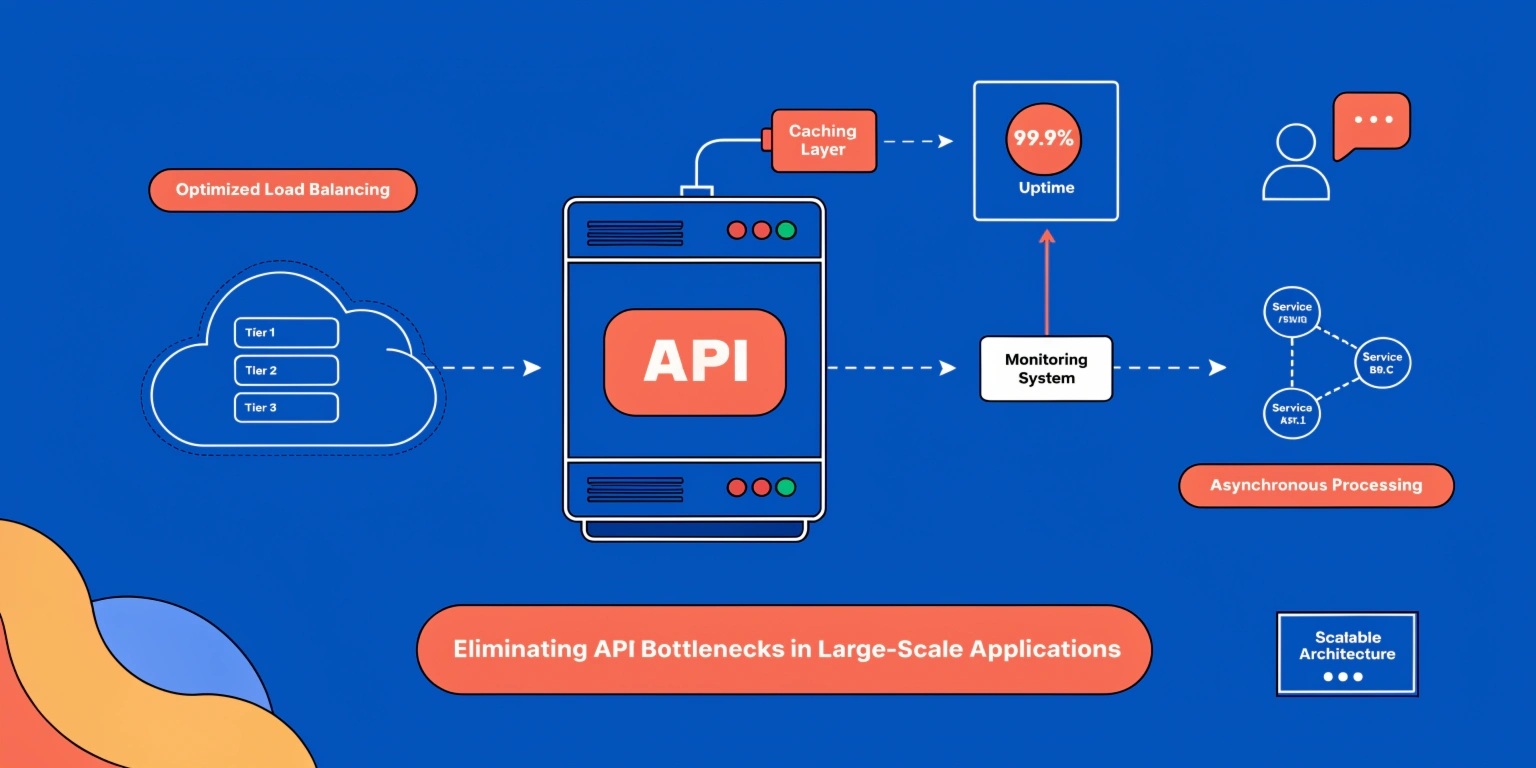
Eliminating API Bottlenecks in Large-Scale Applications: Strategies for High Performance and Scalability
Application Programming Interfaces (APIs) are the backbone of modern software systems. They connect mobile applications, websites, third-party integrations, cloud services, and microservices, enabling seamless communication between components. As user traffic grows from thousands to millions of requests, APIs can quickly become performance bottlenecks if they are not designed for scale.
Slow response times, overloaded servers, inefficient database queries, and network latency can all impact API performance, resulting in poor user experiences and increased operational costs. Eliminating API bottlenecks requires a combination of architectural improvements, infrastructure optimization, and continuous monitoring.
This article explores common causes of API bottlenecks and practical strategies for building fast, scalable, and highly available APIs.
What Is an API Bottleneck?
An API bottleneck occurs when one or more components limit the application's ability to process requests efficiently. As traffic increases, these limitations can cause delays, request failures, and degraded performance.
Common symptoms include:
- High response times
- Increased request timeouts
- CPU or memory spikes
- Database overload
- Slow third-party integrations
- Reduced throughput
- Poor user experience
- Service outages during peak traffic
Identifying bottlenecks early is essential for maintaining application reliability.
Common Causes of API Bottlenecks
Inefficient Database Queries
Poorly optimized SQL queries, missing indexes, and unnecessary joins often become the primary source of latency.
Synchronous Processing
Waiting for every operation to complete before responding increases request duration, especially when external services are involved.
Excessive Network Calls
Making multiple API requests for a single client operation adds unnecessary latency and resource consumption.
Resource Contention
Limited CPU, memory, or network bandwidth can prevent APIs from handling concurrent requests efficiently.
Third-Party Dependencies
External services may introduce unpredictable delays or outages that affect your API's overall performance.
Use Caching to Reduce Load
Caching is one of the most effective ways to improve API performance.
Frequently accessed data can be stored temporarily in high-speed caches, reducing repeated database queries.
Common caching approaches include:
- In-memory caching
- Distributed caching
- HTTP response caching
- CDN caching
- Query result caching
By serving cached responses, applications reduce latency and backend resource usage.
Implement Load Balancing
Load balancers distribute incoming requests across multiple application instances.
Benefits include:
- Higher availability
- Better resource utilization
- Automatic failover
- Improved scalability
- Reduced server overload
Horizontal scaling combined with intelligent load balancing enables APIs to handle growing traffic efficiently.
Optimize Database Performance
Database optimization is critical for API responsiveness.
Best practices include:
- Add appropriate indexes
- Optimize slow queries
- Use connection pooling
- Partition large tables
- Implement read replicas
- Avoid unnecessary joins
- Batch database operations
Well-designed database architecture significantly reduces request latency.
Adopt Asynchronous Processing
Not every operation needs to complete before returning a response.
Background processing is ideal for tasks such as:
- Email notifications
- Image processing
- Report generation
- Payment reconciliation
- Log aggregation
- Data synchronization
Using queues and event-driven architectures improves responsiveness while increasing overall system throughput.
Apply Rate Limiting
Rate limiting prevents individual users or systems from overwhelming your APIs.
Common strategies include:
- Requests per minute
- Token bucket algorithms
- Fixed window limits
- Sliding window limits
- User-specific quotas
Rate limiting protects infrastructure and ensures fair resource distribution.
Optimize API Design
Efficient API design reduces unnecessary processing.
Recommendations include:
- Return only required fields
- Support pagination
- Compress responses
- Use efficient serialization formats
- Minimize nested requests
- Reduce payload sizes
GraphQL can also reduce over-fetching by allowing clients to request only the data they need.
Monitor Performance Continuously
Performance monitoring helps identify bottlenecks before they impact users.
Important metrics include:
- Response time
- Throughput
- Error rates
- CPU utilization
- Memory usage
- Database latency
- Cache hit ratio
- Request queue length
Application Performance Monitoring (APM) tools provide real-time insights into API health and performance.
Build for High Availability
Large-scale applications should anticipate failures rather than assume perfect conditions.
Key practices include:
- Multi-region deployment
- Redundant infrastructure
- Health checks
- Automatic failover
- Circuit breakers
- Retry mechanisms with exponential backoff
These techniques improve resilience and minimize downtime.
Security Without Sacrificing Performance
API security should be integrated efficiently.
Recommendations include:
- Token-based authentication
- Efficient authorization checks
- API gateways
- TLS encryption
- Request validation
- Web Application Firewalls (WAF)
Balancing security with performance ensures safe and responsive APIs.
Best Practices
To eliminate API bottlenecks effectively:
- Profile APIs regularly.
- Cache frequently requested data.
- Optimize database queries.
- Use asynchronous processing where appropriate.
- Scale horizontally with load balancing.
- Monitor production systems continuously.
- Limit excessive API requests.
- Design lightweight, efficient endpoints.
- Test under realistic traffic loads.
- Continuously optimize based on real-world usage patterns.
These practices improve scalability while maintaining a consistent user experience.
Future Trends
API architectures continue to evolve with modern cloud-native technologies.
Emerging trends include:
- AI-driven performance optimization
- Serverless APIs
- Edge computing
- Intelligent traffic routing
- API federation
- Event-driven microservices
- gRPC for high-performance communication
- Adaptive autoscaling powered by machine learning
These innovations enable applications to support millions of users with lower latency and greater operational efficiency.
Conclusion
API bottlenecks are inevitable as applications grow, but they can be effectively addressed through thoughtful architecture and proactive optimization. Techniques such as caching, load balancing, database tuning, asynchronous processing, rate limiting, and continuous monitoring work together to improve performance and ensure reliable service under heavy traffic.
For organizations building modern, large-scale applications, eliminating API bottlenecks is not just about speed—it is about delivering seamless user experiences, reducing infrastructure costs, and creating systems that can scale confidently as demand increases.