Editor Undo/Redo Systems Architecture: Designing Reliable State Management
Undo and redo functionality may appear simple from a user’s perspective, but behind the scenes, it is one of the most complex architectural challenges in software engineering. Modern applications such as code editors, design tools, document processors, game engines, and collaborative platforms rely heavily on robust undo/redo systems to maintain usability and data integrity.
Whether users are editing documents in a browser, designing graphics, or collaborating in real time, they expect every action to be reversible instantly and accurately. Building such systems requires careful planning around state management, data structures, memory optimization, and concurrency handling.
In this blog, we will explore how undo/redo systems work internally, the most common architectural patterns, and the challenges developers face while designing scalable editor systems.
Why Undo/Redo Systems Matter
Undo and redo functionality directly impact user confidence. Users feel safer experimenting when they know actions can be reversed easily.
Without reliable undo systems:
- User productivity decreases
- Accidental changes become costly
- Editing workflows feel frustrating
- Collaboration becomes risky
Applications like graphic editors, IDEs, spreadsheets, and collaborative platforms depend heavily on efficient state recovery mechanisms.
A poorly designed undo/redo system can cause:
- Corrupted states
- Memory leaks
- Performance degradation
- Inconsistent synchronization
Therefore, undo/redo architecture is considered a core component of editor engineering.
The Basic Undo/Redo Model
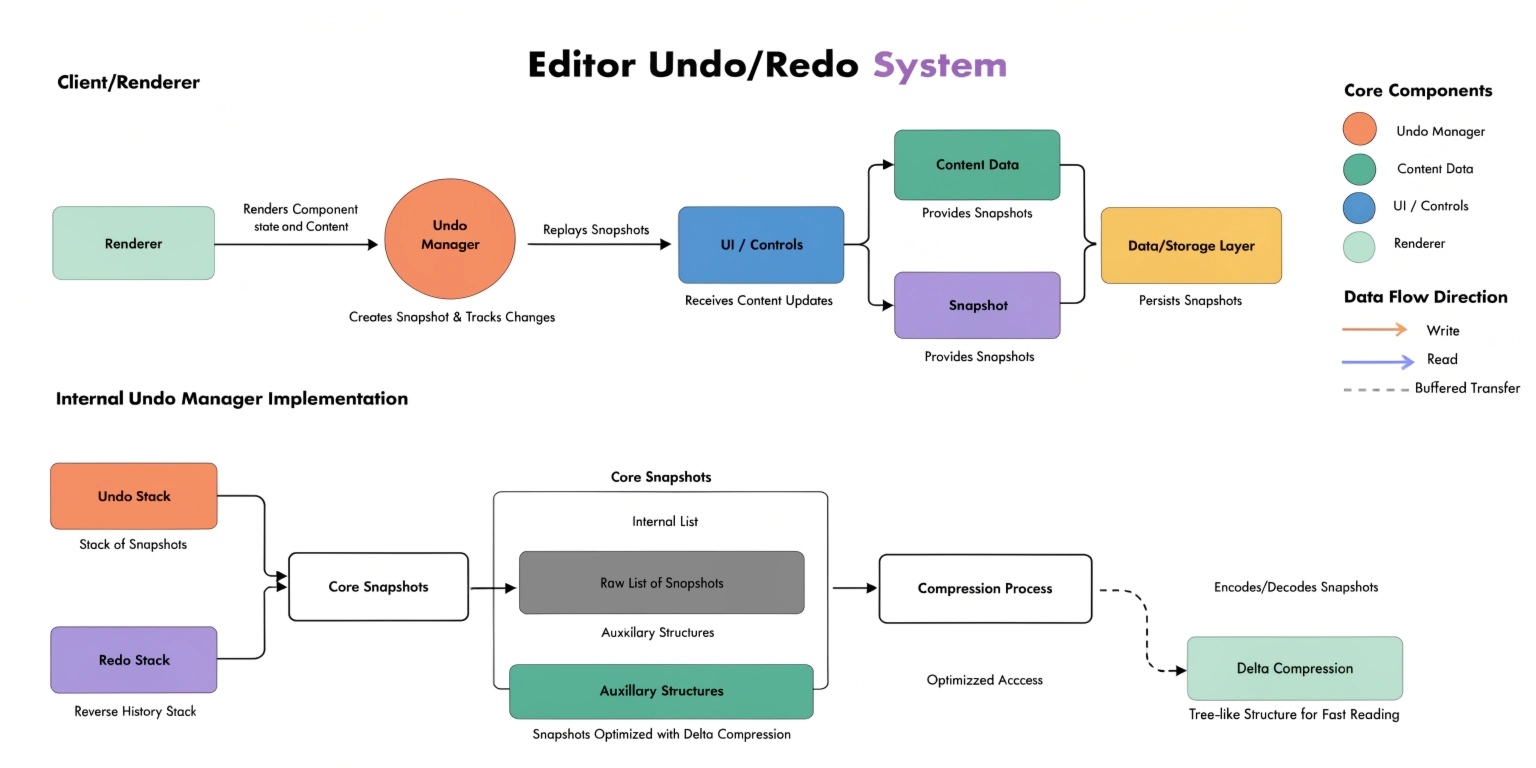
At the simplest level, undo/redo systems use two stacks:
- Undo Stack
- Redo Stack
When a user performs an action:
- The action is pushed to the undo stack.
- The redo stack is cleared.
When the user clicks Undo:
- The latest action is reversed.
- That action moves to the redo stack.
When the user clicks Redo:
- The action is reapplied.
- It moves back to the undo stack.
This approach works well for small applications but becomes difficult to scale in complex systems with large state changes.
State Snapshot Architecture
One common implementation strategy is the snapshot-based approach.
In this model:
- The application stores a complete snapshot of the editor state after each operation.
- Undo simply restores the previous snapshot.
Advantages:
- Easy implementation
- Reliable recovery
- Simple debugging
However, snapshot systems become inefficient for large applications because storing complete state copies consumes significant memory.
For example:
- Large design editors
- Video editing software
- 3D modeling systems
These systems may contain massive datasets that cannot be duplicated repeatedly.
To solve this, developers often use incremental state storage.
Command Pattern Architecture
The Command Pattern is one of the most widely used approaches for scalable undo/redo systems.
Instead of storing entire states, the application stores commands representing actions.
Example commands:
- InsertText
- DeleteObject
- MoveLayer
- ResizeImage
Each command contains:
- Execute()
- Undo()
This architecture is efficient because only action metadata is stored rather than full application states.
Benefits include:
- Better memory efficiency
- Modular design
- Easier testing
- Cleaner separation of concerns
This approach is commonly used in:
- IDEs
- Graphic editors
- CAD software
- Game engines
The command pattern is especially powerful in systems with complex user interactions.
Event Sourcing for Advanced Editors
Large-scale systems increasingly use Event Sourcing architecture.
In event sourcing:
- Every user action is stored as an immutable event log.
- The application state is reconstructed by replaying events.
For example:
- Typing text
- Deleting components
- Changing styles
- Moving objects
Everything becomes an event.
Advantages:
- Complete history tracking
- Auditability
- Time-travel debugging
- Easier synchronization
Event sourcing is highly effective for:
- Collaborative applications
- Enterprise systems
- Real-time editors
However, rebuilding state from large event histories can impact performance, so systems often combine event sourcing with periodic snapshots.
Challenges in Collaborative Editors
Undo/redo becomes significantly more difficult in collaborative systems where multiple users edit the same document simultaneously.
Challenges include:
- Conflicting operations
- State synchronization
- Network latency
- Concurrent modifications
Modern collaborative editors solve this using:
- Operational Transformation (OT)
- Conflict-Free Replicated Data Types (CRDTs)
These technologies allow distributed users to maintain consistent document states while supporting reversible actions.
Applications like collaborative document editors and multiplayer design platforms depend heavily on these architectures.
Memory and Performance Optimization
Undo systems must balance:
- Performance
- Scalability
- Memory consumption
Some optimization techniques include:
- Delta storage
- Compression
- Batched operations
- Action grouping
For example, typing an entire sentence may be stored as one grouped action rather than dozens of separate keystrokes.
Efficient memory management becomes critical in applications with:
- Long editing sessions
- Large datasets
- Real-time rendering
- High-frequency updates
Without optimization, undo history can consume massive system resources.
Designing Reliable User Experiences
A technically correct undo system may still fail if the user experience feels inconsistent.
Good undo systems should:
- Behave predictably
- Restore exact previous states
- Maintain cursor positions
- Preserve selection states
- Support grouped operations
Users expect intuitive behavior. Even small inconsistencies can create confusion and reduce trust in the application.
Therefore, undo/redo architecture requires both engineering precision and UX thinking.
Conclusion
Undo/redo systems are far more than simple “Ctrl+Z” functionality. They represent a critical architectural component in modern applications, requiring advanced state management, memory optimization, and synchronization strategies.
From snapshot models and command patterns to event sourcing and collaborative editing algorithms, modern editor systems use sophisticated engineering techniques to deliver reliable and scalable user experiences.
As applications become increasingly real-time and collaborative, undo/redo architectures will continue evolving as one of the most important challenges in software system design.