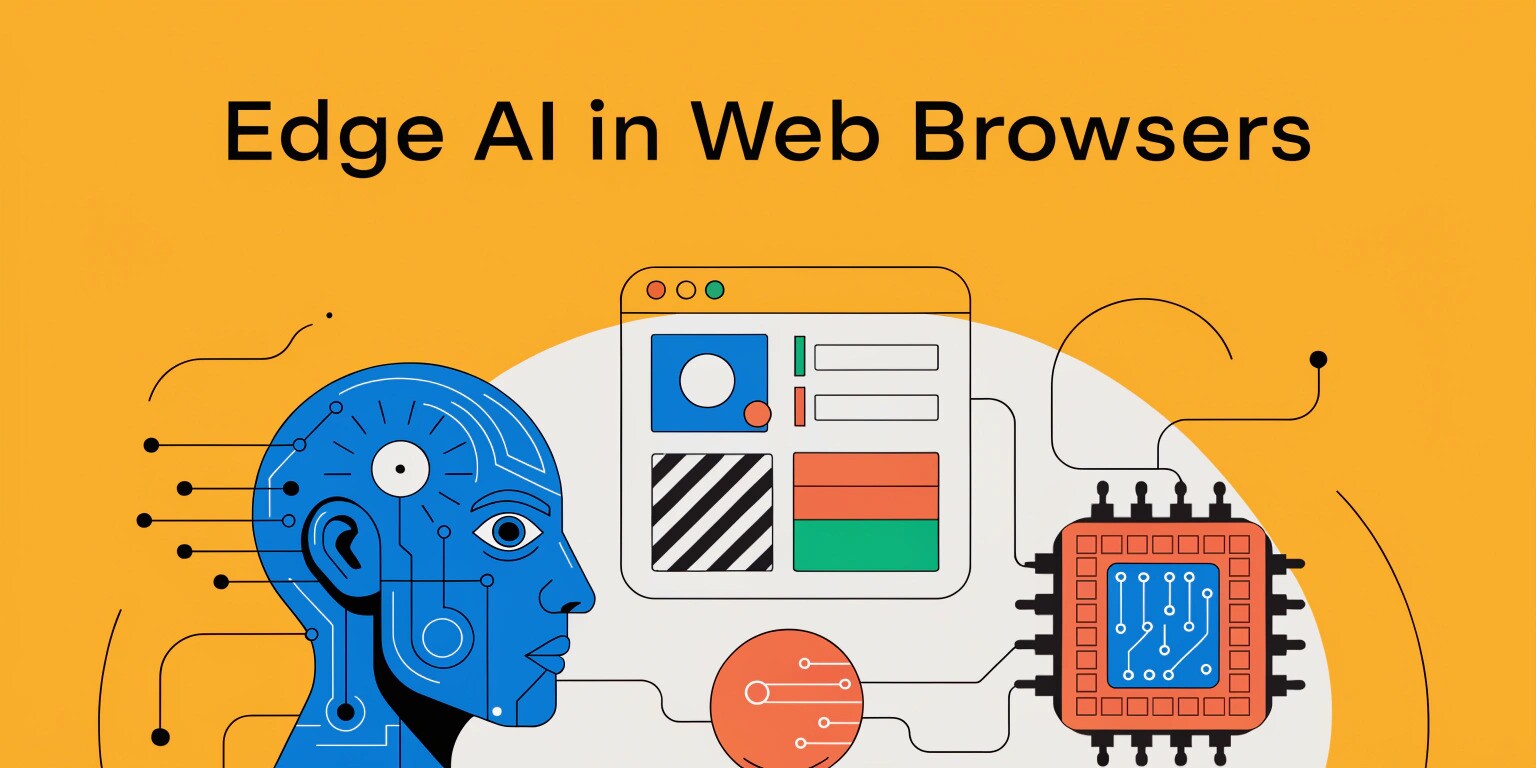
Artificial Intelligence has traditionally relied on powerful cloud servers to process data, generate predictions, and perform complex computations. While cloud-based AI remains essential for training large models, a new trend is changing how intelligent applications are built—Edge AI in web browsers.
Instead of sending every user request to a remote server, Edge AI allows AI models to run directly inside the browser. This approach reduces latency, improves privacy, lowers cloud costs, and enables applications to function even with limited or no internet connectivity.
As browser technologies continue to evolve, Edge AI is becoming a powerful tool for developers building fast, intelligent, and user-centric web applications.
What Is Edge AI?
Edge AI refers to running artificial intelligence models on the user's device rather than on centralized cloud infrastructure.
In web applications, this means AI inference happens inside the browser using technologies such as:
- WebGPU
- WebAssembly (WASM)
- TensorFlow.js
- ONNX Runtime Web
- MediaPipe
- Web Neural Network (WebNN) API
Instead of uploading sensitive data to a server, the browser downloads a trained model and performs predictions locally.
For example, an image classification application can recognize objects using your computer's GPU without sending images to a remote server.
Why Edge AI Matters
Traditional cloud AI introduces several challenges:
- Network latency
- Internet dependency
- Cloud infrastructure costs
- Privacy concerns
- Bandwidth limitations
Edge AI addresses these issues by processing data where it is generated.
The benefits become especially valuable for applications requiring instant responses, such as facial recognition, voice assistants, gesture detection, document scanning, and augmented reality.
How Edge AI Works in a Browser
The process is surprisingly straightforward.
- The browser downloads a pre-trained AI model.
- User data remains on the device.
- JavaScript loads the model using an AI framework.
- GPU or CPU performs inference locally.
- Results are displayed instantly.
Since only the model is downloaded, no user data needs to leave the device for inference.
Modern browsers increasingly leverage WebGPU, allowing AI workloads to utilize graphics hardware for significantly faster performance compared to CPU-only execution.
Technologies Powering Browser-Based AI
WebGPU
WebGPU is the next-generation graphics API for browsers.
Unlike traditional graphics APIs, WebGPU provides high-performance GPU computing, making it ideal for machine learning inference.
Developers can execute neural network operations much faster than before, enabling real-time AI experiences directly in the browser.
TensorFlow.js
TensorFlow.js is one of the most popular JavaScript machine learning libraries.
It enables developers to:
- Train lightweight models
- Load pre-trained models
- Perform image classification
- Detect objects
- Analyze text
- Recognize handwriting
All without requiring backend inference for many workloads.
ONNX Runtime Web
Many AI models are developed using frameworks like PyTorch or TensorFlow.
ONNX Runtime Web allows developers to convert these models into the ONNX format and execute them efficiently inside web browsers.
This simplifies deploying production-ready AI models across multiple platforms.
WebAssembly (WASM)
WebAssembly significantly improves execution speed compared to traditional JavaScript.
Many AI libraries use WASM to accelerate mathematical operations and improve browser-based inference performance, particularly on devices without powerful GPUs.
Real-World Applications
Edge AI is already powering a wide range of intelligent web applications.
Smart Image Recognition
Photo editing tools can detect faces, remove backgrounds, and classify objects instantly without uploading images.
Voice Recognition
Speech-to-text systems can process voice locally, improving response speed while protecting user privacy.
AI Chat Interfaces
Lightweight language models can perform basic text generation, summarization, and autocomplete directly inside the browser.
Fraud Detection
Financial applications can perform behavioral analysis locally before communicating with backend services, adding another layer of security.
Healthcare Applications
Medical imaging tools can analyze scans locally, helping protect sensitive patient information while providing faster results.
Education Platforms
Interactive learning applications can evaluate handwriting, pronunciation, and quizzes in real time, even with unstable internet connections.
Benefits of Edge AI
Organizations adopting browser-based AI gain several advantages:
- Faster inference with minimal latency
- Reduced cloud computing costs
- Enhanced user privacy
- Offline functionality
- Lower bandwidth usage
- Better responsiveness
- Improved scalability
- Enhanced user experience
Since servers process fewer AI requests, infrastructure becomes more efficient and cost-effective.
Challenges of Browser-Based AI
Despite its advantages, Edge AI also has limitations.
Model Size
Large language models may require several gigabytes of memory, making them difficult to run on average consumer devices.
Device Variability
Performance differs across smartphones, laptops, and desktop computers due to varying CPU and GPU capabilities.
Browser Compatibility
Not all browsers fully support emerging technologies like WebGPU or WebNN, requiring developers to implement fallback solutions.
Security
Although inference occurs locally, developers should still protect AI models against reverse engineering and unauthorized access.
Best Practices for Developers
To build efficient browser-based AI applications:
- Optimize models using quantization and pruning.
- Use lightweight architectures whenever possible.
- Cache AI models after the first download.
- Leverage GPU acceleration through WebGPU.
- Provide graceful fallbacks for unsupported browsers.
- Perform intensive AI tasks only when necessary.
- Keep sensitive user data on the client device whenever possible.
- Continuously monitor browser compatibility.
The Future of Edge AI
As browser APIs continue to mature, Edge AI will become a standard capability for modern web applications.
Advancements in WebGPU, WebNN, faster JavaScript engines, and smaller optimized AI models will make browser-based intelligence more powerful than ever.
Future applications may include fully offline AI assistants, real-time language translation, intelligent productivity tools, augmented reality experiences, advanced accessibility features, and personalized recommendation systems—all running directly inside the browser.
Edge AI is transforming web development from static user interfaces into intelligent, responsive, and privacy-first applications.
Conclusion
Edge AI in web browsers represents a major shift in how AI-powered applications are designed and delivered. By moving inference closer to users, developers can create faster, more secure, and more reliable experiences while reducing cloud dependency and operational costs.
As technologies such as WebGPU, TensorFlow.js, ONNX Runtime Web, and WebAssembly continue to advance, browser-based AI will play a central role in the next generation of web applications. Businesses and developers that embrace Edge AI today will be well-positioned to build intelligent, scalable, and privacy-focused digital products for the future.