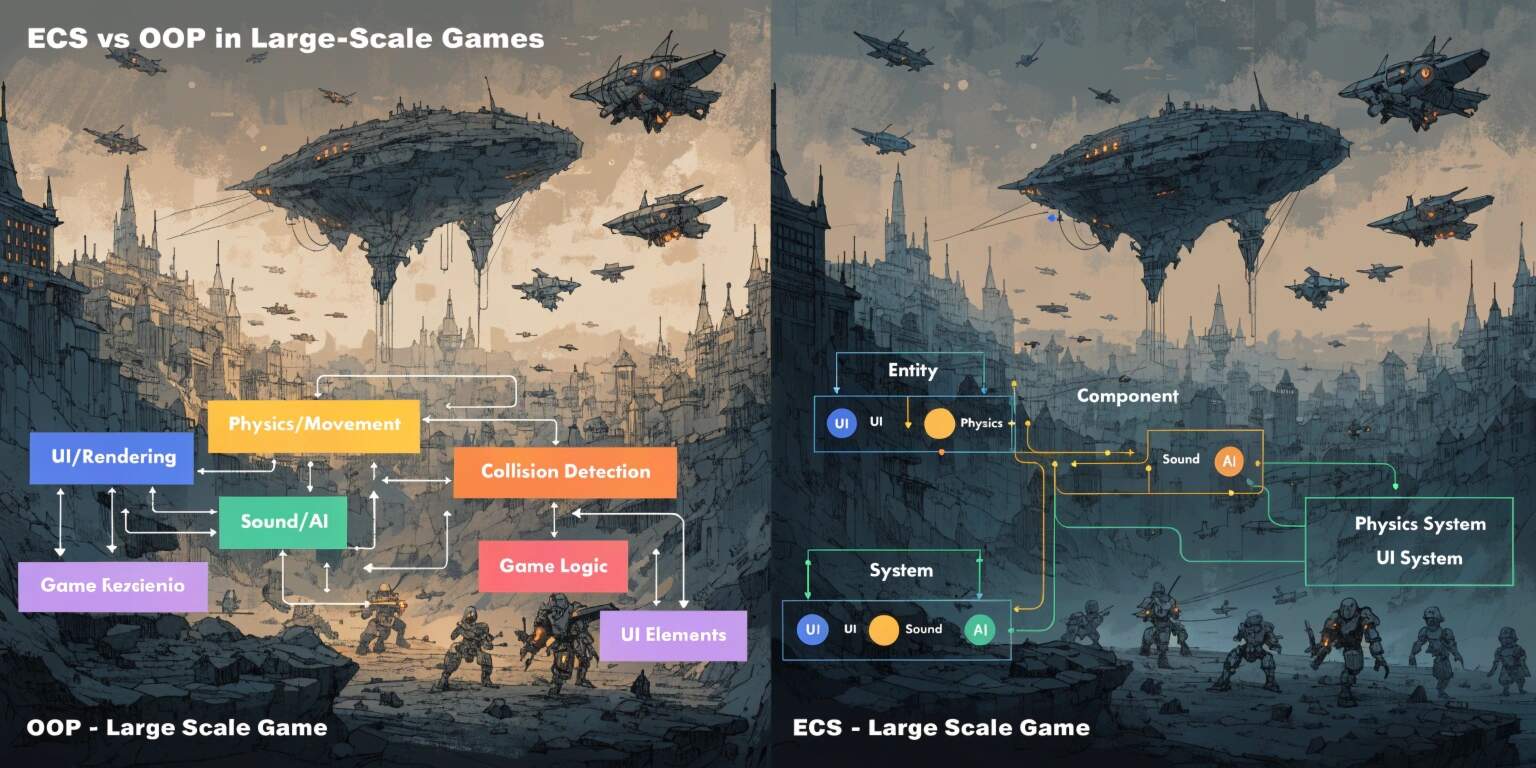
As modern games grow increasingly complex, handling thousands of entities, real-time interactions, and high-performance requirements becomes a major challenge. Choosing the right architecture is critical. Two dominant paradigms—Object-Oriented Programming (OOP) and Entity Component System (ECS)—offer different approaches to structuring game logic. Understanding their differences is essential for building scalable and efficient large-scale games.
Understanding Object-Oriented Programming (OOP)
OOP is one of the most widely used programming paradigms in game development. It organizes code around objects, which encapsulate both data and behavior. Developers create classes like Player, Enemy, or Weapon, each with properties and methods.
Advantages of OOP:
- Intuitive Design: Easy to understand and map to real-world concepts.
- Encapsulation: Combines data and behavior, improving code organization.
- Reusability: Inheritance and polymorphism allow code reuse.
Challenges in Large-Scale Games:
- Tight Coupling: Objects often depend on each other, making systems harder to scale.
- Inheritance Complexity: Deep class hierarchies can become difficult to manage.
- Performance Bottlenecks: Poor cache utilization due to scattered memory layouts.
In small to medium-sized games, OOP works effectively. However, as the number of entities increases, performance and maintainability issues start to surface.
What is Entity Component System (ECS)?
ECS is a data-oriented design pattern that separates data and behavior into three parts:
- Entities: Unique identifiers (no logic or data).
- Components: Pure data containers (e.g., position, velocity).
- Systems: Logic that operates on entities with specific components.
Instead of creating a Player class, ECS defines a player as an entity with components like Health, Position, and Input.
Advantages of ECS:
- High Performance: Better cache locality and memory efficiency.
- Scalability: Handles thousands or millions of entities efficiently.
- Flexibility: Easy to add or remove components without changing system logic.
- Parallelism: Systems can run concurrently, leveraging multi-core CPUs.
Challenges of ECS:
- Learning Curve: Less intuitive than OOP for beginners.
- Debugging Complexity: Harder to trace behavior since logic is distributed.
- Initial Setup: Requires careful architectural planning.
Key Differences Between ECS and OOP
1. Data vs Behavior Organization
- OOP: Combines data and behavior in objects.
- ECS: Separates data (components) from behavior (systems).
2. Performance
- OOP: May suffer from cache misses due to object-oriented memory layout.
- ECS: Optimized for CPU cache, leading to significant performance gains.
3. Scalability
- OOP: Struggles with large numbers of entities.
- ECS: Designed to scale efficiently with massive entity counts.
4. Flexibility
- OOP: Changes may require modifying class hierarchies.
- ECS: Easily extendable by adding/removing components.
When to Use OOP
OOP is still a strong choice in many scenarios:
- Small to medium-sized games
- Projects with limited complexity
- Rapid prototyping
- Teams familiar with traditional programming paradigms
It allows faster development cycles and is easier to debug, making it ideal for indie developers or simpler game systems.
When to Use ECS
ECS shines in performance-critical and large-scale environments:
- Open-world games with thousands of entities
- Simulation-heavy systems (AI, physics, particles)
- Games requiring high frame rates and optimization
- Projects leveraging multi-threading
Modern engines and frameworks increasingly adopt ECS principles to meet the demands of next-generation games.
Hybrid Approaches in Modern Game Development
In practice, many game developers use a hybrid model:
- Core gameplay systems use ECS for performance.
- UI, tools, and higher-level logic use OOP for simplicity.
This combination allows teams to leverage the strengths of both paradigms while minimizing their weaknesses.
For example, a game might use ECS for rendering, physics, and AI systems, while using OOP for menus, inventory systems, and scripting.
Best Practices
- Avoid deep inheritance hierarchies in OOP.
- Use ECS for systems that require high performance and scalability.
- Keep components small and focused in ECS.
- Design systems to be independent and reusable.
- Profile performance before deciding architecture.
Conclusion
ECS and OOP represent two fundamentally different approaches to game architecture. While OOP offers simplicity and familiarity, ECS provides unmatched performance and scalability for large-scale games.
Rather than choosing one over the other, modern game development often benefits from combining both. By understanding their strengths and limitations, developers can build systems that are not only efficient but also maintainable and future-proof.