Modern game development requires systems capable of handling thousands or even millions of real-time interactions efficiently. Traditional object-oriented programming approaches often struggle with scalability and performance when dealing with large-scale simulations, multiplayer environments, or physics-heavy games. To solve these challenges, developers increasingly rely on ECS (Entity Component System) architecture.
ECS architecture is a powerful design pattern focused on performance, modularity, and data-oriented programming. It separates game objects into independent data and behavior systems, enabling better CPU cache utilization, parallel processing, and easier scalability.
Today, ECS is widely used in advanced game engines, simulation platforms, AI systems, and real-time interactive applications. Popular technologies such as Unity DOTS (Data-Oriented Technology Stack) have accelerated ECS adoption across the gaming industry.
What is ECS Architecture?
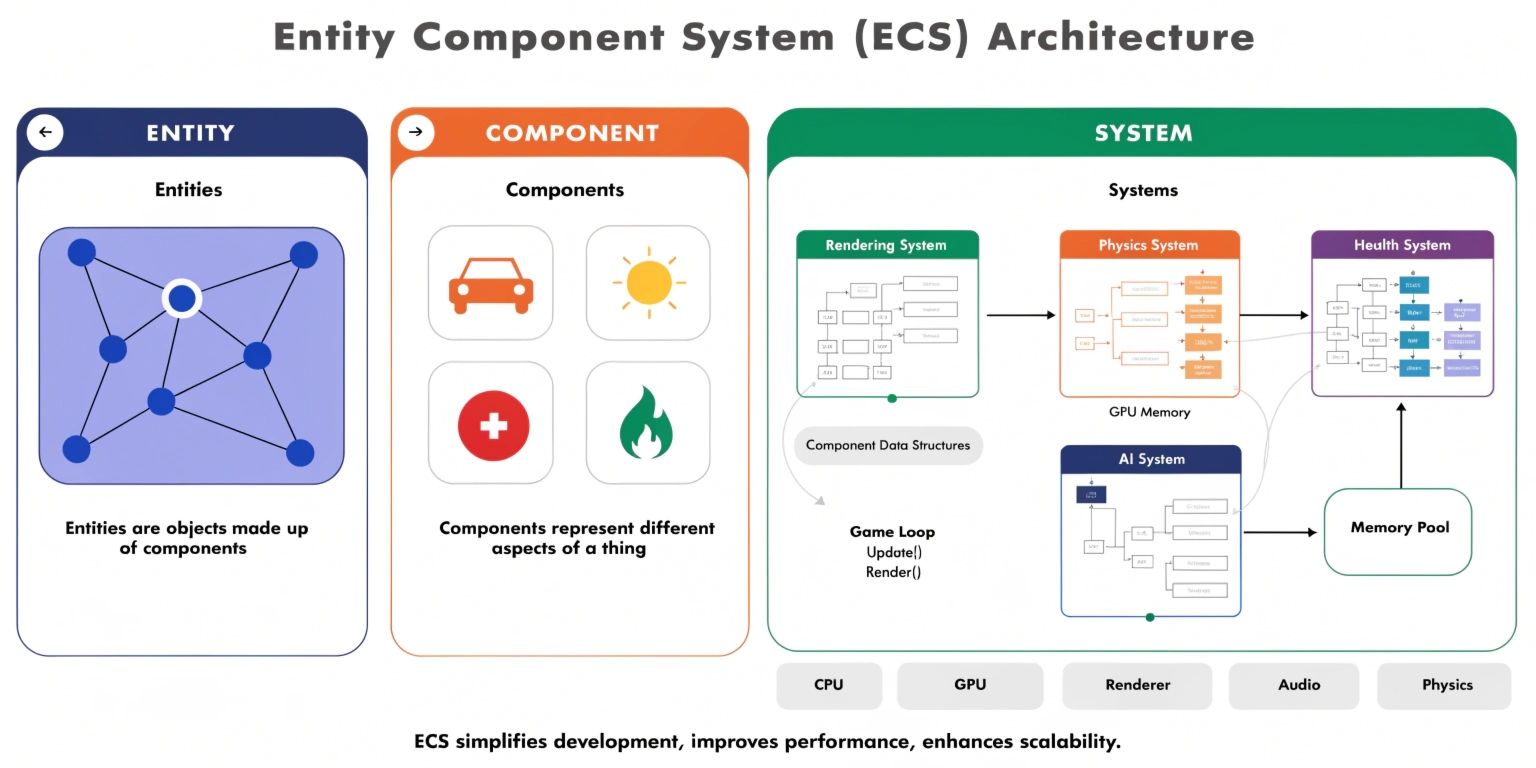
Entity Component System (ECS) is a software architectural pattern that organizes game objects into three core parts:
- Entities
- Components
- Systems
Unlike traditional object-oriented architectures where objects contain both data and behavior, ECS separates these responsibilities for improved flexibility and performance.
This approach allows developers to process large numbers of objects efficiently while maintaining clean and modular code structures.
Understanding the Core Components of ECS
1. Entities
Entities are unique identifiers representing objects in the game world.
Examples:
- Player characters
- Enemies
- Bullets
- Vehicles
- Trees
- NPCs
An entity itself contains no logic or data. It simply acts as a container that references components.
For example:
- Entity ID: 1001
- Represents: Enemy Soldier
This minimal structure keeps the system lightweight and scalable.
2. Components
Components store pure data without containing behavior or logic.
Examples of components:
- Position Component
- Velocity Component
- Health Component
- Animation Component
- Inventory Component
A Position Component may contain:
- X coordinate
- Y coordinate
- Z coordinate
A Health Component may contain:
- Current health
- Maximum health
By separating data into reusable components, developers can create highly modular systems.
3. Systems
Systems contain the logic that operates on entities with specific components.
Examples:
- Movement System
- Physics System
- Rendering System
- AI System
- Combat System
A Movement System processes all entities containing:
- Position Component
- Velocity Component
The system updates movement data every frame without needing complex inheritance hierarchies.
Why ECS Architecture Matters
High Performance
ECS follows data-oriented design principles, improving memory access patterns and CPU cache efficiency. This significantly boosts performance for large-scale applications.
Better Scalability
Games with thousands of entities can be processed more efficiently compared to traditional object-oriented systems.
Improved Modularity
Components are reusable and independent, reducing code duplication and simplifying maintenance.
Easier Parallel Processing
Systems operate independently, making ECS ideal for multithreading and modern multicore processors.
Flexible Object Composition
Developers can create new entity types by combining different components without creating deep inheritance trees.
ECS vs Traditional Object-Oriented Architecture
Traditional OOP Approach
In object-oriented systems:
- Objects contain both data and behavior
- Deep inheritance chains are common
- Memory layout becomes fragmented
- Scaling large simulations becomes difficult
Example:
- BaseCharacter
- EnemyCharacter
- FlyingEnemy
- BossEnemy
This structure often leads to rigid and hard-to-maintain codebases.
ECS Approach
In ECS:
- Data and logic are separated
- Composition replaces inheritance
- Systems process homogeneous data efficiently
- Performance is significantly improved
This makes ECS more suitable for modern real-time applications.
ECS in Modern Game Engines
Unity DOTS (Data-Oriented Technology Stack)
Unity has heavily invested in ECS through DOTS, which includes:
- ECS framework
- Burst Compiler
- Job System
Benefits:
- Massive performance improvements
- Better multithreading support
- Optimized large-scale simulations
Unity ECS is commonly used in:
- RTS games
- Multiplayer systems
- Simulation-heavy projects
Unreal Engine
While Unreal Engine primarily uses object-oriented architecture, many developers implement ECS-inspired systems for optimization and large-scale gameplay mechanics.
Custom Game Engines
AAA studios often build custom ECS frameworks tailored for:
- Open-world games
- Physics simulations
- Massive multiplayer games
Practical Example of ECS
Imagine a racing game.
Entity:
- Car Entity
Components:
- Position Component
- Speed Component
- Fuel Component
- Input Component
Systems:
- Movement System
- Fuel Consumption System
- Input Handling System
- Collision System
The same systems can process thousands of cars efficiently without specialized subclasses.
Challenges of ECS Architecture
Increased Complexity
ECS introduces a different programming mindset that may be difficult for beginners.
Debugging Difficulty
Tracing entity behavior across multiple systems can become complex.
Tooling Limitations
Some traditional debugging and editor workflows are less intuitive with ECS structures.
Learning Curve
Developers experienced in OOP may require time to adapt to data-oriented programming principles.
Best Practices for ECS Development
Keep Components Lightweight
Components should contain only data.
Avoid System Dependencies
Systems should remain independent whenever possible.
Optimize Memory Layout
Store similar component data contiguously for better cache performance.
Use Composition Over Inheritance
Build entities dynamically using reusable components.
Profile Performance Regularly
Optimization should be guided by profiling and benchmarking.
Future of ECS Architecture
As games and simulations become more complex, ECS architecture is becoming increasingly important.
Future trends include:
- AI-driven ECS optimization
- GPU-accelerated ECS processing
- Cloud-scale ECS simulations
- Integration with procedural generation systems
- Large-scale metaverse environments
ECS is also expanding beyond gaming into:
- Robotics
- Autonomous systems
- VR/AR platforms
- Scientific simulations
Conclusion
ECS (Entity Component System) architecture has transformed modern game development by providing scalable, modular, and high-performance systems for real-time applications. By separating entities, components, and systems, ECS enables developers to build flexible architectures capable of handling massive simulations and complex gameplay mechanics efficiently.
As the gaming industry moves toward larger worlds, advanced AI, and real-time multiplayer ecosystems, ECS will continue playing a central role in powering next-generation interactive experiences.