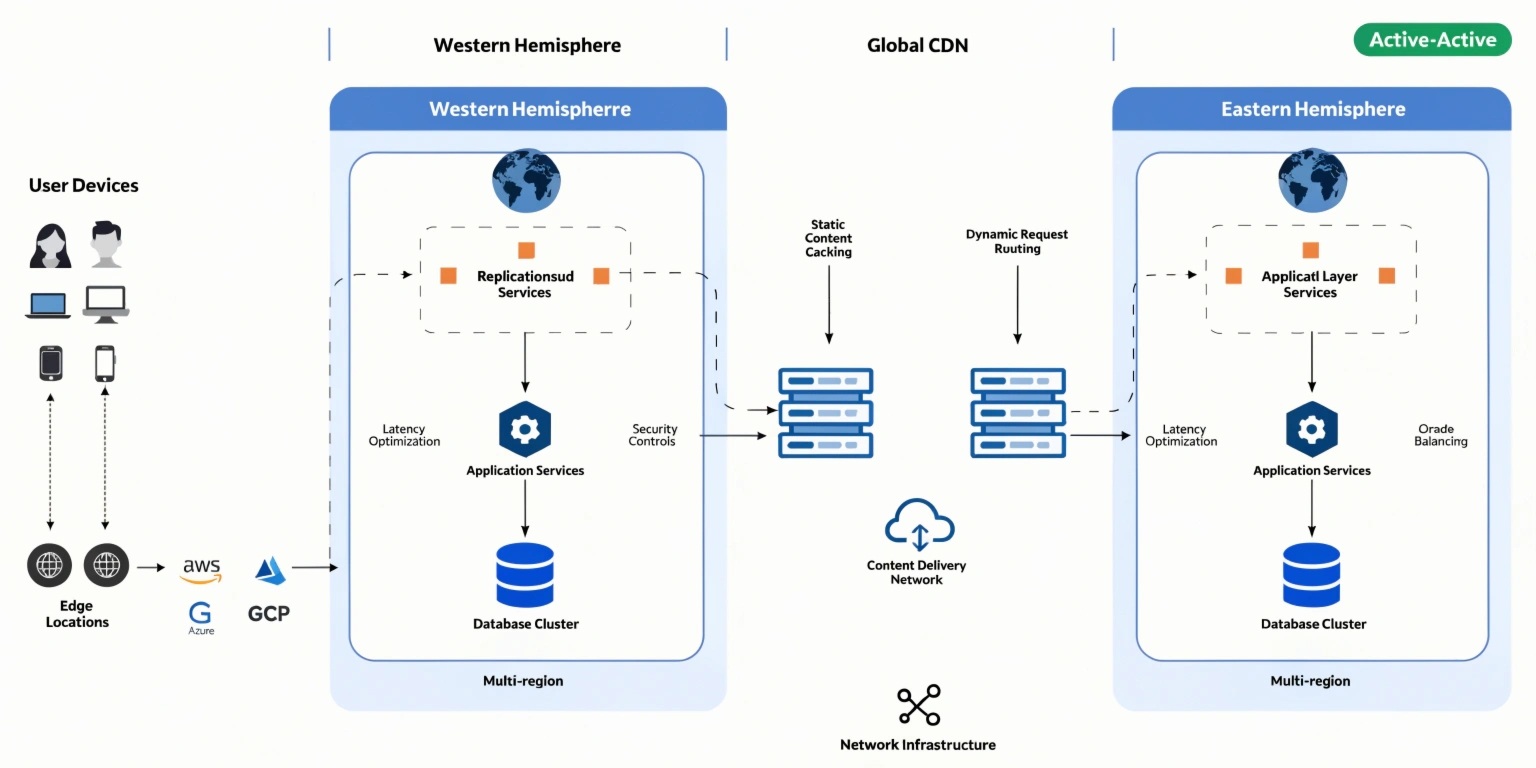
Active-active architecture enables multiple geographic regions to serve production traffic simultaneously. By combining global traffic routing, data replication, resilient infrastructure, observability, and automated failover, organizations can build highly available applications with lower latency and stronger disaster recovery capabilities.
Modern applications often serve customers across multiple countries and time zones. As global user bases grow, deploying an application in a single geographic region can introduce latency, availability, and disaster recovery risks. A regional outage could make the entire application unavailable to users.
Active-active architecture addresses this challenge by running multiple production environments simultaneously across different geographic regions. Unlike active-passive architectures, where a secondary region remains on standby, active-active systems allow multiple regions to actively serve users at the same time.
This architecture can improve availability, reduce latency, and increase resilience, but it also introduces significant challenges around data consistency, traffic management, deployment, and observability.
1. Understand the Active-Active Model
In an active-active architecture, two or more regions independently run application infrastructure and handle live production traffic.
For example:
Users → Global Traffic Manager → Region A / Region B / Region C
Each region may contain:
- Application servers
- APIs
- Databases
- Caches
- Message brokers
- Monitoring systems
- Supporting services
If one region becomes unavailable, traffic can be redirected to healthy regions.
The key advantage is that every region is already operational rather than waiting for disaster recovery activation.
2. Deploy Applications Across Multiple Regions
The first architectural requirement is deploying application infrastructure in geographically distributed locations.
Cloud platforms provide multiple regions and availability zones that can host independent application environments.
Each region should ideally be capable of handling production workloads independently.
Infrastructure-as-code tools can help maintain consistency between regions by defining infrastructure configurations programmatically.
This reduces configuration drift and makes it easier to provision or recover environments.
3. Implement Intelligent Global Traffic Routing
Global traffic management is critical to active-active architecture.
A global load balancer or traffic management layer can determine where users should be routed.
Routing strategies can include:
- Geographic routing
- Latency-based routing
- Weighted routing
- Health-based routing
- Anycast routing
For example, European users can be directed toward a European region while users in Asia can be routed to an Asian region.
Health checks should continuously verify regional availability so traffic can automatically move away from unhealthy environments.
4. Design for Data Replication
Data is one of the most difficult components of active-active architecture.
Application servers can be replicated relatively easily, but maintaining synchronized data across multiple regions requires careful architectural decisions.
Organizations may use:
- Multi-region databases
- Asynchronous replication
- Synchronous replication
- Distributed databases
- Event-driven replication
- Conflict-resolution mechanisms
The appropriate strategy depends on application requirements.
5. Choose the Right Consistency Model
Globally distributed applications must balance consistency, availability, and latency.
Strong consistency can provide accurate, immediately synchronized data but may introduce additional latency across geographic regions.
Eventual consistency can improve performance and availability but means different regions may temporarily observe different versions of data.
For example, a social media application may tolerate eventual consistency for engagement metrics, while a financial transaction system may require much stronger consistency guarantees.
The consistency model should therefore be selected according to business requirements rather than convenience.
6. Handle Data Conflicts
When multiple regions can write to the same data simultaneously, conflicts may occur.
For example, two users could update the same record from different regions at nearly the same time.
Applications may use strategies such as:
- Last-write-wins
- Version numbers
- Logical timestamps
- Application-level conflict resolution
- CRDT-based approaches
- Single-writer patterns for specific data
Conflict resolution should be designed before implementing multi-region writes.
7. Build Stateless Application Services
Stateless services make global distribution easier.
Application servers should avoid storing critical session information locally. Instead, session data can be stored in distributed data stores or represented through secure tokens.
Stateless architecture allows requests to move between regions without depending on a particular server.
This becomes especially important during regional failover.
8. Design Caching Carefully
Distributed caching can reduce database load and improve response times.
However, cache invalidation becomes more complicated across regions.
Teams should define:
- Cache ownership
- Expiration policies
- Invalidation mechanisms
- Regional cache behavior
- Consistency requirements
Not every piece of data needs global cache synchronization. Caches containing temporary or low-risk data can often operate independently within each region.
9. Implement Automated Failover
Active-active architecture should not rely on humans to manually respond to every regional failure.
Health checks and automated traffic management can detect failures and redirect users toward healthy regions.
Failover mechanisms should be tested regularly.
A system that theoretically supports failover but has never been tested may still fail during an actual incident.
10. Establish Strong Observability
Monitoring globally distributed applications requires visibility across all regions.
Organizations should monitor:
- Request latency
- Error rates
- Availability
- Database replication lag
- Traffic distribution
- Resource utilization
- Queue depth
- Cache performance
- Regional health
Centralized logs, metrics, traces, and alerting allow engineers to identify problems quickly.
Distributed tracing is particularly useful when a request crosses multiple services and geographic regions.
11. Secure Every Region
Security should be consistent across the entire global infrastructure.
Implement centralized security policies while maintaining region-specific controls where necessary.
Important considerations include:
- Encryption in transit
- Encryption at rest
- Identity and access management
- Secret management
- Network segmentation
- Web application firewalls
- DDoS protection
- Audit logging
A security weakness in one region can potentially affect the wider application environment.
12. Test Regional Failures
Resilience should be validated through controlled failure testing.
Teams can simulate:
- Regional outages
- Database failures
- Network partitions
- Increased latency
- Service degradation
- Traffic spikes
Chaos engineering and disaster recovery exercises can reveal weaknesses before real incidents occur.
Conclusion
Designing a globally distributed application with active-active architecture requires much more than deploying identical servers in multiple regions. Engineering teams must carefully design traffic routing, data replication, consistency, state management, caching, failover, security, and observability.
The architecture can provide significant benefits, including lower latency, improved availability, better disaster recovery, and greater global scalability. However, these benefits come with increased operational and architectural complexity.
The best active-active systems are designed around clear business requirements. By combining multi-region infrastructure, intelligent routing, resilient data architecture, automation, and continuous failure testing, organizations can build applications capable of serving global users reliably—even when individual regions experience major failures.
We build scalable web, mobile, and game products for clients worldwide — combining modern frameworks, cloud infrastructure, and best engineering practices.
.jpg)
.jpg)
.jpg)