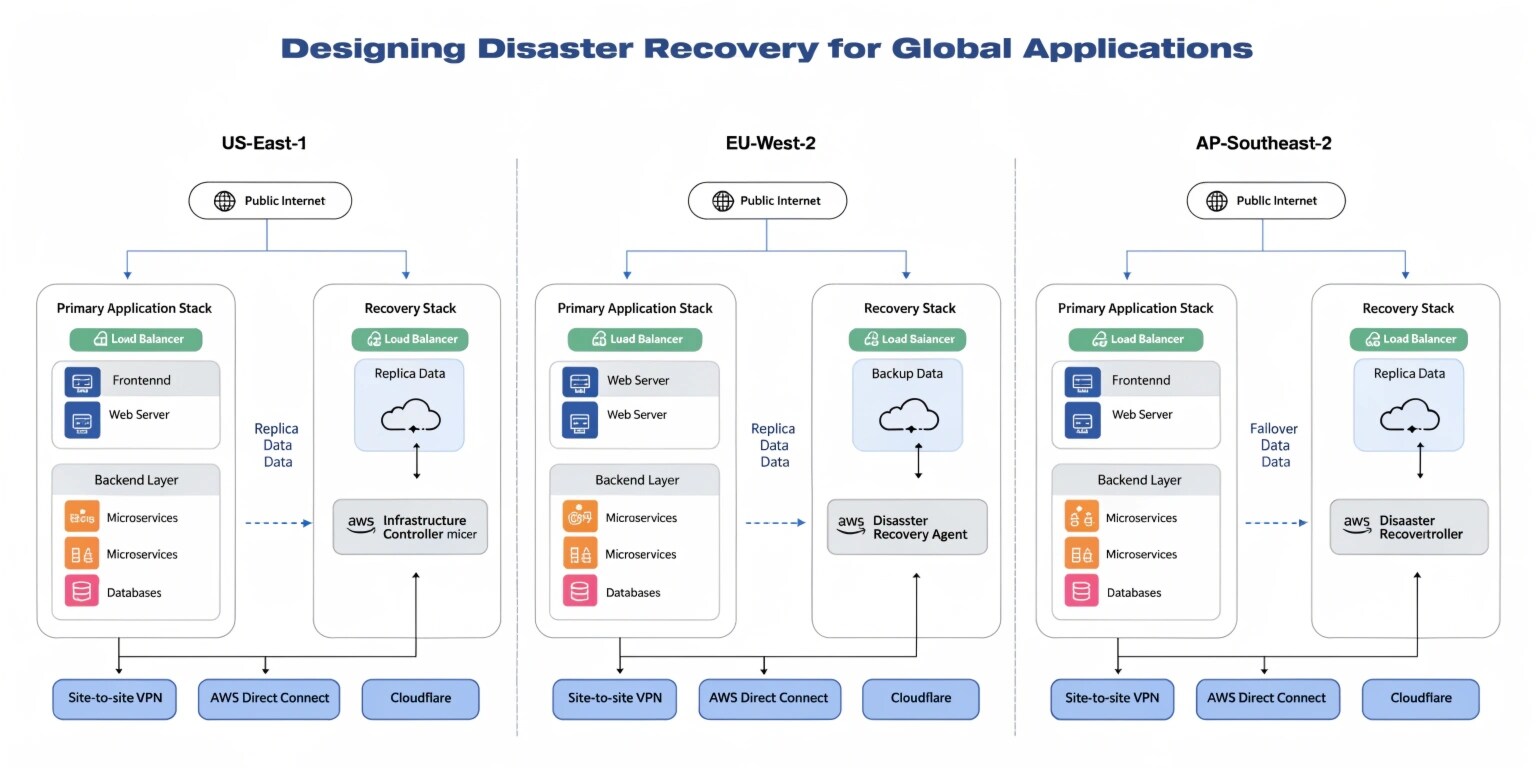
Modern applications serve millions of users across multiple continents. Businesses rely heavily on these systems to maintain continuous operations, which means downtime can lead to financial losses, damaged reputation, and poor user experience. Designing a robust disaster recovery (DR) strategy is essential for global applications to ensure that services remain available even during catastrophic failures.
Disaster recovery refers to the set of policies, tools, and procedures used to restore systems after unexpected disruptions such as server failures, natural disasters, cyberattacks, or data corruption. For globally distributed systems, DR planning must consider geographic distribution, replication strategies, and automated recovery mechanisms.
Understanding Disaster Recovery Objectives
Two key metrics guide disaster recovery planning: Recovery Time Objective (RTO) and Recovery Point Objective (RPO).
Recovery Time Objective (RTO) defines how quickly systems must be restored after an outage. For example, an application might require restoration within five minutes to avoid service disruption.
Recovery Point Objective (RPO) defines how much data loss is acceptable. If the RPO is five minutes, the system must ensure that no more than five minutes of data can be lost during recovery.
Organizations must carefully define these objectives based on the importance of the application and the potential impact of downtime.
Multi-Region Architecture
One of the most effective ways to design disaster recovery for global applications is through multi-region deployment. Instead of relying on a single data center, applications are distributed across multiple geographic regions.
If one region becomes unavailable due to infrastructure failure or natural disasters, traffic can be automatically redirected to another healthy region.
Multi-region architectures typically follow one of these models:
Active-Active Architecture:
All regions handle live traffic simultaneously. If one region fails, the others continue operating without noticeable downtime.
Active-Passive Architecture:
One region handles traffic while another remains on standby. When failure occurs, the standby region takes over operations.
Active-active models offer better availability but require more complex data synchronization strategies.
Data Replication Strategies
For disaster recovery to work effectively, data must be continuously replicated between regions.
Common replication strategies include:
Synchronous Replication
Data is written to multiple locations simultaneously. This ensures zero data loss but may introduce latency.
Asynchronous Replication
Data is first written locally and later replicated to other regions. This improves performance but may result in minimal data loss during failures.
Most global systems combine both approaches depending on data sensitivity and performance requirements.
Automated Failover Mechanisms
Manual intervention during outages increases recovery time. Automated failover mechanisms allow systems to detect failures and switch traffic to healthy regions instantly.
Failover can be implemented through several technologies:
Load Balancers monitor server health and redirect traffic when failures occur.
DNS Failover automatically routes users to alternative endpoints if the primary region becomes unavailable.
Service Mesh and Traffic Managers help manage intelligent routing across multiple infrastructure clusters.
Automation significantly reduces downtime and improves system resilience.
Backup and Snapshot Strategies
While replication protects against infrastructure failures, backups protect against data corruption, accidental deletion, or cyberattacks such as ransomware.
Effective backup strategies include:
- Automated scheduled backups
- Database snapshots
- Immutable backup storage
- Offsite backup storage
Cloud platforms allow organizations to store backups in isolated environments that remain protected even if the primary system is compromised.
Regular testing of backup recovery processes is equally important to ensure that systems can actually be restored during emergencies.
Chaos Testing and Disaster Simulations
A disaster recovery plan is only effective if it works during real incidents. Many engineering teams conduct disaster recovery drills to simulate outages and test system resilience.
Chaos engineering techniques intentionally introduce failures into production-like environments to observe system behavior.
Examples include:
- Simulating server crashes
- Blocking network connectivity
- Shutting down entire regions
These experiments reveal hidden vulnerabilities and help engineers improve recovery procedures.
Monitoring and Incident Response
Monitoring systems play a crucial role in disaster recovery. Real-time alerts help teams detect failures immediately and trigger automated responses.
Monitoring should cover:
- Application performance
- Server health
- Network latency
- Database replication status
- Error rates
In addition to monitoring tools, organizations should maintain incident response runbooks that clearly define recovery procedures and responsibilities.
Best Practices for Disaster Recovery
Organizations designing disaster recovery for global applications should follow these best practices:
- Define clear RTO and RPO goals.
- Use multi-region infrastructure to reduce single points of failure.
- Implement automated failover mechanisms.
- Maintain regular backups and secure storage.
- Test disaster recovery plans through simulations.
- Monitor system health continuously.
By combining these practices, businesses can significantly reduce downtime and protect critical services.
Conclusion
As applications scale globally, the impact of downtime becomes more severe. Designing an effective disaster recovery strategy is essential for ensuring business continuity and maintaining user trust.
Through multi-region architectures, automated failover systems, reliable backups, and continuous monitoring, organizations can build resilient platforms capable of surviving unexpected failures. Disaster recovery is not just a technical requirement—it is a core component of modern software architecture that enables applications to operate reliably in an unpredictable world.