Main Content
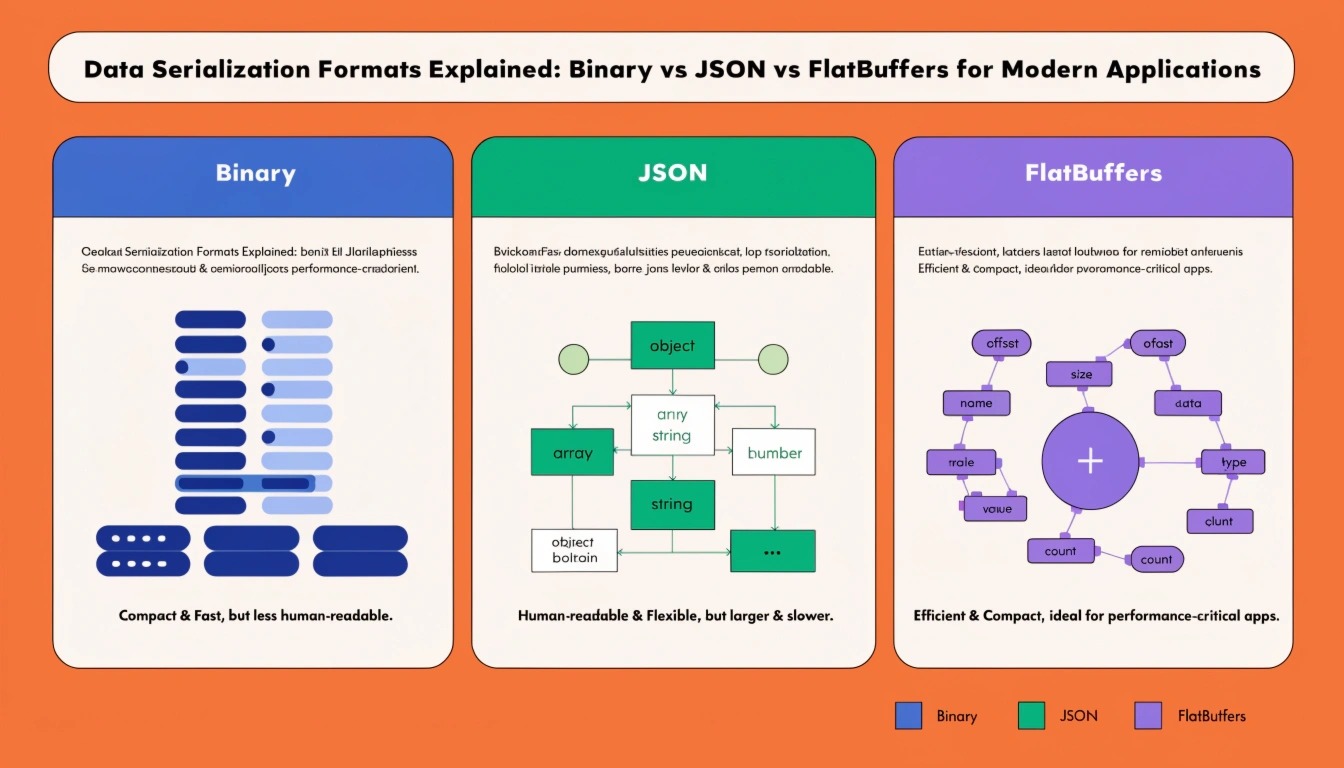
Data Serialization Formats Explained: Binary vs JSON vs FlatBuffers
Modern applications constantly exchange data between servers, databases, APIs, and devices. To transfer this information efficiently, developers rely on data serialization formats. Serialization transforms structured data into a format that can be stored or transmitted and later reconstructed.
Three popular serialization methods are JSON, Binary serialization, and FlatBuffers. Each has unique strengths and trade-offs depending on the application's requirements.
What is JSON?
JSON (JavaScript Object Notation) is a lightweight, text-based format that is easy for humans to read and machines to parse. It has become the standard format for REST APIs and web services.
Advantages of JSON
- Human-readable and easy to debug.
- Supported by virtually every programming language.
- Simple integration with web browsers and APIs.
- Flexible structure with minimal configuration.
Disadvantages of JSON
- Larger file size compared to binary formats.
- Requires parsing before data can be accessed.
- Slower performance for high-frequency data processing.
- Increased memory consumption.
Common Use Cases
- REST APIs
- Web applications
- Configuration files
- Data exchange between services
What is Binary Serialization?
Binary serialization stores information in a compact binary representation instead of plain text. Examples include Protocol Buffers, MessagePack, BSON, and custom binary formats.
Advantages of Binary Formats
- Smaller payload sizes.
- Faster transmission over networks.
- Better storage efficiency.
- Reduced bandwidth usage.
Disadvantages
- Not human-readable.
- More difficult to debug.
- Often requires additional libraries or schemas.
Common Applications
- Distributed systems
- Cloud services
- IoT devices
- Database storage engines
What are FlatBuffers?
FlatBuffers is Google's high-performance serialization library designed for speed and memory efficiency. Unlike JSON, FlatBuffers allows applications to access serialized data directly without unpacking or parsing it.
Key Benefits of FlatBuffers
1. Zero-Copy Access
Data can be read directly from memory without deserialization, significantly improving performance.
2. Faster Execution
FlatBuffers eliminate parsing overhead, making them ideal for latency-sensitive applications.
3. Reduced Memory Usage
The format minimizes memory allocation, improving scalability.
4. Cross-Platform Support
FlatBuffers support multiple programming languages including:
- C++
- Java
- Python
- Go
- Rust
- C#
- JavaScript
Typical Use Cases
- Game development
- Real-time systems
- Mobile applications
- Machine learning frameworks
- Graphics engines
- AR and VR applications
Comparing JSON, Binary, and FlatBuffers
FeatureJSONBinary FormatFlatBuffersHuman ReadableYesNoNoFile SizeLargeSmallVery SmallParsing RequiredYesYesNoPerformanceModerateHighVery HighMemory EfficiencyLowHighExcellentDebuggingEasyModerateModerateNetwork SpeedModerateFastVery FastBest ForAPIs and Web AppsDistributed SystemsReal-Time Applications
Which Format Should You Choose?
Choose JSON When:
- Building REST APIs.
- Human readability is important.
- Development speed matters more than maximum performance.
- Data structures change frequently.
Choose Binary Formats When:
- Reducing bandwidth consumption.
- Optimizing storage.
- Building microservices and cloud systems.
Choose FlatBuffers When:
- Low latency is critical.
- Creating high-performance games.
- Developing real-time applications.
- Memory efficiency is essential.
- Handling large datasets or streaming data.
Future of Data Serialization
As applications become more distributed and performance-oriented, efficient serialization methods are increasingly important. Technologies such as FlatBuffers and Protocol Buffers are gaining popularity in cloud computing, AI systems, IoT devices, and game engines where speed and low memory usage are critical.
Meanwhile, JSON remains the dominant choice for web APIs because of its simplicity and universal support. Rather than replacing one another, these formats complement different architectural needs.
Conclusion
Data serialization plays a fundamental role in modern software development. JSON provides simplicity and interoperability, binary formats offer compact storage and faster communication, while FlatBuffers deliver exceptional performance with zero-copy access. Choosing the right serialization format depends on your application's speed requirements, memory constraints, and development priorities. Understanding these differences enables developers to design scalable and efficient systems for the future.