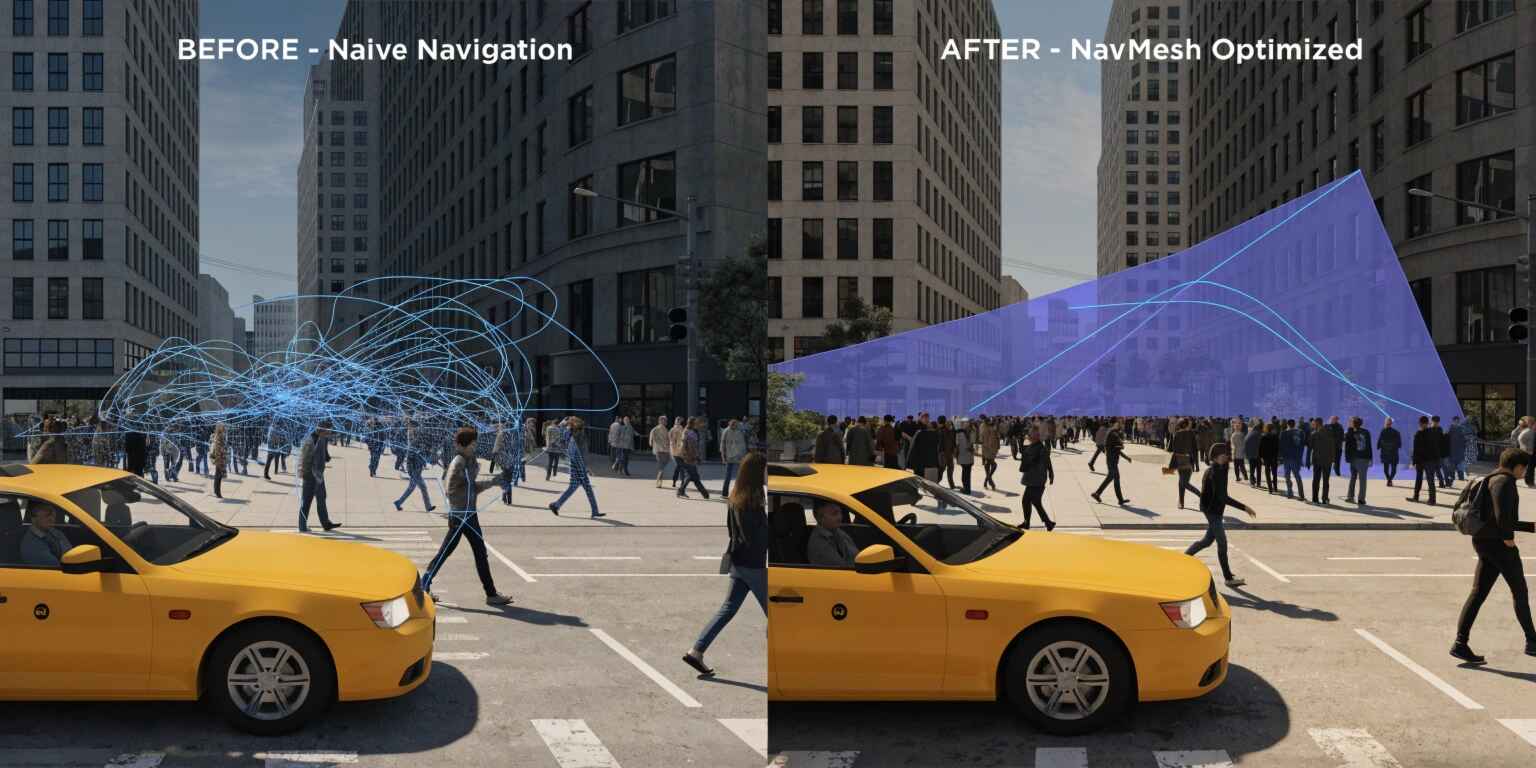
Modern video games aim to create immersive worlds filled with dynamic characters and environments. One of the biggest challenges in game development is simulating large crowds of non-player characters (NPCs) that move naturally and respond to their surroundings. Whether it is a busy city street, a stadium crowd, or an army of characters in a strategy game, efficient crowd simulation is essential.
A widely used technique for managing large numbers of AI agents is Navigation Mesh (NavMesh) optimization. NavMesh-based systems allow characters to navigate complex environments while maintaining performance and realism.
This article explores how crowd simulation works using NavMesh optimization and how developers implement it in modern game engines.
Understanding Crowd Simulation
Crowd simulation refers to the process of controlling multiple AI agents moving simultaneously in a shared environment. Each character must navigate obstacles, avoid collisions with other characters, and reach its destination smoothly.
Traditional pathfinding algorithms like A* can work well for individual characters, but when hundreds or thousands of agents are involved, performance becomes a major concern.
Without optimization, the CPU must constantly recalculate paths for every agent, leading to frame drops and performance issues.
This is where NavMesh optimization becomes essential.
What is NavMesh?
A Navigation Mesh (NavMesh) is a simplified representation of the walkable areas in a game environment. Instead of calculating movement on every surface polygon, developers divide the map into navigable regions.
Each region represents a space where AI agents can move freely.
NavMesh provides several benefits:
- Efficient pathfinding
- Reduced computational cost
- Improved AI navigation accuracy
- Better obstacle handling
By using NavMesh, AI agents can calculate optimal paths while avoiding walls, barriers, and other obstacles.
How NavMesh Works in Crowd Simulation
In crowd simulation, each AI agent uses the NavMesh to determine its movement path. The system calculates a path from the character’s current position to its target location using graph-based navigation.
However, when many agents share the same space, additional logic is required to prevent collisions and unnatural movement.
Key components include:
Pathfinding
AI agents compute the shortest path across the NavMesh using algorithms such as A*.
Local Avoidance
Agents adjust their movement in real time to avoid colliding with nearby characters.
Dynamic Obstacle Handling
Objects such as moving vehicles or temporary barriers can update the NavMesh dynamically.
Agent Steering
Steering behaviors allow characters to smoothly change direction instead of making sudden turns.
Together, these techniques create believable crowd behavior.
NavMesh Optimization Techniques
Efficient crowd simulation requires several optimization strategies to maintain performance in large environments.
1. NavMesh Simplification
Large maps often contain thousands of polygons. Simplifying the NavMesh reduces unnecessary complexity and improves pathfinding speed.
Developers remove small triangles and merge regions to create a cleaner navigation structure.
2. Hierarchical Pathfinding
Instead of calculating detailed paths for every movement, hierarchical navigation divides the map into large regions.
Agents first determine a high-level route and then calculate detailed movement within smaller zones.
This dramatically reduces computational overhead.
3. Agent Grouping
When multiple characters move toward the same destination, developers can group them together.
Instead of calculating separate paths for each agent, the system calculates a shared path and applies minor adjustments to individual characters.
This technique is commonly used in strategy games and large battle simulations.
4. Local Avoidance Algorithms
Local avoidance prevents agents from colliding with each other.
One common approach is Reciprocal Velocity Obstacles (RVO), which allows agents to predict potential collisions and adjust their movement accordingly.
This produces smooth crowd flow in dense environments such as marketplaces or train stations.
5. Level-of-Detail (LOD) for AI
Just like graphical LOD systems reduce rendering load, AI LOD systems reduce the complexity of distant agents.
For example:
- Characters near the player use full AI simulation
- Distant characters use simplified movement logic
- Very far characters may switch to animation-only movement
This technique helps maintain high performance even when thousands of agents exist in the scene.
Real-World Game Examples
Many modern games rely heavily on crowd simulation systems powered by NavMesh optimization.
Open-world games simulate busy cities with pedestrians navigating streets.
Sports games simulate audiences in stadiums.
Strategy games manage large armies moving across battlefields.
Game engines like Unity and Unreal Engine include built-in NavMesh systems that help developers implement these features efficiently.
Challenges in Crowd Simulation
Despite its advantages, crowd simulation still presents several technical challenges.
Large numbers of AI agents can still strain CPU resources if poorly optimized. Developers must carefully balance realism and performance.
Additionally, designing believable human-like movement requires sophisticated steering behaviors and animation blending.
Debugging pathfinding errors can also be complex, especially in dynamic environments where obstacles constantly change.
Conclusion
Crowd simulation is a crucial component of modern game development. Without efficient AI navigation systems, creating realistic and interactive environments would be nearly impossible.
NavMesh optimization provides a powerful solution by simplifying navigation data, improving pathfinding performance, and enabling large-scale AI movement.
By combining NavMesh systems with techniques like hierarchical pathfinding, local avoidance, and AI level-of-detail optimization, developers can create dynamic worlds filled with lifelike characters while maintaining smooth gameplay performance.