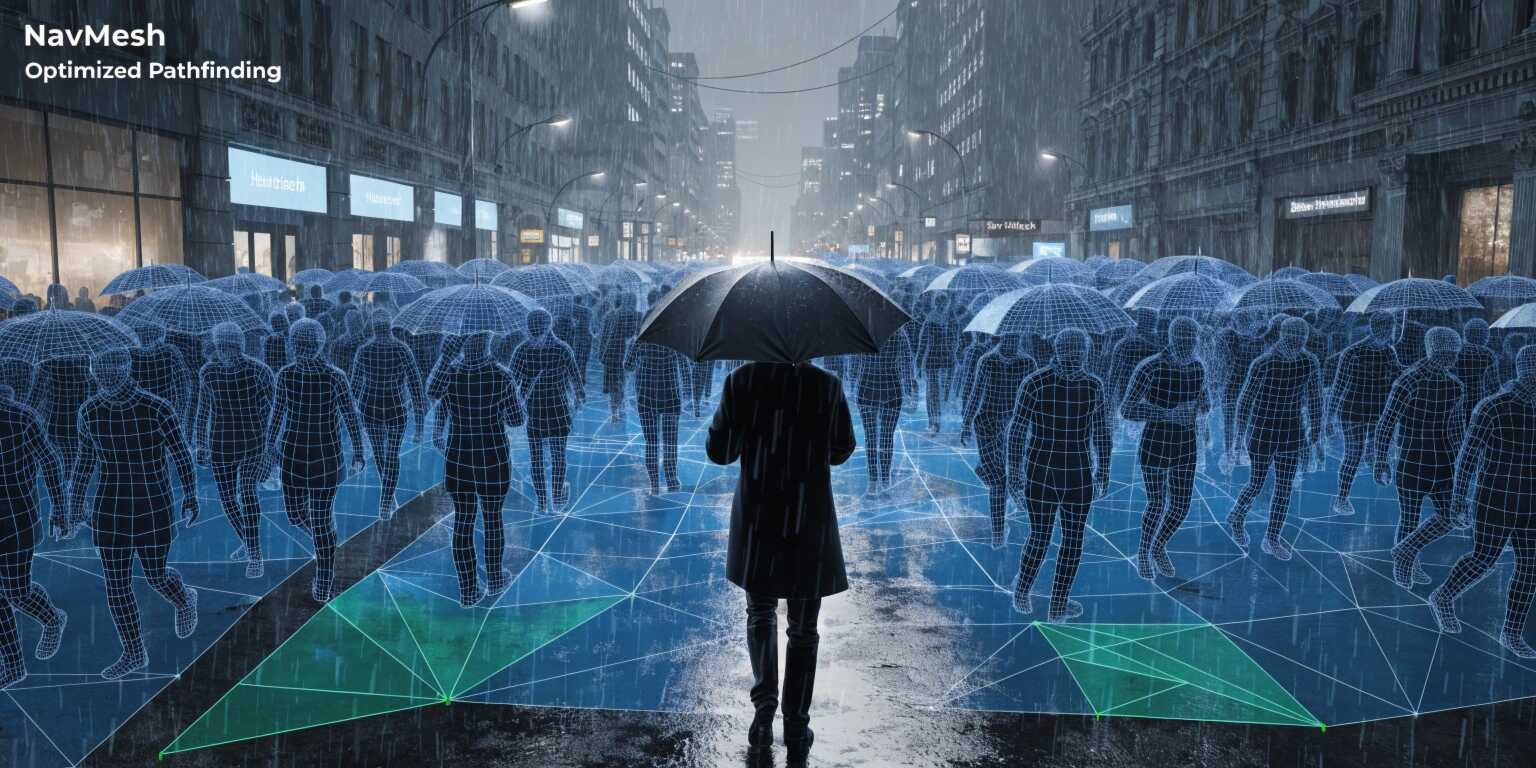
Creating realistic crowd behavior is one of the most challenging aspects of modern game development and simulation systems. Whether it's pedestrians in an open-world game, NPCs in a strategy game, or agents in a virtual training environment, managing large numbers of entities moving intelligently requires efficient algorithms and optimization techniques. One of the most widely used solutions is NavMesh (Navigation Mesh), which, when optimized correctly, enables scalable and realistic crowd simulation.
What is NavMesh?
A Navigation Mesh, or NavMesh, is a data structure used in game development to define walkable areas in a virtual environment. Instead of calculating movement across every possible surface, NavMesh simplifies the world into polygons that represent traversable zones. AI agents use this mesh to determine the most efficient path from one point to another.
NavMesh-based pathfinding is preferred over grid-based systems because it produces more natural movement and reduces computational overhead.
Importance of Crowd Simulation
Crowd simulation involves controlling multiple agents simultaneously while ensuring they behave realistically and avoid collisions. This is essential in:
- Open-world games with populated cities
- Simulation and training environments
- Virtual reality experiences
- Strategy and RTS games
Without proper optimization, managing hundreds or thousands of agents can quickly overwhelm system resources, leading to performance issues.
Challenges in Crowd Simulation
Implementing crowd simulation comes with several challenges:
- High computational cost: Pathfinding for multiple agents simultaneously can be expensive.
- Collision avoidance: Agents must navigate without overlapping or colliding unnaturally.
- Dynamic environments: Obstacles and terrain may change in real time.
- Scalability: Systems must handle increasing numbers of agents efficiently.
This is where NavMesh optimization plays a crucial role.
Key NavMesh Optimization Techniques
1. NavMesh Baking Optimization
Efficient NavMesh baking reduces unnecessary polygons and simplifies navigation data. Adjusting parameters like agent radius, height, and step height ensures optimal mesh generation.
2. Hierarchical Pathfinding
Instead of calculating paths across the entire NavMesh, divide it into smaller regions. Agents first determine a high-level path, then refine it locally. This significantly reduces computation time.
3. Local Avoidance Systems
Implement algorithms like Reciprocal Velocity Obstacles (RVO) to enable agents to avoid each other dynamically. This ensures smooth and realistic movement in crowded environments.
4. Dynamic Obstacle Handling
Use dynamic NavMesh updates or obstacle carving to adapt to changes in the environment. This is essential for interactive and real-time simulations.
5. Agent Grouping
Group nearby agents and process them collectively instead of individually. This reduces redundant calculations and improves performance.
6. Level of Detail (LOD) for AI
Apply different levels of simulation detail based on distance from the player. Agents far away can use simplified logic, conserving resources.
Benefits of NavMesh Optimization
Optimizing NavMesh for crowd simulation offers several advantages:
- Improved Performance: Reduced CPU usage allows more agents to be simulated.
- Realistic Movement: Smooth navigation enhances immersion.
- Scalability: Systems can handle larger crowds efficiently.
- Better User Experience: Stable frame rates and responsive AI behavior improve gameplay quality.
Tools and Engines Supporting NavMesh
Popular game engines provide built-in support for NavMesh systems:
- Unity: Offers NavMesh components with real-time updates and agent control.
- Unreal Engine: Provides advanced AI tools including NavMesh, behavior trees, and crowd managers.
These engines also include debugging tools to visualize NavMesh and optimize performance effectively.
Best Practices for Implementation
To achieve optimal results in crowd simulation, developers should follow these best practices:
- Design environments with navigation in mind
- Minimize unnecessary NavMesh complexity
- Use efficient pathfinding algorithms
- Test with large numbers of agents early in development
- Continuously profile and optimize performance
Future of Crowd Simulation
As technology advances, crowd simulation is becoming more sophisticated. Integration with machine learning and AI behavior models is enabling agents to make smarter decisions and adapt to complex scenarios.
Additionally, GPU-based simulations and parallel processing are opening new possibilities for handling massive crowds in real time. These innovations will further enhance realism and scalability in games and simulations.
Conclusion
Crowd simulation is a critical component of immersive digital experiences, and NavMesh optimization is key to making it efficient and scalable. By leveraging optimized navigation meshes, developers can create realistic AI movement while maintaining high performance.
Whether you're building a large-scale open-world game or a simulation environment, mastering NavMesh optimization techniques will help you deliver smoother, smarter, and more engaging experiences.