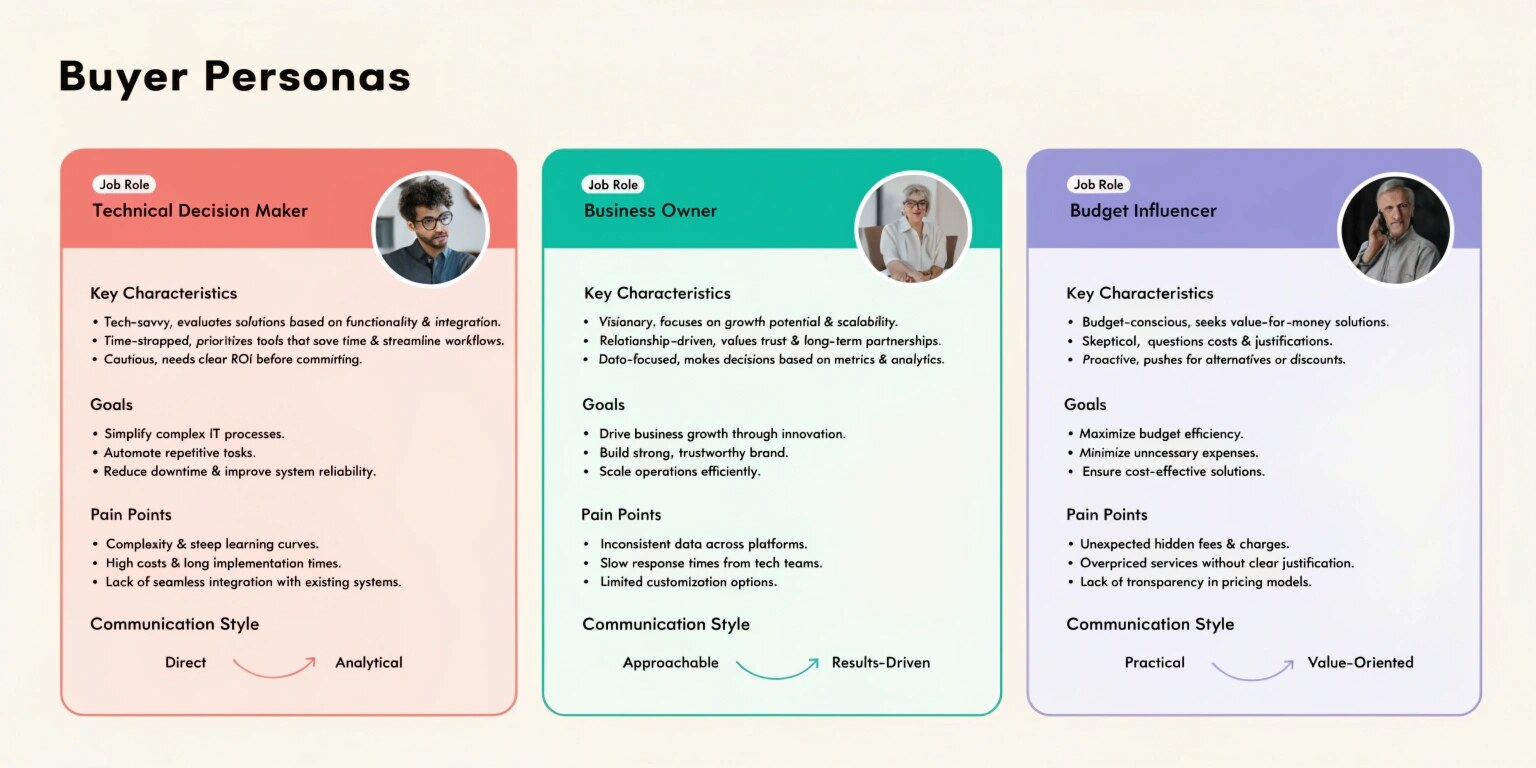
Buyer personas help software companies understand their ideal customers, personalize marketing efforts, and improve sales conversions. Learn how to build data-driven personas that align your services with client needs and drive sustainable business growth.
Creating Buyer Personas for Software Services
In today's highly competitive software industry, offering exceptional services alone is not enough. Whether your company develops web applications, mobile apps, AI solutions, enterprise software, or cloud platforms, understanding your target audience is essential for successful marketing and sales.
One of the most effective ways to understand potential clients is by creating buyer personas. Buyer personas are detailed representations of your ideal customers based on market research, customer data, and real-world insights. They help software companies tailor messaging, improve lead generation, and deliver solutions that directly address customer needs.
This guide explains why buyer personas matter, how to create them, and how they contribute to long-term business growth.
What Is a Buyer Persona?
A buyer persona is a semi-fictional profile of your ideal customer that represents a specific type of buyer.
Rather than marketing to everyone, businesses create targeted personas that reflect:
- Professional background
- Industry
- Company size
- Business objectives
- Pain points
- Budget
- Decision-making authority
- Preferred communication channels
- Buying behavior
- Technology preferences
For software service providers, buyer personas help identify organizations most likely to purchase custom software solutions.
Why Buyer Personas Matter
Without clearly defined buyer personas, marketing campaigns often become too broad and fail to connect with the right audience.
Well-developed personas help businesses:
- Improve lead quality
- Increase marketing ROI
- Shorten sales cycles
- Personalize communication
- Create relevant content
- Enhance customer experience
- Improve product positioning
- Increase conversion rates
When every department understands the target customer, business decisions become more focused and effective.
Step 1: Analyze Existing Customers
The best buyer personas begin with your current clients.
Review information such as:
- Industry
- Company size
- Geographic location
- Annual revenue
- Technology stack
- Purchased services
- Project budget
- Business goals
Look for patterns among your most successful and profitable customers.
For example, you may discover that mid-sized healthcare companies frequently request custom CRM systems, while eCommerce businesses often seek scalable cloud solutions.
Step 2: Identify Decision Makers
Software purchases usually involve multiple stakeholders.
Common decision makers include:
- CEOs
- CTOs
- CIOs
- Product Managers
- Operations Managers
- IT Managers
- Procurement Teams
- Startup Founders
Understanding who influences purchasing decisions helps create more effective marketing campaigns.
Each stakeholder has different priorities.
For example:
A CTO focuses on scalability and security.
A CEO is more interested in business growth and return on investment.
Step 3: Understand Customer Goals
Every software investment aims to solve a business problem.
Common goals include:
- Automating workflows
- Increasing productivity
- Reducing operational costs
- Improving customer experience
- Enhancing security
- Scaling business operations
- Integrating existing systems
- Accelerating digital transformation
Your buyer persona should clearly define these objectives.
Step 4: Identify Pain Points
Understanding customer challenges enables software companies to position their services as solutions.
Common pain points include:
- Legacy systems
- Manual processes
- Poor software performance
- Security vulnerabilities
- Lack of scalability
- High maintenance costs
- Slow development cycles
- Limited technical expertise
The more specific the pain point, the more compelling your messaging becomes.
Step 5: Map the Buying Journey
Customers rarely purchase software immediately.
Typical buying stages include:
Awareness
The customer recognizes a problem.
Example:
"Our manual inventory system is slowing operations."
Consideration
They begin researching software providers and comparing solutions.
Activities may include:
- Reading blogs
- Downloading whitepapers
- Attending webinars
- Comparing vendors
- Requesting demos
Decision
The customer evaluates proposals, pricing, and technical capabilities before selecting a software partner.
Understanding this journey allows you to provide relevant content at every stage.
Step 6: Define Communication Preferences
Different buyers consume information differently.
Some prefer:
- LinkedIn articles
- Email newsletters
- Video demonstrations
- Technical documentation
- Case studies
- Webinars
- Product demos
Knowing where your audience spends time helps maximize marketing effectiveness.
Step 7: Build Detailed Persona Profiles
An effective buyer persona includes:
Name
Sarah – Operations Director
Industry
Healthcare
Company Size
250 employees
Goals
- Automate operations
- Improve reporting
- Increase efficiency
Challenges
- Outdated software
- Data silos
- Limited integrations
Budget
Medium to high
Decision Factors
- Security
- Reliability
- Vendor expertise
- Long-term support
Preferred Content
- Case studies
- Product demos
- ROI calculators
This profile helps marketing and sales teams create highly targeted campaigns.
Using Buyer Personas Across Departments
Buyer personas are valuable beyond marketing.
Marketing
- Personalized campaigns
- Better SEO targeting
- Relevant blog content
- Improved advertising
Sales
- Customized proposals
- Better qualification
- Stronger presentations
- Faster conversions
Product Development
- Feature prioritization
- User-centered design
- Better roadmap planning
Customer Success
- Personalized onboarding
- Better support experiences
- Improved retention strategies
Cross-functional use of personas ensures a consistent customer experience.
Common Mistakes to Avoid
Many businesses make these errors when creating buyer personas:
- Relying on assumptions instead of data
- Creating too many personas
- Ignoring customer feedback
- Failing to update personas regularly
- Overlooking negative personas (customers who are not a good fit)
Regularly reviewing personas ensures they remain aligned with changing market conditions.
Measuring Success
Evaluate the effectiveness of buyer personas using metrics such as:
- Website conversion rate
- Qualified lead volume
- Customer acquisition cost
- Sales cycle duration
- Proposal win rate
- Customer retention
- Marketing engagement
- Revenue growth
These insights help refine personas over time and improve overall business performance.
Future of Buyer Personas
Artificial intelligence and advanced analytics are transforming persona development.
Emerging trends include:
- AI-generated customer insights
- Predictive lead scoring
- Behavioral segmentation
- Intent-based marketing
- Dynamic personas that update in real time
- CRM-driven personalization
- Automated customer journey mapping
These innovations enable software companies to deliver increasingly personalized experiences that resonate with modern buyers.
Conclusion
Creating buyer personas is one of the most valuable investments a software services company can make. By understanding your ideal clients’ goals, challenges, decision-making processes, and purchasing behaviors, you can craft targeted marketing campaigns, improve sales conversations, and build software solutions that genuinely solve business problems. As markets evolve, regularly updating your buyer personas with real customer data ensures your marketing and sales strategies remain relevant, helping your business attract qualified leads, strengthen client relationships, and achieve sustainable growth.
We build scalable web, mobile, and game products for clients worldwide — combining modern frameworks, cloud infrastructure, and best engineering practices.
.jpg)
.jpg)
.jpg)