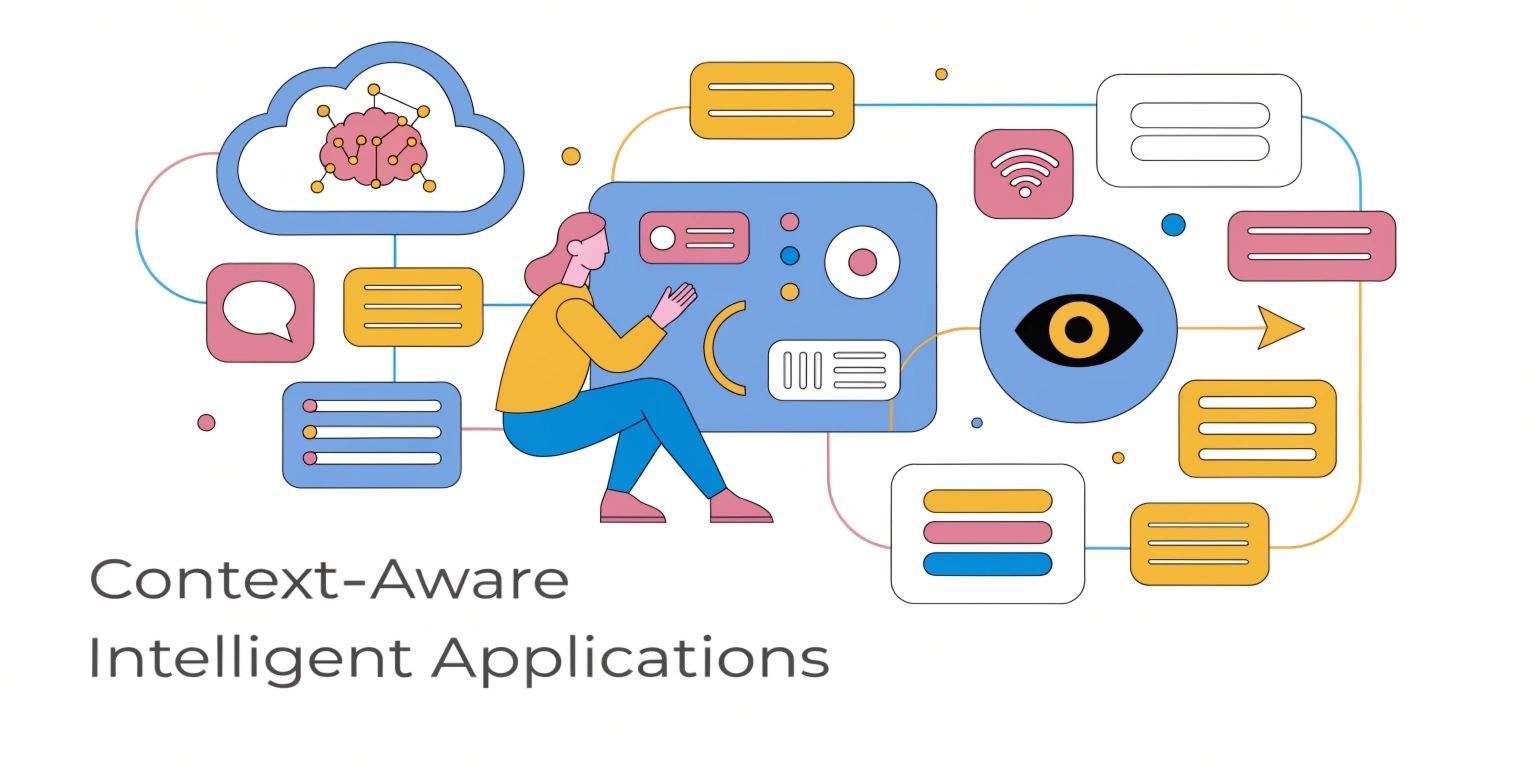
Context-aware intelligent applications use AI, machine learning, and real-time contextual data to adapt experiences based on user behavior, location, preferences, and environment. These applications are transforming customer engagement, automation, and digital experiences.
As digital technology continues to evolve, users increasingly expect applications to understand their needs, preferences, and situations without requiring constant input. Traditional applications operate based on predefined rules and user commands, but modern users demand experiences that feel intuitive, adaptive, and personalized.
This growing expectation has led to the rise of Context-Aware Intelligent Applications—software systems capable of understanding their environment, interpreting user behavior, and making intelligent decisions in real time. Powered by Artificial Intelligence (AI), Machine Learning (ML), cloud computing, and IoT technologies, these applications are transforming how businesses engage with customers and optimize operations.
What Are Context-Aware Intelligent Applications?
Context-aware intelligent applications are software systems that gather and analyze contextual information such as user location, device type, activity, preferences, behavior patterns, time of day, and environmental conditions. Based on this information, they dynamically adjust their functionality, content, or recommendations to provide a more relevant user experience.
Unlike traditional applications that respond only to direct commands, intelligent applications proactively anticipate user needs and deliver personalized interactions.
For example:
- Navigation apps suggest alternative routes based on traffic conditions.
- Streaming platforms recommend content based on viewing history.
- E-commerce applications display personalized product suggestions.
- Smart home systems adjust lighting and temperature automatically.
These applications continuously learn and improve through user interactions and data analysis.
Core Components of Context-Aware Applications
Several technologies work together to create intelligent contextual experiences.
Data Collection
Context-aware systems gather information from multiple sources, including:
- User profiles
- Mobile devices
- GPS location services
- IoT sensors
- Browsing history
- Social interactions
- Device usage patterns
The more relevant data collected, the more accurate the application's decision-making becomes.
Artificial Intelligence and Machine Learning
AI algorithms process large volumes of contextual data and identify meaningful patterns.
Machine learning models help applications:
- Predict user preferences
- Recommend actions
- Personalize content
- Detect anomalies
- Improve decision-making over time
Real-Time Processing
Modern intelligent applications require immediate responses. Real-time analytics platforms process incoming data streams and generate contextual insights within milliseconds.
Decision Engines
Decision engines evaluate contextual information and determine the most appropriate action based on predefined business rules and AI-driven predictions.
Benefits of Context-Aware Intelligent Applications
Organizations across industries are investing heavily in intelligent applications because of the significant advantages they provide.
Enhanced User Experience
Personalized experiences increase user satisfaction and engagement. Applications become more useful when they understand user intentions and preferences.
Increased Customer Retention
Users are more likely to continue using applications that consistently deliver relevant recommendations and seamless interactions.
Improved Operational Efficiency
Businesses can automate repetitive tasks and optimize workflows through intelligent decision-making systems.
Better Data Utilization
Context-aware applications convert raw data into actionable insights, helping organizations make informed decisions.
Competitive Advantage
Companies that deliver personalized experiences often outperform competitors by creating stronger customer relationships.
Real-World Applications
Healthcare
Healthcare providers use intelligent applications to monitor patient conditions, recommend treatments, and alert medical staff to potential health risks.
Wearable devices continuously collect patient data and provide real-time health insights.
E-Commerce
Online retailers leverage contextual data to personalize shopping experiences.
Examples include:
- Product recommendations
- Dynamic pricing
- Personalized promotions
- Smart search functionality
These features increase conversion rates and customer satisfaction.
Smart Cities
Municipalities deploy intelligent systems to improve urban services through:
- Traffic management
- Energy optimization
- Public safety monitoring
- Waste management automation
Financial Services
Banks and financial institutions use contextual intelligence to:
- Detect fraud
- Assess risk
- Offer personalized financial products
- Improve customer support
Mobile Applications
Modern mobile applications frequently use context-awareness through location-based services, behavioral analytics, and predictive recommendations.
Examples include ride-sharing apps, food delivery platforms, and travel applications.
Challenges in Developing Context-Aware Applications
Despite their advantages, building intelligent applications presents several challenges.
Data Privacy Concerns
Collecting user data raises privacy and compliance issues. Organizations must ensure transparency and comply with regulations such as GDPR and CCPA.
Data Accuracy
Incorrect or incomplete contextual data can lead to poor recommendations and user frustration.
Integration Complexity
Combining data from multiple sources, devices, and platforms requires sophisticated integration architectures.
Scalability
As user bases grow, applications must process increasing volumes of contextual data while maintaining performance.
Security Risks
Sensitive contextual information must be protected through encryption, authentication, and access controls.
Emerging Technologies Driving Context Awareness
Several technological advancements are accelerating the development of intelligent applications.
Edge Computing
Processing data closer to the source reduces latency and enables faster contextual decision-making.
Internet of Things (IoT)
Connected devices continuously generate valuable contextual information that enhances application intelligence.
Generative AI
Large Language Models (LLMs) and generative AI systems improve contextual understanding and natural interactions.
Predictive Analytics
Advanced analytics helps organizations anticipate user behavior before actions occur.
Digital Twins
Virtual representations of physical systems enable more accurate contextual modeling and decision-making.
The Future of Context-Aware Applications
The future of software development is moving toward hyper-personalized digital experiences. Applications will increasingly understand not only user actions but also intentions, emotions, and situational context.
Future advancements may include:
- Emotion-aware AI systems
- Autonomous decision-making applications
- Intelligent virtual assistants
- Predictive customer engagement platforms
- Industry-specific contextual AI solutions
As AI technologies mature, context-aware applications will become more adaptive, proactive, and capable of delivering highly personalized experiences across every industry.
Conclusion
Context-aware intelligent applications represent a significant shift from reactive software to proactive digital experiences. By leveraging AI, machine learning, real-time analytics, and contextual data, organizations can create applications that understand users and respond intelligently to changing situations.
As businesses continue their digital transformation journeys, context-aware systems will play a critical role in improving customer engagement, operational efficiency, and innovation. Organizations that embrace this technology today will be better positioned to meet the expectations of tomorrow's connected and data-driven world.
We build scalable web, mobile, and game products for clients worldwide — combining modern frameworks, cloud infrastructure, and best engineering practices.
.jpg)
.jpg)
.jpg)