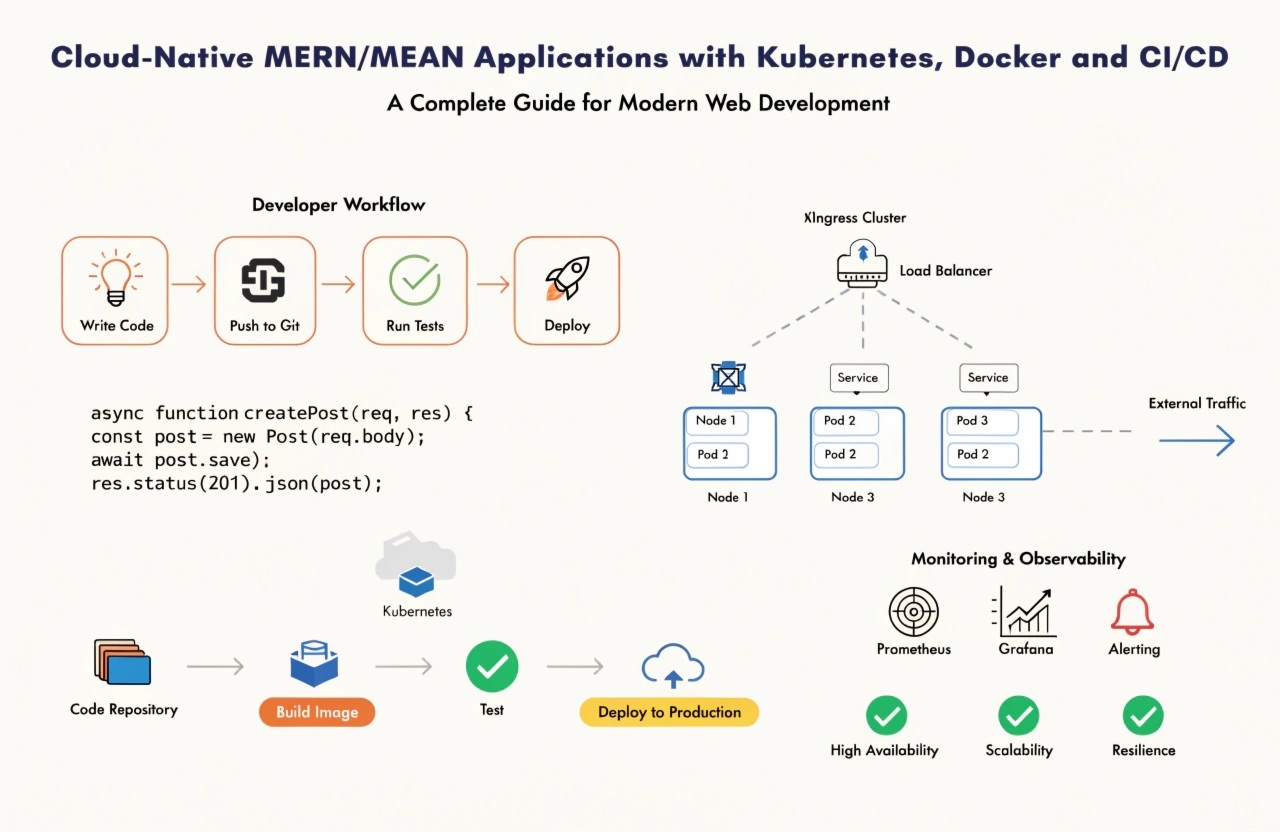
Discover how Docker, Kubernetes, and CI/CD transform MERN and MEAN applications into scalable, automated, resilient, and cloud-ready solutions for modern businesses.
Introduction
Modern businesses need web applications that can handle changing traffic, frequent updates, and growing customer demands without sacrificing performance or reliability. Traditional application deployment methods can become difficult to manage as applications grow. This is where cloud-native development provides a more flexible approach.
MERN and MEAN are two popular JavaScript-based technology stacks for building modern web applications. MERN uses MongoDB, Express.js, React, and Node.js, while MEAN uses MongoDB, Express.js, Angular, and Node.js.
When these stacks are combined with Docker, Kubernetes, and CI/CD, development teams can create applications that are portable, scalable, automated, and easier to maintain.
What Is a Cloud-Native Application?
A cloud-native application is designed specifically to take advantage of cloud infrastructure and modern development practices. Instead of depending heavily on a single physical server, cloud-native applications can use containers, automated deployments, orchestration, and scalable infrastructure.
For MERN and MEAN applications, cloud-native architecture can help teams:
- Scale applications according to demand
- Deploy updates more frequently
- Improve application availability
- Isolate application components
- Automate testing and deployment
- Reduce deployment-related errors
- Make applications portable across environments
This approach is particularly useful for businesses expecting rapid growth or unpredictable traffic.
MERN and MEAN in a Cloud-Native Architecture
A typical MERN or MEAN application contains several layers.
The frontend is developed using React in MERN or Angular in MEAN. Express.js and Node.js commonly handle backend APIs and business logic, while MongoDB stores application data.
In a cloud-native environment, these components can be packaged into containers and deployed through Kubernetes.
For example, a production architecture may include:
Frontend → Backend API → MongoDB → Cloud Infrastructure
Each major component can be independently configured, deployed, monitored, and scaled depending on application requirements.
Why Docker Matters
Docker provides a standardized way to package an application together with its dependencies. This helps ensure that an application behaves consistently across development, testing, and production environments.
A MERN or MEAN application can be packaged into Docker images containing the required Node.js runtime, application code, dependencies, and configuration.
This eliminates many common problems such as:
"It works on my machine but not in production."
Docker also makes it easier for development teams to create reproducible environments.
For example, developers can create separate containers for the frontend, backend, and supporting services. These containers can then be tested locally before being deployed to a cloud environment.
Kubernetes for Container Orchestration
Running a few Docker containers manually may be manageable, but large applications can require dozens or hundreds of containers. Kubernetes helps automate the management of these containers.
Kubernetes can handle tasks such as:
- Deploying containers
- Restarting failed containers
- Scaling application instances
- Service discovery
- Load balancing
- Rolling updates
- Resource management
For a Node.js-based MERN or MEAN backend, Kubernetes can automatically run multiple application instances when demand increases.
For example, if an application normally requires three backend instances but traffic suddenly increases, Kubernetes can scale the deployment based on predefined rules.
This makes Kubernetes particularly valuable for applications that experience changing workloads.
CI/CD for Automated Delivery
CI/CD stands for Continuous Integration and Continuous Delivery or Deployment. It allows development teams to automate the process of building, testing, and releasing applications.
A typical CI/CD workflow may look like this:
Developer → Git Repository → Build → Automated Tests → Docker Image → Container Registry → Kubernetes Deployment
Whenever developers push code to a repository, the pipeline can automatically build the application and execute tests.
If the tests pass, a Docker image can be created and pushed to a container registry. The deployment system can then update the Kubernetes environment.
This reduces manual work and allows teams to release features and bug fixes more efficiently.
Combining Docker, Kubernetes, and CI/CD
The real advantage comes from combining these technologies rather than using them independently.
Docker standardizes application packaging. Kubernetes manages and scales containers. CI/CD automates the software delivery lifecycle.
Together, they create a development workflow where applications can move from development to production in a controlled and repeatable manner.
For example:
- A developer creates a new feature.
- The code is pushed to Git.
- CI automatically runs tests.
- The application is built into a Docker image.
- The image is stored in a container registry.
- CD updates the Kubernetes deployment.
- Kubernetes gradually replaces old application instances.
- Monitoring tools verify application health.
This approach helps reduce deployment risks and improves development velocity.
Security Considerations
Cloud-native applications must also be designed with security in mind. Teams should avoid storing passwords, API keys, and database credentials directly inside source code or Docker images.
Kubernetes Secrets and secure configuration management can help protect sensitive information.
Other important practices include:
- Regularly updating Docker base images
- Scanning container images for vulnerabilities
- Applying least-privilege access controls
- Securing APIs
- Using HTTPS
- Monitoring application logs
- Limiting container resources
- Keeping dependencies updated
Security should be incorporated throughout the development lifecycle rather than treated as a final deployment step.
Monitoring and Scalability
A cloud-native MERN or MEAN application should be monitored continuously. Teams need visibility into CPU and memory usage, API response times, errors, container health, and database performance.
Kubernetes health checks can help determine whether application containers are functioning correctly. Monitoring and logging platforms can provide additional visibility into production environments.
Horizontal scaling can also help applications handle increased traffic by running additional instances of services.
Benefits for Businesses
Adopting cloud-native MERN or MEAN development can provide several business advantages:
Faster Releases: Automated CI/CD pipelines reduce manual deployment processes.
Better Scalability: Kubernetes can increase or decrease application instances based on demand.
Improved Reliability: Failed containers can be restarted automatically.
Environment Consistency: Docker reduces differences between development and production environments.
Operational Efficiency: Automation reduces repetitive deployment and infrastructure tasks.
Future Readiness: Cloud-native architecture provides a strong foundation for microservices, cloud platforms, and advanced DevOps practices.
Conclusion
Cloud-native architecture is changing how modern web applications are developed and deployed. MERN and MEAN provide powerful JavaScript-based foundations, while Docker, Kubernetes, and CI/CD add portability, orchestration, automation, and scalability.
For businesses building applications that need to evolve quickly, this combination can provide a more efficient approach to development and deployment. By adopting containerization, automated pipelines, Kubernetes orchestration, security best practices, and continuous monitoring, development teams can build web applications that are ready to scale with business requirements.
As cloud computing and DevOps practices continue to evolve, cloud-native MERN and MEAN applications will remain an important approach for organizations looking to build reliable, scalable, and continuously deliverable digital products.
We build scalable web, mobile, and game products for clients worldwide — combining modern frameworks, cloud infrastructure, and best engineering practices.
.jpg)
.jpg)
.jpg)