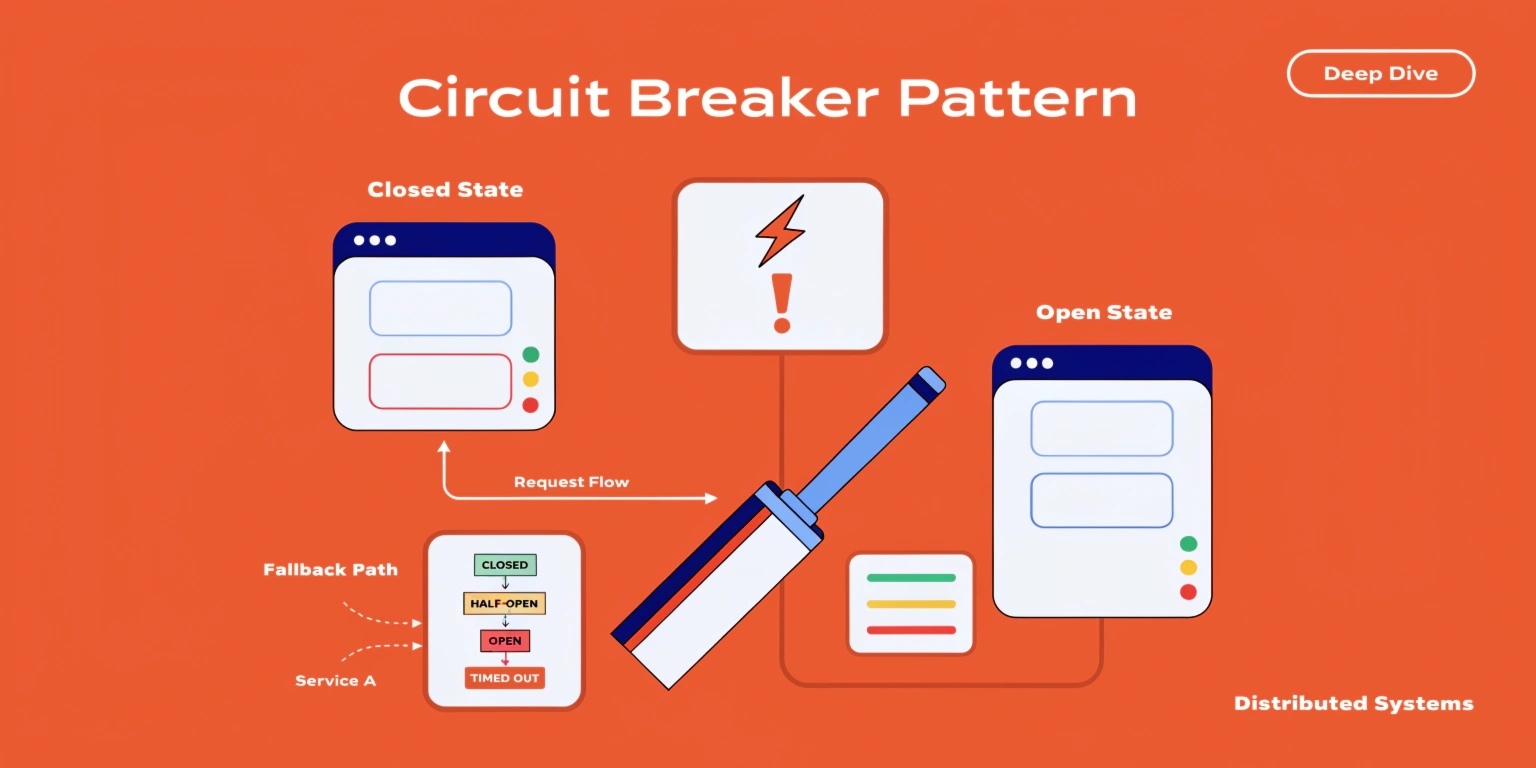
Discover how the Circuit Breaker Pattern protects distributed systems from cascading failures. Learn its architecture, states, implementation methods, and best practices for building highly resilient applications.
Modern applications increasingly rely on distributed architectures composed of multiple services communicating over networks. While this approach improves scalability and flexibility, it also introduces a significant challenge: failure management. In distributed environments, a single failing service can trigger a chain reaction that impacts multiple dependent services, leading to system-wide outages.
To address this problem, software architects use the Circuit Breaker Pattern, one of the most important resilience patterns in modern distributed systems.
This article explores the Circuit Breaker Pattern in depth, including how it works, its states, implementation strategies, advantages, and best practices.
Understanding the Problem
Imagine an e-commerce application with several microservices:
- User Service
- Product Service
- Inventory Service
- Payment Service
- Notification Service
When a customer places an order, multiple services communicate with each other. If the Payment Service becomes slow or unavailable, the Order Service may continuously send requests while waiting for responses.
As traffic increases:
- Threads become blocked.
- Connection pools get exhausted.
- Request queues grow rapidly.
- Other dependent services become overloaded.
Eventually, the failure spreads throughout the system, creating a cascading failure.
The Circuit Breaker Pattern prevents this scenario by detecting failures early and stopping unnecessary requests.
What Is the Circuit Breaker Pattern?
The Circuit Breaker Pattern is inspired by electrical circuit breakers found in homes and buildings.
In electrical systems:
- A breaker allows electricity to flow normally.
- When excessive current is detected, it trips and cuts the connection.
- After some time, it allows limited testing before restoring full flow.
Similarly, in software systems:
- Requests are allowed during normal operation.
- When failure thresholds are exceeded, the circuit opens.
- Incoming requests fail fast without contacting the unhealthy service.
- The system periodically checks whether the service has recovered.
This mechanism protects both clients and downstream services.
The Three States of a Circuit Breaker
1. Closed State
The circuit starts in the Closed state.
Characteristics:
- Requests flow normally.
- Failures are monitored.
- Success and error rates are recorded.
If failures remain below the configured threshold, the circuit stays closed.
Example:
- 100 requests processed.
- 2 failures detected.
- Failure rate remains acceptable.
No action is required.
2. Open State
When failures exceed a predefined threshold, the circuit enters the Open state.
Characteristics:
- No requests are forwarded.
- Requests fail immediately.
- System resources are preserved.
Example:
- Failure rate exceeds 50%.
- Timeout errors continue for several seconds.
- Circuit opens automatically.
Instead of waiting for timeouts, users receive fallback responses instantly.
3. Half-Open State
After a configured recovery period, the circuit enters the Half-Open state.
Characteristics:
- Limited requests are allowed.
- Service health is tested.
- Recovery is evaluated.
Possible outcomes:
Successful Requests
- Circuit returns to Closed state.
Failed Requests
- Circuit returns to Open state.
This prevents overwhelming a recovering service.
Circuit Breaker Workflow
A typical workflow follows these steps:
- Client sends request.
- Circuit breaker checks current state.
- If Closed, request proceeds.
- Failures are tracked.
- Failure threshold exceeded.
- Circuit transitions to Open.
- Requests fail immediately.
- Recovery timer expires.
- Circuit enters Half-Open state.
- Test requests are sent.
- If successful, circuit closes again.
This cycle continuously protects the system from instability.
Key Benefits
1. Prevents Cascading Failures
The primary advantage is stopping failure propagation across interconnected services.
2. Improves System Stability
Failing services are isolated before they impact the entire architecture.
3. Reduces Resource Consumption
Fail-fast behavior prevents wasted:
- CPU cycles
- Network calls
- Database connections
- Application threads
4. Faster Response Times
Users receive immediate fallback responses rather than waiting for long timeouts.
5. Better User Experience
Applications remain partially functional even during service outages.
Circuit Breaker in Microservices
Microservices communicate extensively through APIs.
Common use cases include:
API Gateways
Protect backend services from overload.
Payment Processing
Prevent repeated calls to unavailable payment providers.
Inventory Systems
Avoid overwhelming inventory databases during failures.
Third-Party Integrations
Handle failures from:
- Payment gateways
- Shipping providers
- Authentication providers
- External APIs
Popular Circuit Breaker Frameworks
Several frameworks provide Circuit Breaker implementations:
Resilience4j
Widely used in Java-based microservices.
Features:
- Lightweight design
- Spring Boot integration
- Metrics support
- Retry combination
Netflix Hystrix (Legacy)
Previously the industry standard for fault tolerance.
Although maintenance has ended, it influenced modern resilience frameworks.
Istio Service Mesh
Provides circuit-breaking capabilities at the infrastructure level.
Benefits:
- No application code changes
- Centralized traffic control
- Advanced observability
Envoy Proxy
Supports sophisticated traffic management and resilience patterns.
Best Practices
Configure Sensible Thresholds
Avoid opening circuits too aggressively.
Monitor:
- Failure rates
- Response times
- Timeout frequency
Combine with Retry Pattern
Use retries carefully.
Recommended sequence:
Retry → Circuit Breaker → Fallback
This maximizes recovery opportunities while avoiding overload.
Implement Fallback Mechanisms
Examples:
- Cached responses
- Default values
- Graceful degradation
Users should still receive meaningful responses.
Monitor Circuit Health
Track metrics such as:
- Open circuit count
- Failure percentage
- Recovery duration
- Request latency
Observability is essential for tuning configurations.
Test Failure Scenarios
Regularly simulate:
- Service outages
- High latency
- Network partitions
- Dependency failures
Chaos engineering practices help validate resilience.
Common Challenges
Despite its advantages, improper implementation can create issues:
- Incorrect thresholds causing unnecessary circuit trips
- Excessive retries increasing load
- Inadequate fallback strategies
- Lack of monitoring and alerting
Careful configuration is critical for success.
Conclusion
As distributed systems grow more complex, resilience becomes a core architectural requirement. The Circuit Breaker Pattern provides an effective mechanism for preventing cascading failures, protecting resources, and maintaining service availability during outages.
Whether you are building cloud-native applications, microservices platforms, or large-scale enterprise systems, implementing circuit breakers can significantly improve reliability and user experience. Combined with retries, fallbacks, monitoring, and observability, the Circuit Breaker Pattern forms a fundamental pillar of modern fault-tolerant architecture.
Organizations that adopt this pattern effectively can build systems that continue operating gracefully even when individual components fail—an essential capability in today's always-on digital world.
We build scalable web, mobile, and game products for clients worldwide — combining modern frameworks, cloud infrastructure, and best engineering practices.
.jpg)
.jpg)
.jpg)