Introduction
Choosing the right technology stack is one of the most important decisions in software development. Every web application, mobile application, or enterprise software solution requires a combination of technologies to deliver the desired functionality. However, selecting technologies is not only about popularity or technical capabilities. The client's budget, business goals, project complexity, and future growth plans also play important roles.
A suitable technology stack helps businesses control development expenses, improve application performance, and reduce long-term maintenance costs. On the other hand, selecting technologies without considering the budget can result in unnecessary expenses, delayed delivery, and complicated maintenance.
For development companies and businesses investing in digital solutions, understanding how to balance technology and budget is essential for building successful software products.
1. Understand the Client's Business Requirements
Before recommending any technology, developers should understand what the client wants to achieve. A simple business website, an e-commerce platform, and a large enterprise application have different technical requirements.
For example, a small business website may require a content management system or a lightweight web framework. A complex application with user authentication, real-time updates, payment integration, and multiple user roles may need a more structured architecture.
During the initial discussion, identify the following factors:
- Project objectives and target audience.
- Required features and integrations.
- Expected number of users.
- Security and performance requirements.
- Project delivery timeline.
- Available development and maintenance budget.
Understanding these requirements helps the development team avoid recommending expensive technologies that provide little practical value.
2. Choose Technologies According to the Available Budget
Technology selection should match the client's financial capacity without compromising essential requirements.
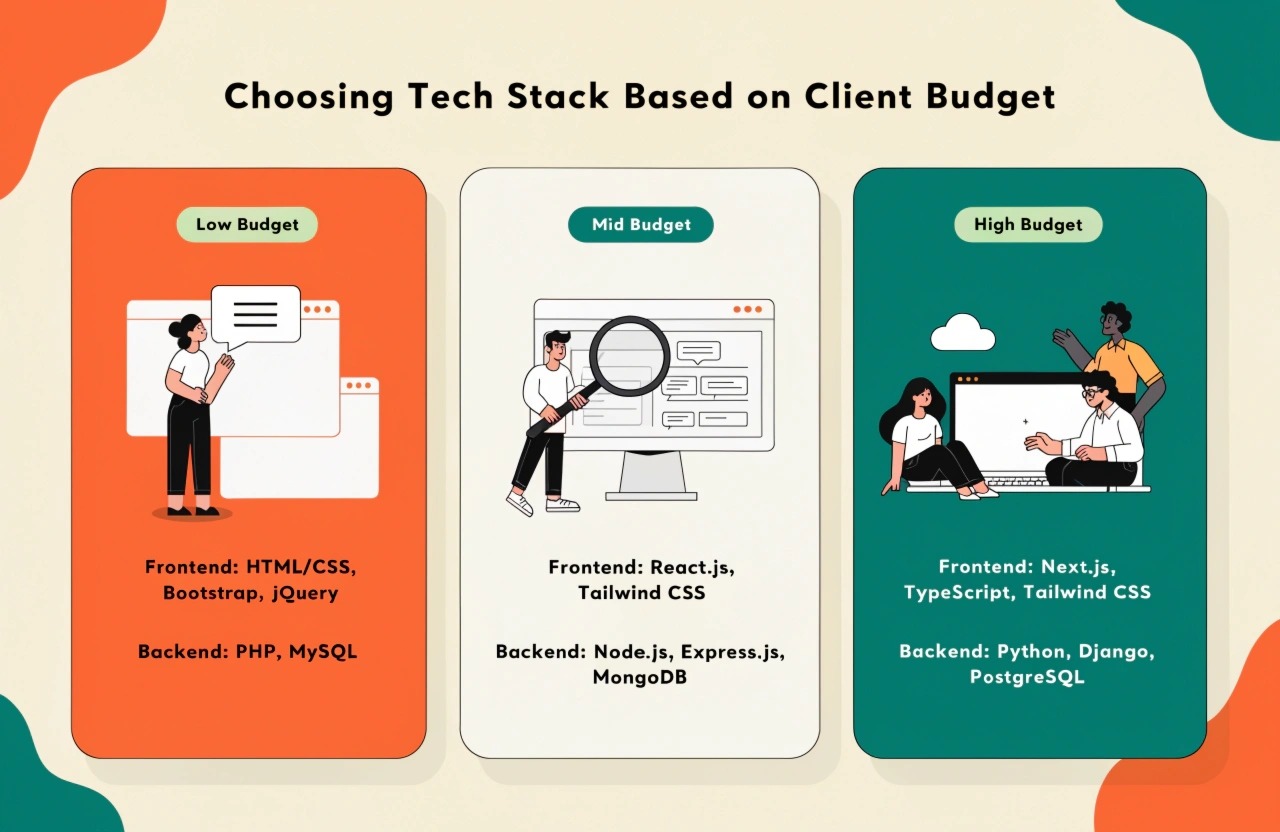
For low-budget projects: Open-source technologies such as React, Node.js, PHP, and PostgreSQL can help reduce licensing expenses. Established content management systems may also be appropriate for websites with standard functionality.
For medium-budget projects: Frameworks such as Laravel, Django, and the MERN stack can support custom business applications, dashboards, customer portals, and growing e-commerce platforms. The right choice depends on available developer skills, project complexity, and integration requirements.
For high-budget projects: Enterprise applications may benefit from cloud infrastructure, advanced security controls, distributed systems, or specialized data platforms when the requirements justify them. These solutions can introduce additional infrastructure and operational costs, so they should be selected carefully.
A larger budget does not automatically require a more complicated technology stack. The goal is to invest in capabilities that solve actual business problems.
3. Evaluate Frontend and Backend Technologies
The frontend and backend form the foundation of most modern applications.
Frontend technologies determine how users interact with a product. React, Angular, and Vue.js are popular options for building interactive web interfaces. The best choice depends on the application's complexity, design requirements, team expertise, and maintenance expectations.
Backend technologies manage business logic, authentication, APIs, and data processing. Node.js, Laravel, Django, and ASP.NET are examples of technologies that support different application requirements.
For instance, a startup building a web platform may benefit from a React and Node.js combination if its team is familiar with JavaScript. Another business may find Laravel or ASP.NET more suitable because of its existing infrastructure or development team.
Choosing technologies that align with the team's experience can reduce development time, training expenses, and the likelihood of avoidable mistakes.
4. Select the Right Database and Hosting Solution
Database and hosting decisions can significantly affect both initial and recurring costs.
Relational databases such as PostgreSQL and MySQL are suitable for many applications that require structured information and reliable transactions. MongoDB may be appropriate when the application's data model benefits from a document-oriented approach.
The database should be selected according to data relationships, consistency requirements, query patterns, and expected workload rather than popularity alone.
Hosting also requires careful consideration. Shared hosting may be sufficient for a small website, while a growing application may need managed cloud hosting or dedicated infrastructure.
When comparing hosting options, consider:
- Monthly infrastructure expenses.
- Storage and bandwidth requirements.
- Backup and disaster recovery.
- Security and monitoring.
- Expected traffic growth.
- Scaling and support costs.
A low initial hosting price may not represent the lowest long-term cost if performance, reliability, or maintenance becomes a problem.
5. Consider Long-Term Maintenance and Scalability
The initial development budget is only one part of the total cost of ownership. Software also requires updates, security patches, bug fixes, infrastructure management, and improvements as business requirements change.
A technology stack that appears inexpensive initially may become costly if it is difficult to maintain or requires specialized developers who are difficult to find.
Businesses should evaluate the availability of developers, community support, documentation, third-party integrations, and upgrade paths before making a final decision.
Scalability should also match realistic growth expectations. A new business does not necessarily need a complex microservices architecture from day one. A well-structured monolithic application may be more economical and easier to maintain initially, with opportunities to introduce additional services when demand justifies them.
6. Avoid Common Technology Selection Mistakes
Several mistakes can increase development expenses unnecessarily.
First, choosing technologies only because they are trending can lead to poor project alignment. Second, selecting an unfamiliar framework without evaluating the learning curve may delay delivery. Third, overlooking licensing, hosting, and maintenance expenses can create budget problems after launch.
Another common mistake is building too many features into the first release. Businesses can instead prioritize essential functionality and develop additional features in later phases.
A minimum viable product (MVP) allows clients to test their core business idea, collect user feedback, and make informed decisions before committing to a larger investment.
However, reducing costs should never mean ignoring essential security, data protection, testing, or reliability requirements.
7. Create a Budget-Friendly Technology Roadmap
A practical technology roadmap connects current spending with future business objectives.
Begin by separating essential features from optional enhancements. Estimate design, development, testing, deployment, hosting, and maintenance expenses. Compare suitable technology combinations and explain the trade-offs in terms the client can understand.
Next, identify which components can be reused and which integrations require additional investment. Establish realistic delivery milestones and retain an appropriate contingency for unexpected technical challenges.
Review the proposed stack with both technical and business stakeholders before development begins. This approach creates transparency and helps clients understand why a particular technology is being recommended.
Conclusion
Choosing the right tech stack based on client budget requires a balance between affordability, functionality, performance, security, and long-term maintainability. There is no single technology stack that works best for every project.
By understanding business requirements, evaluating development and operational costs, selecting technologies that match team expertise, and planning for realistic growth, businesses can make better technology investments.
The most effective solution is not necessarily the cheapest or most advanced one. It is the technology stack that delivers the required business value within the available budget while remaining reliable, maintainable, and adaptable as the organization grows.