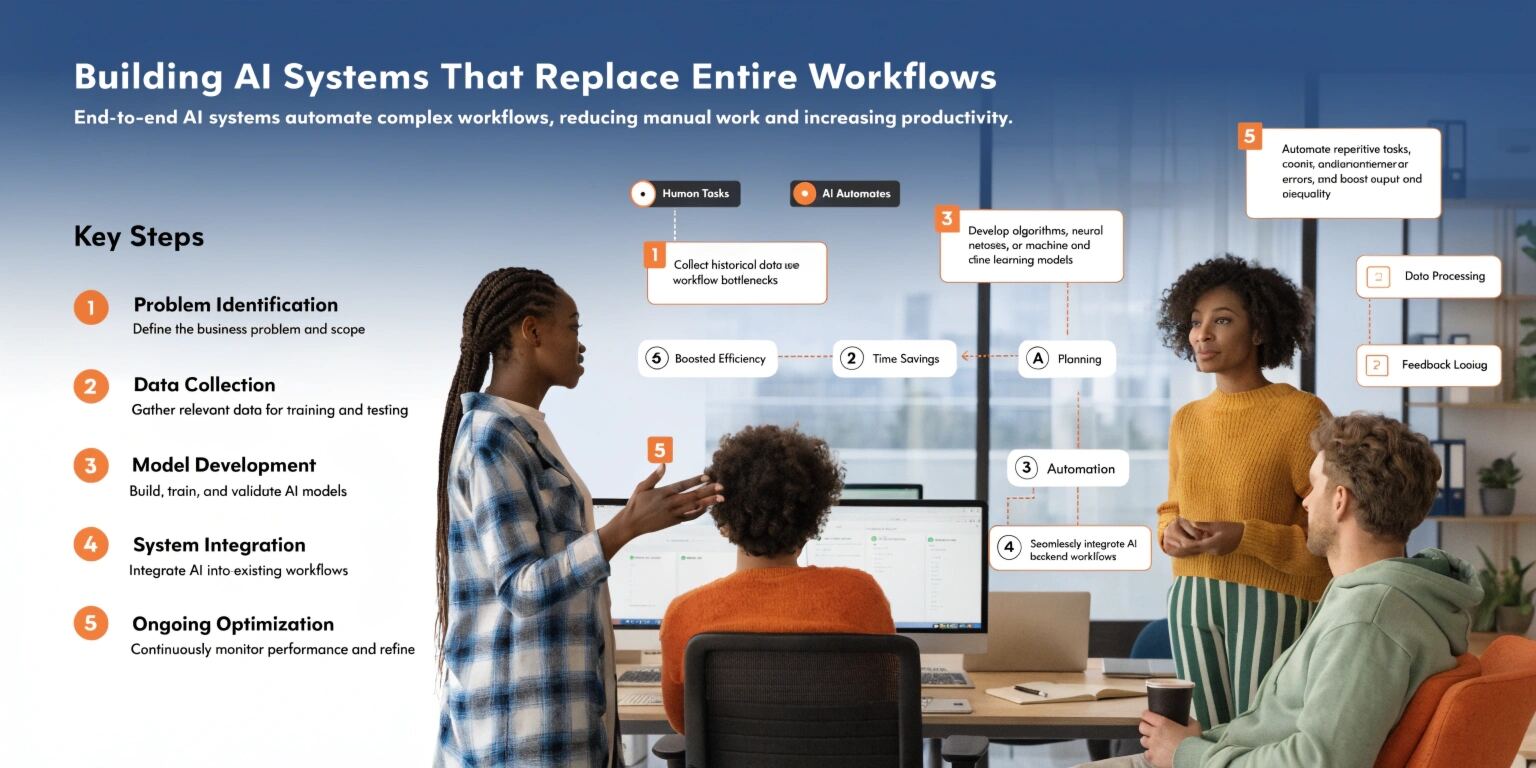
Artificial Intelligence is no longer limited to chatbots, recommendation engines, or simple automation scripts. Modern AI systems are evolving rapidly and are now capable of replacing complete business workflows across industries such as healthcare, finance, software development, customer support, logistics, marketing, and eCommerce.
Businesses are shifting from task-based automation to workflow-level intelligence, where AI can manage multiple interconnected operations with minimal human intervention. This transformation is redefining productivity, operational efficiency, and digital scalability.
In this blog, we will explore how companies are building AI systems that replace entire workflows, the technologies behind them, the challenges involved, and why this trend is becoming the future of enterprise operations.
Understanding Workflow-Level AI
Traditional automation focuses on repetitive tasks like:
- Sending emails
- Generating reports
- Data entry
- Scheduling appointments
However, workflow-level AI goes much further. Instead of automating one task, it automates a complete sequence of activities from start to finish.
For example, an AI-powered recruitment workflow may:
- Screen resumes
- Rank candidates
- Schedule interviews
- Conduct AI interviews
- Generate hiring reports
- Send onboarding emails
All these processes can now function within one intelligent AI system.
This shift is possible because of advancements in:
- Large Language Models (LLMs)
- Machine Learning
- Natural Language Processing (NLP)
- AI Agents
- Workflow orchestration platforms
- Cloud computing infrastructure
Why Businesses Want AI Workflow Automation
Companies are under constant pressure to reduce operational costs while increasing speed and scalability. AI workflow systems help organizations achieve this by:
- Reducing manual effort
- Eliminating repetitive processes
- Improving decision-making
- Increasing accuracy
- Operating 24/7
- Enhancing customer experiences
For startups and enterprises alike, workflow automation also creates competitive advantages because businesses can scale operations without proportionally increasing workforce size.
This is especially important in industries where speed and efficiency directly impact profitability.
Core Components of AI Workflow Systems
Building a workflow-level AI system requires multiple technologies working together.
1. Large Language Models (LLMs)
LLMs act as the reasoning engine behind many AI workflows. They understand instructions, process language, generate responses, summarize data, and make contextual decisions.
These models are widely used in:
- Customer support automation
- Content generation
- Internal business assistants
- Knowledge management systems
2. AI Agents
AI agents are autonomous systems capable of performing tasks independently. Unlike basic chatbots, AI agents can:
- Access tools
- Execute actions
- Analyze outputs
- Make decisions
- Trigger additional workflows
AI agents are becoming essential for multi-step workflow automation.
3. Workflow Orchestration Platforms
Workflow orchestration platforms connect different systems together. They coordinate how data flows between:
- APIs
- Databases
- CRM systems
- Internal software
- External tools
Without orchestration, AI systems cannot efficiently manage large operational workflows.
4. Data Infrastructure
AI systems depend heavily on structured and high-quality data. Poor data quality results in inaccurate decisions and unreliable automation.
Modern AI architectures require:
- Real-time data pipelines
- Cloud storage
- Vector databases
- Secure data processing systems
Strong data infrastructure is the foundation of successful workflow automation.
Real-World Examples of AI Workflow Replacement
Customer Support
AI systems can now:
- Answer support tickets
- Analyze customer sentiment
- Suggest solutions
- Escalate complex cases
- Update CRM systems automatically
This dramatically reduces response times and support costs.
Software Development
AI-powered development workflows can:
- Generate code
- Review pull requests
- Detect bugs
- Write documentation
- Deploy applications
Developers increasingly use AI assistants to accelerate the software development lifecycle.
Digital Marketing
AI workflow systems are transforming marketing by automating:
- Content creation
- SEO optimization
- Ad copy generation
- Campaign analysis
- Audience segmentation
- Performance reporting
This enables marketing teams to operate faster with fewer manual processes.
Challenges in Building AI Workflow Systems
Despite the advantages, workflow-level AI systems also introduce challenges.
Reliability Issues
AI models can occasionally produce inaccurate or inconsistent outputs. This becomes risky when workflows involve critical business decisions.
Security and Compliance
AI systems often process sensitive business and customer data. Companies must ensure:
- Data encryption
- Access control
- Compliance with regulations
- Secure API integrations
Human Oversight
Fully autonomous systems still require human supervision, especially in areas involving legal, financial, or ethical decisions.
The most successful businesses use “human-in-the-loop” models where AI handles operations while humans monitor critical checkpoints.
The Future of Workflow Automation
The future of AI is moving toward autonomous enterprise systems where AI agents collaborate across departments and manage entire operational pipelines.
We are entering an era where businesses may operate with:
- AI-driven project management
- Autonomous sales pipelines
- Intelligent HR operations
- Self-optimizing marketing campaigns
- Automated software engineering workflows
Companies that adopt workflow-level AI early will likely gain major advantages in productivity, scalability, and cost efficiency.
Conclusion
AI is rapidly evolving from simple automation into intelligent systems capable of replacing entire workflows. By combining LLMs, AI agents, orchestration platforms, and scalable data infrastructure, businesses can automate complex operations that once required large human teams.
However, successful implementation requires careful planning, strong security practices, reliable infrastructure, and ongoing human oversight.
As AI technology continues to mature, workflow automation will become one of the most transformative forces shaping the future of business and technology.