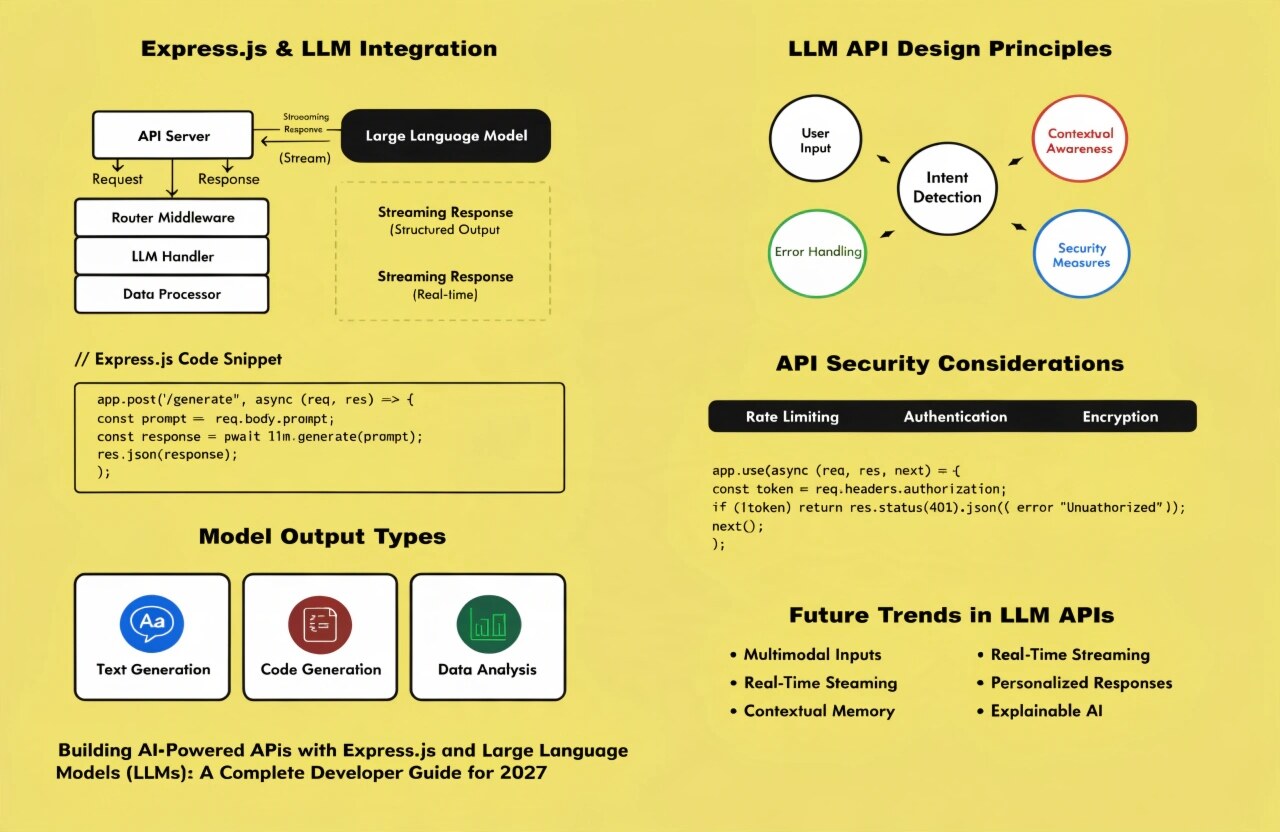
Artificial Intelligence is transforming modern web applications, and Express.js has become one of the most popular frameworks for creating scalable AI-powered APIs. This blog explores how developers can integrate Large Language Models (LLMs) into Express.js applications, covering architecture, security, optimization, real-world use cases, and best development practices for building intelligent, production-ready applications
Building AI-Powered APIs with Express.js and Large Language Models (LLMs)
Artificial Intelligence is no longer limited to research laboratories. Today, businesses integrate AI into customer support, marketing, healthcare, education, finance, and enterprise software. At the center of this revolution are Large Language Models (LLMs), capable of understanding natural language, generating content, summarizing documents, translating languages, writing code, and much more.
For developers, one of the easiest ways to build AI-enabled applications is by combining Express.js with modern LLM APIs. Express.js provides a lightweight backend framework, while LLMs provide intelligent decision-making capabilities.
Let's explore how this powerful combination is shaping the future of software development.
Why Express.js is Ideal for AI APIs
Express.js remains one of the most trusted backend frameworks because of its simplicity, flexibility, and performance.
Key advantages include:
- Lightweight architecture
- Fast API development
- Easy middleware integration
- Excellent scalability
- Massive Node.js ecosystem
- Easy cloud deployment
- Perfect for RESTful APIs
Since most AI providers expose REST or HTTP APIs, Express.js becomes the perfect bridge between frontend applications and AI services.
Typical AI API Architecture
A common AI-powered application follows this workflow:
Client Application
↓
Express.js Backend
↓
Authentication Layer
↓
Prompt Processing
↓
LLM API
↓
Response Formatting
↓
Client
The Express server handles authentication, validates user input, communicates with the AI model, filters responses, logs requests, and returns structured JSON data.
This architecture keeps API keys secure while allowing centralized monitoring and optimization.
Popular AI Features Built with Express.js
Developers are using Express.js to create intelligent APIs for numerous business applications.
AI Chatbots
Modern customer support bots understand user intent instead of relying on predefined rules.
Examples include:
- Customer support
- Technical assistance
- HR automation
- Sales inquiries
- Internal knowledge assistants
Content Generation
LLMs can generate:
- Blog articles
- Product descriptions
- Marketing copy
- Social media captions
- Email campaigns
- Documentation
Express APIs make these services available to websites and mobile applications.
Document Intelligence
Businesses use AI APIs to:
- Summarize PDFs
- Extract important information
- Analyze reports
- Generate meeting notes
- Classify documents
Code Assistance
Developer platforms now integrate AI to:
- Explain code
- Generate functions
- Detect bugs
- Suggest improvements
- Convert programming languages
Express.js can expose these features through secure internal APIs.
Integrating LLM APIs
Most AI providers follow a similar integration process:
- Receive user input
- Validate request
- Authenticate API call
- Create prompt
- Send request to LLM
- Process AI response
- Return structured output
Developers should never expose AI API keys directly to frontend applications. Express.js acts as the secure intermediary.
Best Practices for Prompt Engineering
The quality of AI output depends heavily on prompt design.
Useful practices include:
- Provide clear instructions
- Define output format
- Add context
- Specify tone
- Limit response length
- Use examples
- Validate generated responses
Good prompts significantly improve consistency and accuracy.
Security Considerations
AI APIs introduce new security challenges.
Developers should implement:
- Authentication
- Authorization
- Rate limiting
- Input validation
- Prompt filtering
- API key protection
- HTTPS encryption
- Request logging
These measures help prevent abuse, prompt injection attacks, and unauthorized access.
Performance Optimization
AI requests can take longer than traditional database queries.
Improve performance by:
- Caching repeated prompts
- Streaming responses
- Queueing long-running tasks
- Compressing responses
- Optimizing prompts
- Implementing retry mechanisms
- Using asynchronous processing
These techniques reduce latency and improve user experience.
Real-World Applications
Organizations across industries are leveraging AI-powered Express.js APIs for:
- Healthcare virtual assistants
- Financial advisory systems
- E-learning platforms
- Legal document analysis
- HR recruitment automation
- E-commerce recommendations
- Travel planning assistants
- CRM automation
- Content management systems
The flexibility of Express.js allows these AI services to integrate seamlessly with existing business applications.
Challenges Developers Face
Despite the benefits, AI integration presents several challenges:
- API costs
- Hallucinated responses
- Response latency
- Context limitations
- Data privacy
- Model updates
- Token management
- Compliance requirements
Developers should monitor AI outputs and implement fallback mechanisms to ensure reliability.
The Future of AI APIs
The next generation of AI applications will become even more capable with advancements such as:
- Multimodal AI
- AI agents
- Real-time voice interaction
- Autonomous workflows
- Personalized assistants
- Enterprise knowledge retrieval
- AI-powered search
- Industry-specific language models
Express.js will continue to play a significant role by providing scalable backend infrastructure for these intelligent systems.
Conclusion
Building AI-powered APIs with Express.js and Large Language Models enables developers to create smarter, faster, and more engaging digital experiences. From conversational chatbots and automated content generation to enterprise knowledge systems and workflow automation, the combination of Express.js and LLMs provides a flexible foundation for modern AI applications.
By following best practices in architecture, prompt engineering, security, and performance optimization, developers can build reliable, scalable, and production-ready AI services. As AI technology continues to evolve, Express.js remains an excellent choice for powering the next generation of intelligent web and mobile applications.
We build scalable web, mobile, and game products for clients worldwide — combining modern frameworks, cloud infrastructure, and best engineering practices.
.jpg)
.jpg)
.jpg)