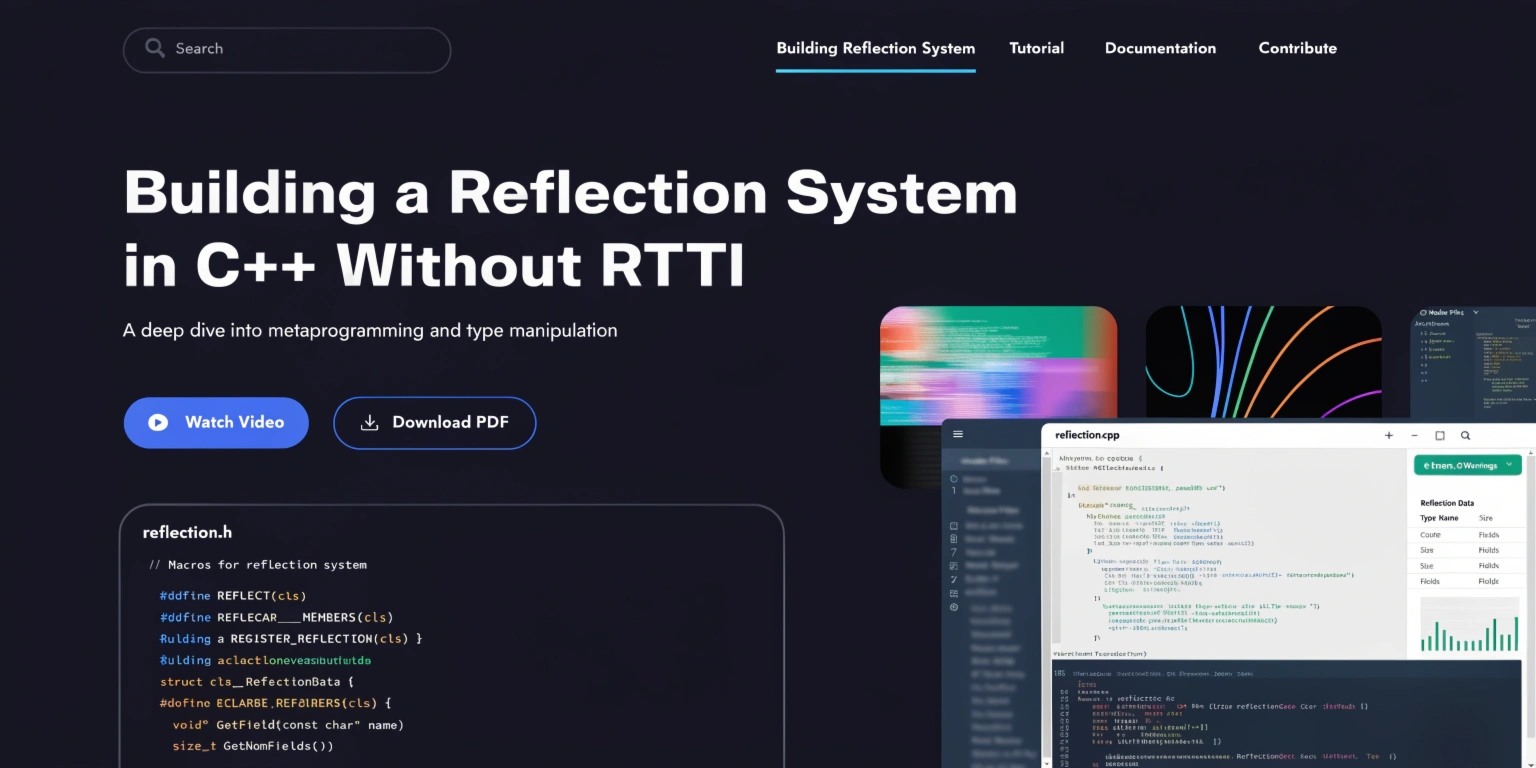
Building a Reflection System in C++ (Without RTTI)
Reflection is one of the most powerful features in modern programming languages. It allows programs to inspect, analyze, and manipulate their own structure during runtime. Languages like Java, C#, and Python provide built-in reflection systems, but C++ traditionally offers only limited runtime type information (RTTI).
However, many high-performance applications and game engines avoid RTTI entirely because of performance overhead, binary size concerns, and limited flexibility. Instead, developers build custom reflection systems tailored to their architecture.
In this blog, we will explore how reflection systems work in C++, why developers avoid RTTI, and how to design a custom reflection framework using metadata registration, templates, and compile-time programming techniques.
What Is Reflection?
Reflection enables a program to:
- Inspect object types
- Access fields dynamically
- Invoke methods at runtime
- Serialize objects
- Build editor tools
- Support scripting systems
For example, a game engine editor may automatically display:
- Object properties
- Transform values
- Component metadata
- Editable settings
Without reflection, developers would need to manually write large amounts of repetitive editor and serialization code.
Reflection becomes essential in systems such as:
- Game engines
- Serialization frameworks
- ECS architectures
- Scripting integrations
- UI editors
- Debugging tools
Why Avoid RTTI?
C++ provides built-in RTTI features like:
- typeid
- dynamic_cast
Although useful, RTTI has several limitations in large-scale systems.
Performance Overhead
RTTI introduces runtime checks that may impact performance in high-frequency systems such as:
- Rendering engines
- Physics systems
- Real-time simulations
Limited Flexibility
RTTI only provides basic type information. It does not expose:
- Member fields
- Method metadata
- Custom annotations
- Serialization rules
Modern applications often require much richer metadata systems.
Binary Size Concerns
In performance-critical applications like games, reducing binary size is important. RTTI can increase executable size due to additional runtime metadata generation.
Because of these limitations, many professional game engines disable RTTI entirely and implement custom alternatives.
Core Idea Behind Custom Reflection
A custom reflection system works by manually registering metadata about classes, fields, and functions.
Instead of relying on compiler-generated RTTI, developers create their own metadata structures.
A reflection system typically stores:
- Class names
- Field names
- Field offsets
- Data types
- Method pointers
- Attributes
This metadata can then be queried dynamically during runtime.
Metadata Registration System
The first step in building reflection is defining metadata structures.
For example:
- TypeInfo
- FieldInfo
- MethodInfo
Each structure stores information about program elements.
A class registration system may include:
- Type identifiers
- Member offsets
- Type categories
- Constructor callbacks
Developers often use macros to simplify registration.
Example concept:
- REGISTER_CLASS(Player)
- REGISTER_FIELD(health)
- REGISTER_FIELD(position)
Macros reduce repetitive code and automate metadata generation.
Using Field Offsets
One of the most important techniques in reflection systems is field offset calculation.
A field offset represents the memory distance between the start of an object and one of its members.
Using offsets allows systems to:
- Access fields dynamically
- Serialize objects generically
- Build property editors
This technique is widely used in:
- Unreal Engine
- ECS frameworks
- Serialization libraries
Offset-based access is extremely fast because it works directly with memory layouts.
Template-Based Reflection
Modern C++ reflection systems heavily rely on templates.
Templates help create:
- Type-safe metadata
- Generic serializers
- Compile-time utilities
- Automatic registration systems
For example, template specialization can generate metadata automatically for different types.
Advantages include:
- Reduced boilerplate
- Better compile-time validation
- Improved performance
- Flexible extensibility
Template metaprogramming has become a core part of advanced C++ engine development.
Reflection for Serialization
Serialization is one of the most common uses of reflection.
Without reflection:
- Every object requires manual serialization code.
With reflection:
- The serializer iterates over metadata automatically.
This allows systems to:
- Save game states
- Export assets
- Load configurations
- Synchronize network data
Reflection-driven serialization significantly reduces maintenance complexity.
Reflection in Game Engines
Game engines rely heavily on reflection systems for:
- Scene editors
- Entity systems
- Scripting
- Animation tools
- Networking
- Asset pipelines
For example, when developers expose variables in an editor:
- Reflection metadata powers the UI automatically.
Instead of manually building editors for every class, the engine dynamically generates interfaces from metadata.
This dramatically improves development speed and tooling flexibility.
Compile-Time Reflection Trends
Modern C++ is evolving toward better compile-time reflection capabilities.
Developers increasingly use:
- constexpr
- template metaprogramming
- code generation tools
Some systems even generate metadata automatically during build steps using:
- AST parsers
- code generators
- compiler plugins
Compile-time reflection improves:
- Runtime performance
- Memory efficiency
- Type safety
It also reduces manual metadata registration effort.
Challenges in Reflection Systems
Despite its advantages, building reflection systems is difficult.
Common challenges include:
- Complex template code
- Cross-platform compatibility
- Memory management
- Build-time complexity
- Macro maintenance
Reflection systems also require careful architecture planning because they often become deeply integrated into the entire engine ecosystem.
Poorly designed reflection systems can create:
- Tight coupling
- Slow compile times
- Difficult debugging
- Maintenance overhead
Therefore, scalability and simplicity are critical design goals.
Conclusion
Building a reflection system in C++ without RTTI is a sophisticated engineering challenge that enables powerful runtime features while maintaining high performance and flexibility.
By combining metadata registration, field offsets, templates, and compile-time programming techniques, developers can create highly efficient systems for serialization, editor tooling, scripting, and engine architecture.
As C++ continues evolving, reflection systems will remain one of the most important foundations behind modern game engines, real-time applications, and advanced software frameworks.