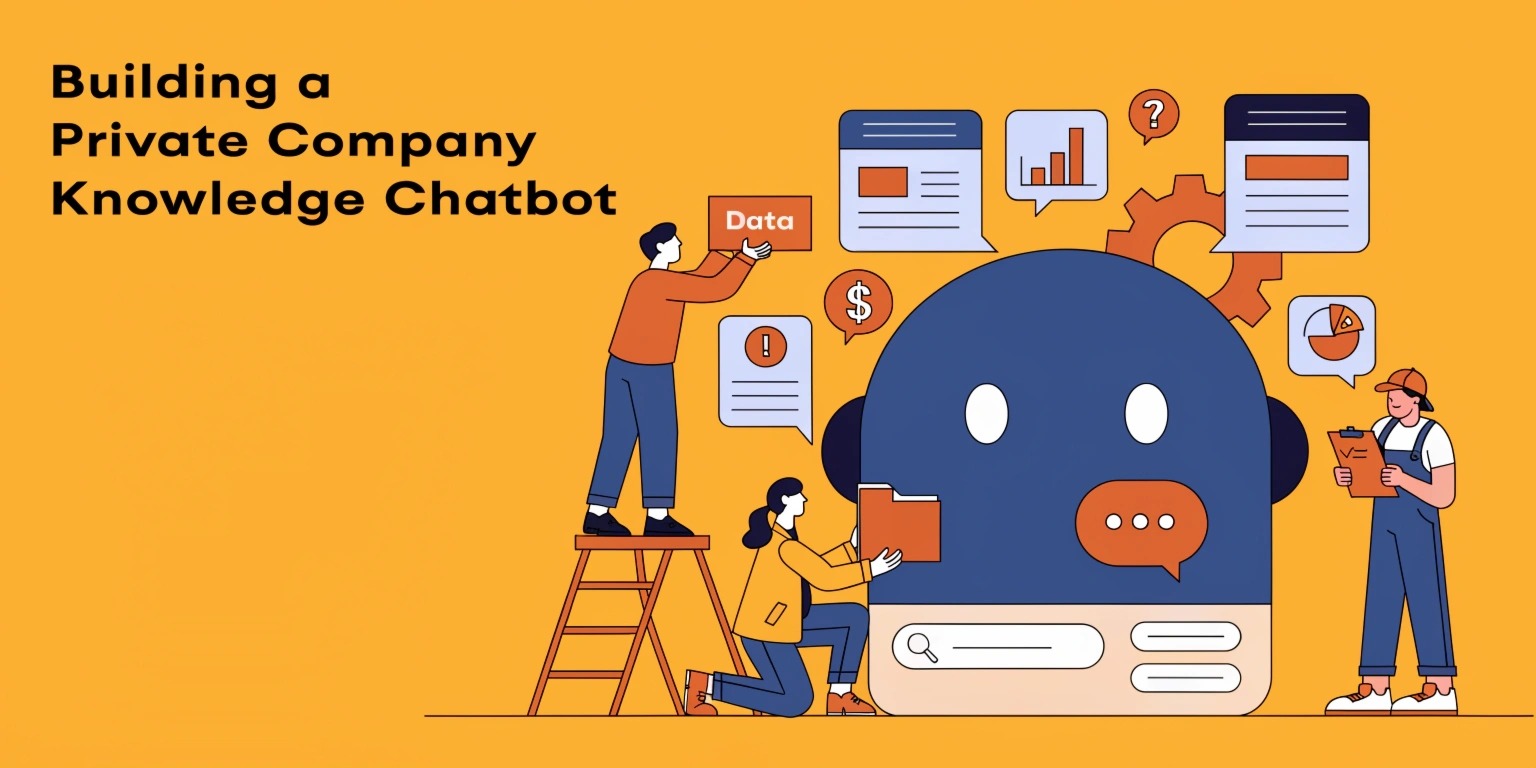
Organizations generate enormous amounts of information every day, including policies, technical documentation, product manuals, HR guidelines, meeting notes, standard operating procedures, and customer support articles. Unfortunately, much of this knowledge remains scattered across shared drives, cloud storage, emails, and internal portals, making it difficult for employees to find the information they need.
A private company knowledge chatbot solves this problem by acting as an AI-powered assistant that answers employee questions using an organization's own documents rather than relying solely on publicly available information.
Unlike public AI chatbots, a private knowledge chatbot operates within a secure environment, ensuring confidential business data remains protected while providing accurate, context-aware responses. This makes it an increasingly valuable tool for enterprises seeking to improve productivity and knowledge sharing.
Why Businesses Need a Private Knowledge Chatbot
Employees spend significant time searching for information spread across multiple systems. Whether it's an HR policy, technical documentation, onboarding guide, or customer contract, locating the right document often takes longer than necessary.
A private AI chatbot allows employees to ask questions in natural language, such as:
- "What is our remote work policy?"
- "Where can I find the API authentication guide?"
- "What is the leave approval process?"
- "Show me the latest product pricing documentation."
Instead of manually searching through folders or documents, the chatbot retrieves relevant information instantly, improving efficiency and reducing interruptions across teams.
Core Architecture of a Private Knowledge Chatbot
A production-ready enterprise chatbot consists of several interconnected components rather than a single AI model.
The architecture typically includes:
- User Interface (Web, Mobile, or Teams/Slack integration)
- Authentication Service
- Document Processing Pipeline
- Embedding Generation
- Vector Database
- Retrieval-Augmented Generation (RAG) Engine
- Large Language Model (LLM)
- Logging and Monitoring
- Access Control Layer
Each component plays a specific role in ensuring the chatbot delivers secure, accurate, and scalable responses.
Document Collection and Processing
The chatbot is only as useful as the information it can access.
Organizations typically collect content from:
- PDF documents
- Microsoft Word files
- Knowledge base articles
- Internal wikis
- Product documentation
- HR manuals
- CRM notes
- Support documentation
- Meeting summaries
After collection, documents are cleaned, divided into logical sections, and converted into vector embeddings that represent their semantic meaning.
This preprocessing enables the chatbot to retrieve relevant information efficiently.
Retrieval-Augmented Generation (RAG)
Rather than storing all company knowledge inside the language model, modern enterprise chatbots rely on Retrieval-Augmented Generation (RAG).
The process works as follows:
- The employee asks a question.
- The system converts the query into an embedding.
- A vector database searches for the most relevant document sections.
- Retrieved content is sent to the LLM as context.
- The model generates a response based only on trusted company information.
This approach offers several advantages:
- Reduces hallucinations
- Keeps information up to date
- Eliminates frequent model retraining
- Improves response accuracy
RAG has become the preferred architecture for enterprise AI assistants.
Security and Access Control
Protecting confidential information is a top priority.
A private chatbot should never expose sensitive documents to unauthorized users.
Essential security measures include:
- Role-based access control (RBAC)
- Single Sign-On (SSO)
- Multi-factor authentication
- End-to-end encryption
- Audit logging
- Secure API communication
- Data masking for confidential information
For example, HR documents should only be accessible to authorized HR personnel, while financial reports should remain restricted to finance teams.
Security must be embedded into every layer of the system.
Improving Search Accuracy
Simply searching by keywords is often insufficient.
Modern enterprise chatbots improve relevance through:
- Semantic search
- Metadata filtering
- Document ranking
- Hybrid keyword and vector search
- Query expansion
- Context-aware retrieval
These techniques help employees receive precise answers instead of lengthy document lists.
Monitoring and Continuous Improvement
A knowledge chatbot should improve over time.
Organizations should monitor:
- Frequently asked questions
- Failed searches
- User feedback
- Response accuracy
- Retrieval quality
- Response latency
Analyzing these metrics helps identify documentation gaps and opportunities to enhance both the chatbot and the underlying knowledge base.
Real-World Business Applications
Private company chatbots provide value across multiple departments.
Human Resources
- Employee policies
- Benefits information
- Leave procedures
- Onboarding support
Information Technology
- Internal technical documentation
- Software setup guides
- Troubleshooting instructions
- API references
Customer Support
- Product manuals
- Resolution procedures
- Service documentation
- Knowledge articles
Sales
- Pricing information
- Product comparisons
- Proposal templates
- Competitive insights
Legal and Compliance
- Contract templates
- Regulatory guidelines
- Compliance documentation
- Internal policies
A single chatbot can support thousands of employees simultaneously while ensuring consistent information delivery.
Future of Enterprise Knowledge Management
Private knowledge chatbots are evolving beyond simple question-answering systems.
Future capabilities include:
- Voice-based enterprise assistants
- Multilingual knowledge retrieval
- AI-powered document summarization
- Automated workflow execution
- Integration with ERP and CRM platforms
- Personalized responses based on employee roles
- Multi-agent collaboration for complex tasks
These innovations will transform enterprise knowledge management from static document repositories into intelligent, interactive systems.
Conclusion
A private company knowledge chatbot is much more than a conversational interface. It is a secure, AI-powered knowledge management solution that enables employees to access trusted information quickly and efficiently while protecting sensitive business data.
By combining Retrieval-Augmented Generation, vector databases, robust security, and intelligent search capabilities, organizations can build enterprise-grade AI assistants that improve productivity, reduce operational costs, and accelerate decision-making.
As businesses continue to embrace digital transformation, private knowledge chatbots will become a foundational component of modern workplaces—empowering teams with instant access to the knowledge they need, exactly when they need it.