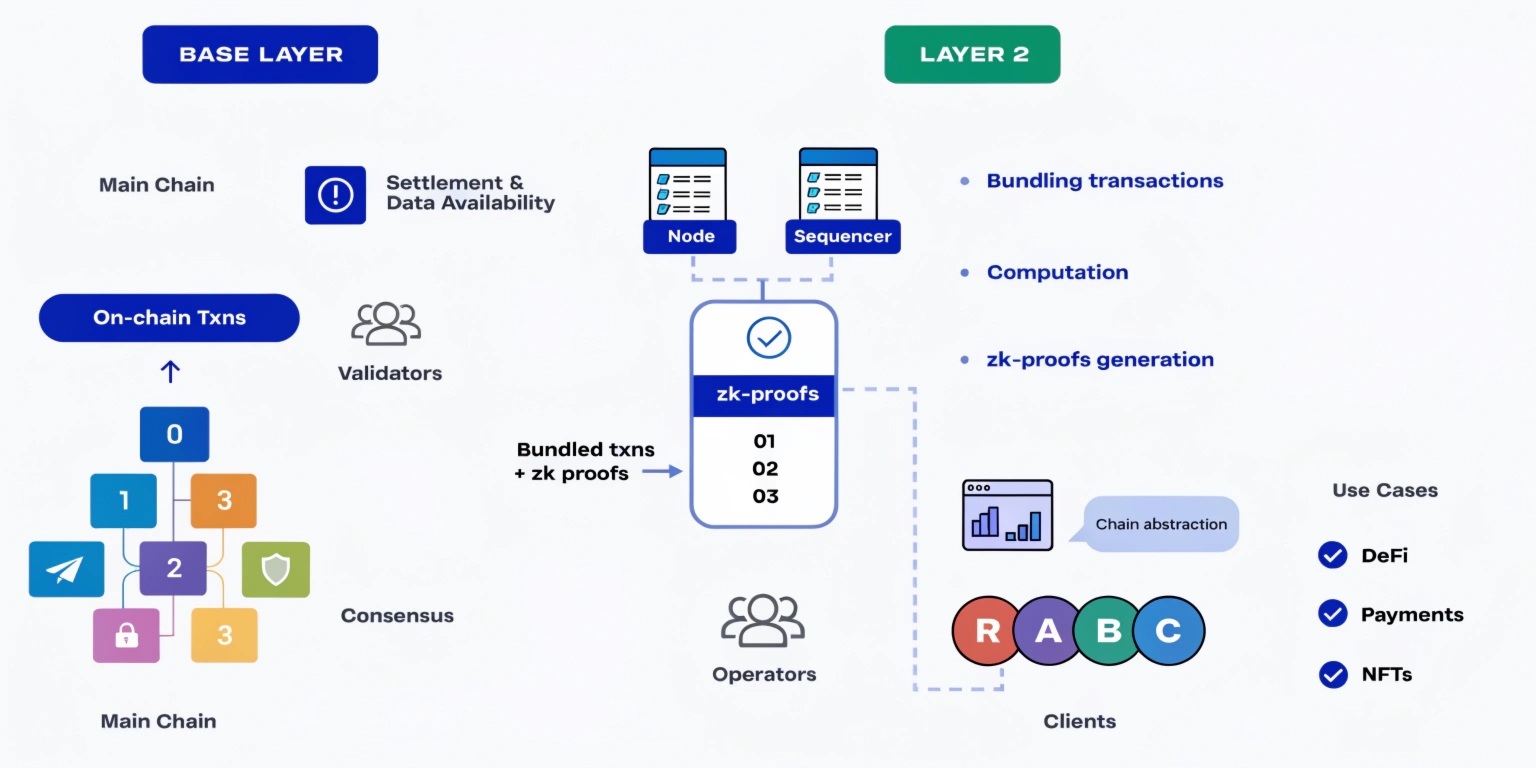
Blockchain scalability solutions like Layer 2 and zk-rollups help improve speed and reduce costs. Learn how these technologies work and enable efficient, scalable decentralized applications.
Blockchain technology has revolutionized digital transactions, but scalability remains one of its biggest challenges. Networks like Ethereum often face congestion, high fees, and slow processing times, especially during peak usage.
To address these issues, developers have introduced Layer 2 solutions and advanced technologies like zk-rollups, enabling faster and more cost-effective blockchain applications.
What is Blockchain Scalability?
Scalability refers to a blockchain’s ability to handle an increasing number of transactions efficiently without compromising speed, cost, or security.
The challenge lies in balancing the blockchain trilemma:
- Decentralization
- Security
- Scalability
Improving one often impacts the others, making scalability a complex problem.
What Are Layer 2 Solutions?
Layer 2 (L2) solutions are built on top of a base blockchain (Layer 1) to improve performance.
Instead of processing every transaction on the main chain, L2 solutions:
- Handle transactions off-chain
- Reduce network congestion
- Lower transaction fees
- Increase throughput
Popular Layer 2 approaches include:
- State channels
- Sidechains
- Rollups
Understanding Rollups
Rollups are a type of Layer 2 solution that bundles multiple transactions into a single batch and submits it to the main chain.
There are two main types:
1. Optimistic Rollups
Assume transactions are valid by default and verify only when challenged.
2. zk-Rollups (Zero-Knowledge Rollups)
Use cryptographic proofs to validate transactions before submission.
What Are zk-Rollups?
zk-rollups leverage zero-knowledge proofs to ensure that transactions are valid without revealing underlying data.
This approach offers:
- High security
- Faster validation
- Reduced data load on the main chain
Popular implementations include projects built on Ethereum that aim to scale decentralized applications efficiently.
How zk-Rollups Work
- Transactions are executed off-chain
- Multiple transactions are grouped into a batch
- A cryptographic proof (zk-proof) is generated
- The proof is submitted to the main blockchain
- The blockchain verifies the proof instead of each transaction
This significantly reduces computation and storage requirements.
Benefits of Layer 2 & zk-Rollups
1. Lower Transaction Fees
By reducing on-chain activity, users pay significantly less in gas fees.
2. Faster Transactions
Processing off-chain enables near-instant transaction speeds.
3. Improved Scalability
Thousands of transactions can be processed per second.
4. Enhanced Security
zk-rollups maintain strong security through cryptographic proofs.
Real-World Use Cases
1. Decentralized Finance (DeFi)
Faster and cheaper transactions improve trading and lending platforms.
2. NFTs and Gaming
Reduced fees make minting and trading NFTs more accessible.
3. Payments and Micropayments
Low-cost transactions enable new payment models.
4. Web3 Applications
Scalable infrastructure supports growing decentralized ecosystems.
Challenges of zk-Rollups
1. Complexity
Implementing zero-knowledge proofs requires advanced cryptographic knowledge.
2. Development Cost
Building and maintaining zk systems can be expensive.
3. Compatibility
Not all smart contracts are easily compatible with zk-rollups.
4. Centralization Risks
Some L2 solutions rely on centralized components.
Layer 2 vs Layer 1 Improvements
AspectLayer 1Layer 2ScalabilityLimitedHighCostHighLowSpeedSlowerFasterComplexityLowerHigher
Layer 2 complements Layer 1 rather than replacing it.
Future of Blockchain Scalability
The future of blockchain lies in:
- Wider adoption of zk-rollups
- Integration with decentralized applications (dApps)
- Improved developer tools
- Hybrid scaling solutions
As demand for blockchain grows, scalability solutions will play a critical role in mainstream adoption.
Best Practices for Developers
- Choose the right Layer 2 solution based on use case
- Optimize smart contracts for scalability
- Monitor transaction costs and performance
- Stay updated with evolving technologies
Conclusion
Blockchain scalability is a critical challenge that must be solved for widespread adoption. Layer 2 solutions and zk-rollups offer powerful ways to improve performance, reduce costs, and enable high-speed transactions.
For developers and businesses building in the Web3 space, understanding and leveraging these technologies is essential. As the ecosystem evolves, scalable solutions like zk-rollups will drive the next generation of decentralized innovation.
We build scalable web, mobile, and game products for clients worldwide — combining modern frameworks, cloud infrastructure, and best engineering practices.
.jpg)
.jpg)
.jpg)