Autonomous Software Development Systems: The Future of AI-Driven Engineering
Software development is entering a major transformation driven by Artificial Intelligence. What started as simple code autocomplete tools has rapidly evolved into intelligent systems capable of writing code, debugging applications, generating documentation, creating test cases, and even managing deployment workflows.
Today, the industry is moving toward autonomous software development systems—AI-driven architectures capable of handling large portions of the software development lifecycle with minimal human intervention.
These systems are reshaping how applications are designed, built, tested, deployed, and maintained. Companies are increasingly investing in AI-powered engineering tools to improve productivity, reduce development time, and accelerate innovation.
In this blog, we will explore what autonomous software development systems are, how they work, the technologies behind them, their benefits, challenges, and their future impact on software engineering.
What Are Autonomous Software Development Systems?
Autonomous software development systems are AI-powered platforms capable of performing development-related tasks independently or semi-independently.
Unlike traditional coding assistants that only suggest snippets, autonomous systems can:
- Understand requirements
- Generate architecture plans
- Write production-ready code
- Execute tests
- Detect bugs
- Refactor code
- Deploy applications
- Monitor systems
- Optimize performance
These systems combine multiple AI technologies into coordinated engineering workflows.
The goal is not simply automation of isolated tasks but automation of entire development pipelines.
Evolution from Coding Assistants to AI Engineers
The software industry has evolved through several phases:
Traditional Development
Developers manually wrote, tested, and deployed all code.
Intelligent IDE Assistance
Tools introduced:
- Syntax suggestions
- Code formatting
- Static analysis
AI Coding Assistants
Modern AI tools began generating:
- Functions
- APIs
- SQL queries
- Documentation
Autonomous Engineering Systems
Now AI systems can:
- Analyze repositories
- Understand project structure
- Coordinate multiple development tasks
- Operate through agent-based workflows
This shift represents a major evolution in software engineering productivity.
Core Technologies Behind Autonomous Systems
1. Large Language Models (LLMs)
LLMs act as the reasoning engine behind autonomous development systems.
They can:
- Interpret natural language
- Generate code
- Understand documentation
- Analyze software architecture
LLMs trained on massive codebases can support multiple programming languages and frameworks.
2. AI Agents
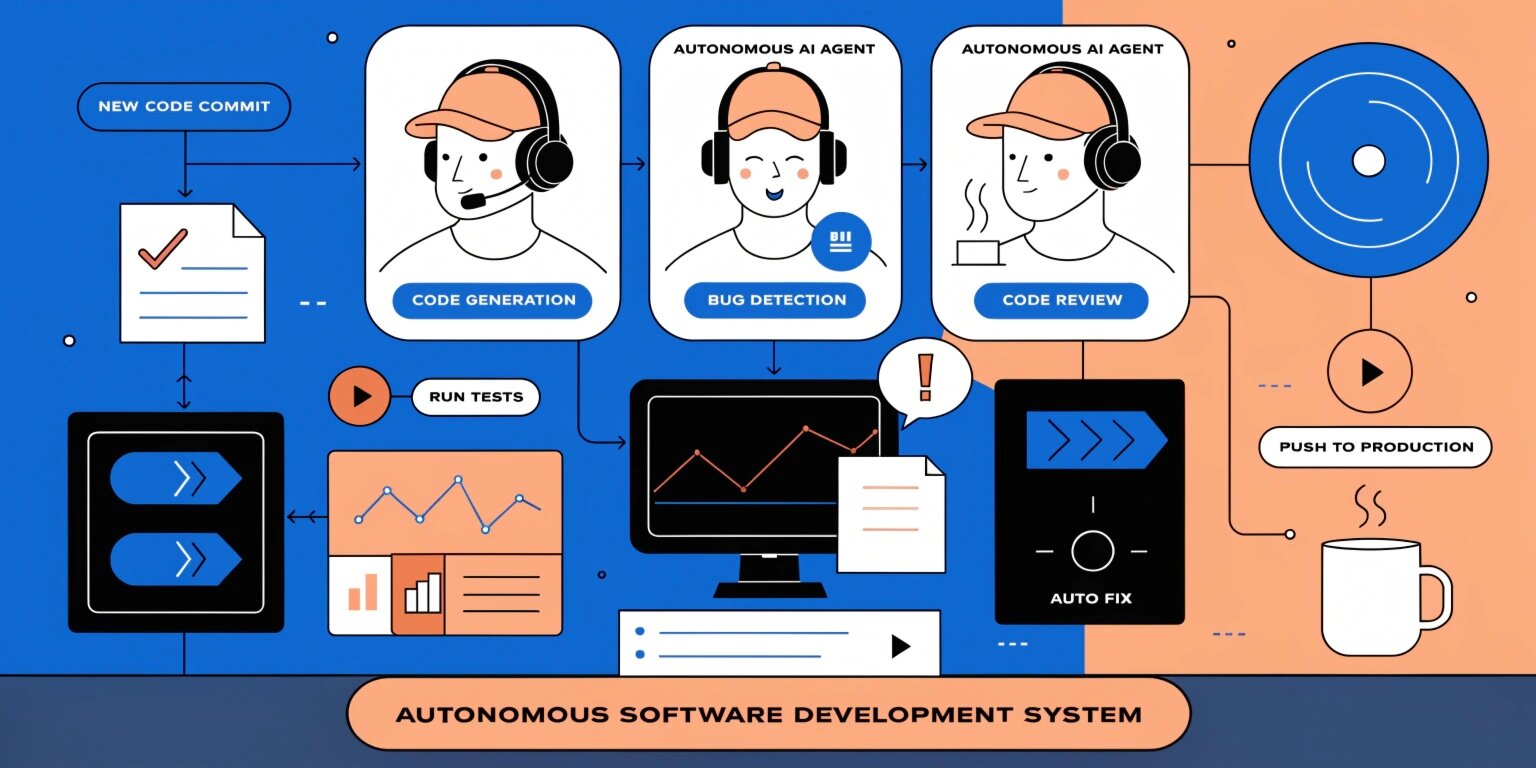
AI agents allow systems to execute multi-step workflows autonomously.
An AI development agent may:
- Read project requirements
- Generate backend APIs
- Create frontend components
- Run tests
- Fix detected issues
- Deploy applications
Agents can coordinate tasks dynamically based on results.
3. Development Tool Integration
Autonomous systems integrate directly with:
- IDEs
- Git repositories
- CI/CD pipelines
- Cloud infrastructure
- Monitoring systems
This integration allows AI systems to interact with real engineering environments rather than operating only as standalone chat interfaces.
4. Workflow Orchestration
Modern AI systems use orchestration layers to coordinate:
- Planning
- Coding
- Testing
- Validation
- Deployment
Workflow orchestration enables complex engineering automation at scale.
Applications of Autonomous Development Systems
Code Generation
AI systems can generate:
- APIs
- Database schemas
- Frontend interfaces
- Authentication systems
- Infrastructure scripts
This accelerates initial development significantly.
Automated Testing
AI can create:
- Unit tests
- Integration tests
- UI test scenarios
- Performance tests
Autonomous testing improves software quality while reducing manual effort.
Bug Detection and Refactoring
AI systems can analyze repositories to:
- Identify vulnerabilities
- Detect performance issues
- Suggest architecture improvements
- Refactor inefficient code
This helps maintain healthier codebases over time.
DevOps Automation
Autonomous systems increasingly manage:
- Deployment pipelines
- Container orchestration
- Infrastructure scaling
- Incident monitoring
This bridges the gap between software development and operations.
Benefits of Autonomous Software Development
Faster Development Cycles
AI significantly reduces repetitive coding work, enabling faster product releases.
Increased Productivity
Developers spend more time solving business problems instead of handling repetitive implementation tasks.
Improved Scalability
AI systems help teams scale engineering output without proportional increases in workforce size.
Reduced Human Error
Automated testing and code analysis improve reliability and reduce deployment failures.
Faster Prototyping
Startups can validate ideas quickly by generating MVPs rapidly using AI-assisted workflows.
Challenges and Limitations
Despite rapid advancements, autonomous systems still face major challenges.
Reliability Concerns
AI-generated code may contain:
- Bugs
- Security vulnerabilities
- Inefficient logic
- Incorrect assumptions
Human oversight remains essential.
Context Understanding
Large projects involve:
- Business logic
- Legacy systems
- Team conventions
- Domain-specific requirements
AI still struggles with deep organizational context.
Security Risks
Autonomous systems with repository or infrastructure access introduce:
- Access control risks
- Data leakage concerns
- Supply chain vulnerabilities
Proper governance and monitoring are critical.
Ethical and Workforce Questions
As AI automates engineering tasks, organizations must rethink:
- Developer roles
- Skill requirements
- Team structures
- Engineering education
The future will likely involve AI-human collaboration rather than full replacement.
The Future of AI-Driven Engineering
The future of autonomous development systems may include:
- Self-improving codebases
- AI-managed infrastructure
- Autonomous debugging
- Intelligent architecture planning
- Real-time software optimization
Development teams may eventually operate as:
- Human architects
- AI implementation agents
- Automated validation systems
Software engineering workflows will increasingly become AI-augmented ecosystems.
Human Developers Will Still Matter
Although AI systems are advancing rapidly, human expertise remains critical for:
- Strategic decision-making
- Product vision
- Creative problem-solving
- Ethical judgment
- Complex system architecture
AI is transforming how developers work—not eliminating the need for engineers entirely.
The most successful developers will likely be those who learn how to collaborate effectively with autonomous systems.
Conclusion
Autonomous software development systems represent one of the most significant technological shifts in modern engineering. By combining AI agents, large language models, workflow orchestration, and automation infrastructure, these systems can automate large portions of the software development lifecycle.
While challenges related to reliability, security, and governance remain, the potential productivity gains are enormous. Organizations adopting AI-driven development workflows early may gain major competitive advantages in speed, scalability, and innovation.
As the industry evolves, autonomous systems will increasingly become core components of modern software engineering ecosystems.