Main Content
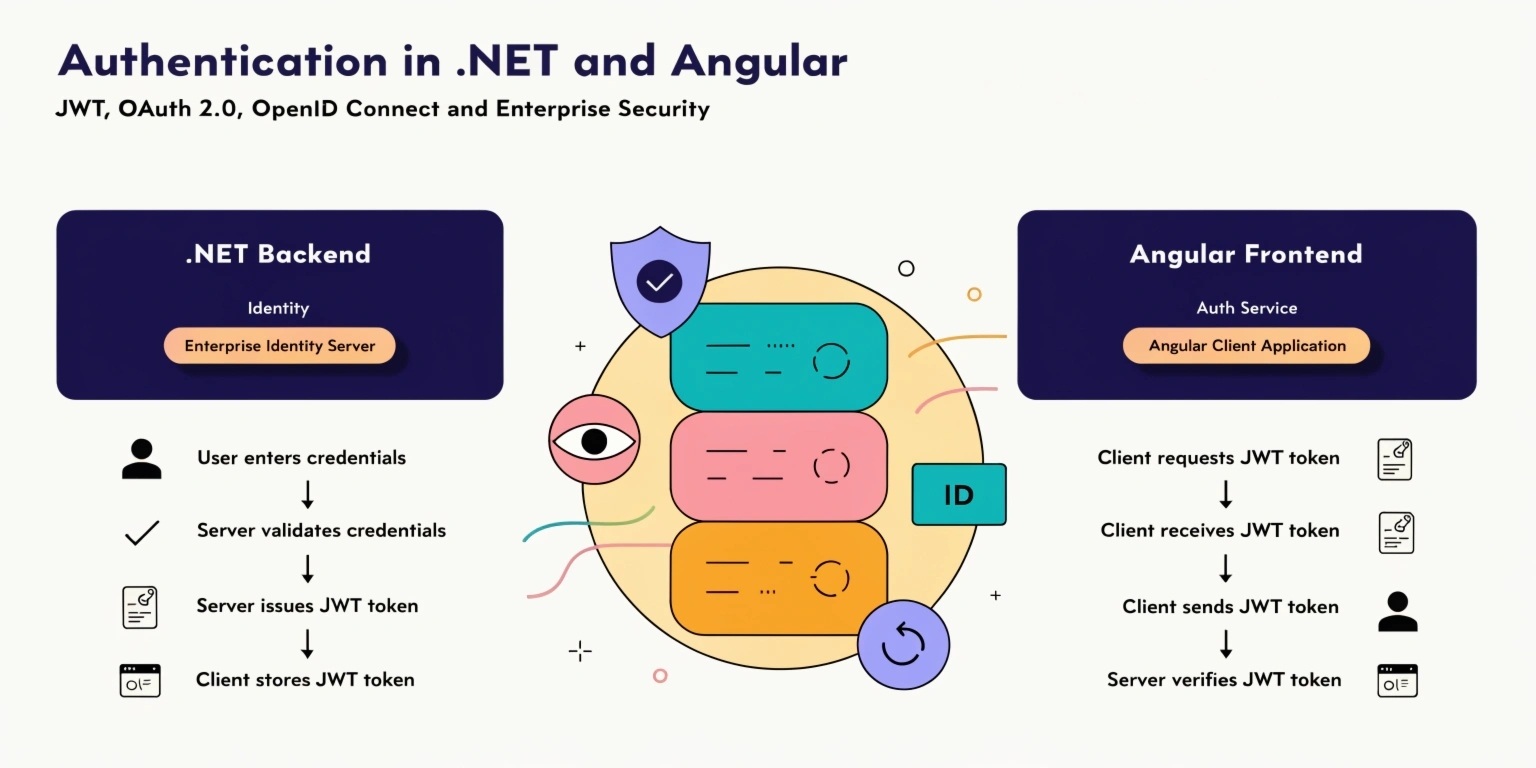
Modern web applications require strong authentication and authorization to protect users, business data, and application resources. When building enterprise applications with ASP.NET Core/.NET and Angular, developers commonly use JSON Web Tokens (JWT), OAuth 2.0, and OpenID Connect (OIDC) to create secure and scalable authentication architectures.
Understanding how these technologies work together is essential for building applications that can support multiple users, APIs, roles, organizations, and identity providers.
Understanding Authentication and Authorization
Authentication answers the question: “Who are you?” Authorization answers: “What are you allowed to access?”
In a typical .NET and Angular application, Angular provides the frontend interface while ASP.NET Core exposes APIs containing business logic and data. The frontend must authenticate users and securely communicate with backend APIs.
A common architecture is:
Angular → Identity Provider → Access Token → ASP.NET Core API → Protected Resource
After successful authentication, the application receives security tokens that can be used to access authorized resources.
JWT Authentication
JWT is one of the most popular approaches for securing REST APIs. A JSON Web Token contains claims about the authenticated user and is digitally signed so the receiving application can verify its integrity.
A JWT generally contains three components:
- Header
- Payload
- Signature
The payload can contain claims such as user ID, username, role, or permissions. Angular can send the access token to a protected .NET API using the HTTP Authorization header.
The typical request looks like:
Authorization: Bearer <access-token>
ASP.NET Core validates the token before allowing access to protected endpoints.
JWT authentication is particularly useful for stateless APIs because the server does not need to maintain a traditional server-side session for every request.
OAuth 2.0
OAuth 2.0 is an authorization framework, rather than an authentication protocol by itself. It allows applications to obtain limited access to protected resources.
For example, an Angular application may request an access token from an identity provider and then use that token to access an ASP.NET Core API.
For modern applications, the Authorization Code Flow with PKCE is commonly preferred for browser-based applications because it provides stronger protection against authorization-code interception.
OAuth 2.0 also supports delegated access, making it useful when applications need to communicate with multiple APIs or external services.
OpenID Connect
OpenID Connect extends OAuth 2.0 to provide an authentication and identity layer.
While OAuth 2.0 focuses on authorization, OpenID Connect allows applications to verify a user's identity. It introduces the ID token, which contains information about the authenticated user.
In an enterprise environment, an identity provider can handle login, multifactor authentication, password policies, account recovery, and identity federation. Angular can use the identity provider for authentication while ASP.NET Core validates the resulting access tokens.
Angular Security
Angular applications should avoid implementing authentication logic entirely on the client side. Instead, authentication should rely on a trusted identity provider and backend validation.
Angular can use HTTP interceptors to attach access tokens to API requests. However, developers must carefully consider where tokens are stored. Storing sensitive tokens in browser storage can increase exposure to certain client-side attacks, particularly if an application has an XSS vulnerability.
Applications should also implement proper route protection, session handling, logout behavior, and secure communication over HTTPS.
ASP.NET Core Authorization
After authentication, .NET provides powerful authorization capabilities. Developers can protect controllers and API endpoints using roles, policies, and claims.
For example, an enterprise application might have roles such as:
- Administrator
- Manager
- Employee
- Customer
However, role-based authorization alone may not be sufficient for complex organizations. Policy-based and claims-based authorization can provide more granular access control.
For example, an API could require a specific permission or department claim before allowing access to a particular resource.
Enterprise Security and Single Sign-On
Enterprise applications often require Single Sign-On (SSO) so employees can access multiple systems using one organizational identity.
OpenID Connect and OAuth 2.0 make it possible to integrate applications with enterprise identity platforms and centralized identity providers.
This approach simplifies account management and allows organizations to enforce security policies consistently across applications.
Enterprise security should also include:
- Multi-factor authentication
- Strong password policies
- Short-lived access tokens
- Secure refresh-token handling
- HTTPS everywhere
- Proper CORS configuration
- Rate limiting
- Audit logging
- Least-privilege access
- Secure secret management
- Regular dependency updates
Access Tokens and Refresh Tokens
Access tokens should generally have a limited lifetime. When an access token expires, a refresh mechanism can obtain a new access token without forcing the user to authenticate repeatedly.
Refresh tokens require particularly careful protection because they can provide continued access to an application. Organizations should use appropriate rotation, expiration, revocation, and storage strategies.
Best Practices
A secure .NET and Angular authentication architecture should separate responsibilities clearly. The identity provider should manage identity, Angular should manage the user experience, and ASP.NET Core should validate tokens and enforce authorization.
Developers should never trust claims simply because they originated from the browser. The backend must validate token signatures, issuer, audience, expiration, and other relevant security requirements.
Security should also be treated as an ongoing process rather than a one-time implementation. Regular security testing, dependency updates, logging, monitoring, and threat modeling help protect enterprise applications as threats evolve.
Conclusion
Authentication in .NET and Angular involves much more than simply creating a login form. JWT provides a practical mechanism for API authentication, OAuth 2.0 enables delegated authorization, and OpenID Connect provides an identity layer for modern applications.
When combined with strong authorization policies, SSO, MFA, secure token management, HTTPS, logging, and least-privilege principles, these technologies can provide a robust foundation for enterprise applications.
For organizations building scalable Angular frontends and ASP.NET Core APIs, designing authentication and authorization correctly from the beginning can significantly improve security, maintainability, and user experience.