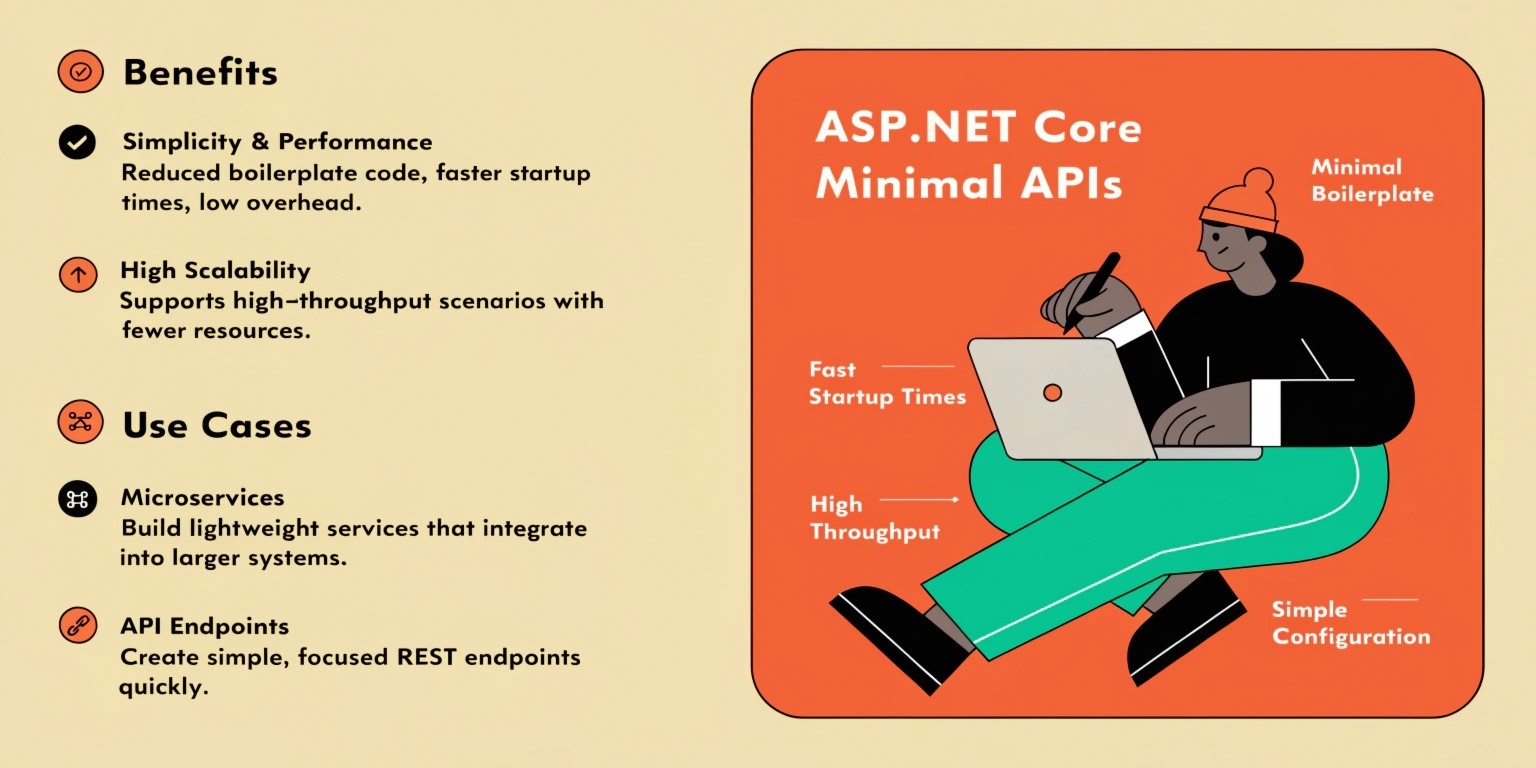
ASP.NET Core Minimal APIs: Benefits and Use Cases
The demand for fast, scalable, and maintainable web applications has transformed how developers build backend services. Modern businesses require APIs that can handle growing traffic, integrate seamlessly with cloud platforms, and support rapid development cycles. Traditional API architectures often involve significant setup, configuration, and boilerplate code, which can slow down development and increase maintenance efforts.
To address these challenges, Microsoft introduced ASP.NET Core Minimal APIs, a lightweight approach to building HTTP APIs within the .NET ecosystem. Minimal APIs simplify endpoint creation, reduce complexity, and improve developer productivity while maintaining the performance and scalability expected from modern web applications.
As organizations increasingly embrace microservices, serverless computing, and cloud-native architectures, ASP.NET Core Minimal APIs are becoming an important tool for developers building next-generation software solutions.
What Are ASP.NET Core Minimal APIs?
ASP.NET Core Minimal APIs are a simplified framework for creating HTTP endpoints without the need for traditional controllers and extensive configurations.
Instead of creating multiple controller files and route definitions, developers can define endpoints directly within the application's startup configuration.
This approach enables developers to:
- Create APIs with fewer lines of code
- Reduce application complexity
- Improve readability
- Accelerate development cycles
- Simplify maintenance
Minimal APIs provide the core functionality needed for API development while eliminating unnecessary layers that may not be required for smaller or service-oriented applications.
Why Microsoft Introduced Minimal APIs
Traditional ASP.NET Core applications typically rely on:
- Controllers
- Route attributes
- Middleware configurations
- Dependency injection setup
- Multiple project structures
While these features are valuable for complex systems, they can introduce unnecessary overhead for smaller applications and services.
Microsoft introduced Minimal APIs to support:
- Faster development
- Lightweight microservices
- Cloud-native deployments
- API-first architectures
- Modern development practices
The result is a streamlined framework that focuses on simplicity and performance.
Key Benefits of ASP.NET Core Minimal APIs
1. Less Boilerplate Code
One of the most significant advantages is the reduction of repetitive code.
Developers can define routes and business logic in a straightforward manner without creating multiple controller classes.
Benefits include:
- Cleaner codebases
- Easier onboarding for new developers
- Faster debugging
- Improved maintainability
With fewer files and configurations, teams can focus more on business functionality.
2. Faster Development Cycles
Minimal APIs significantly reduce setup time.
Developers can:
- Build prototypes quickly
- Launch MVPs faster
- Implement new features efficiently
- Reduce development overhead
This speed is especially valuable for startups and agile development teams that prioritize rapid iteration.
3. Improved Performance
Minimal APIs offer excellent runtime performance because they reduce processing overhead.
Advantages include:
- Faster request handling
- Lower memory consumption
- Reduced latency
- Better scalability
Applications that require high throughput and responsiveness can benefit from this lightweight architecture.
4. Ideal for Microservices
Microservices architectures require services that are:
- Independent
- Lightweight
- Easy to deploy
- Easily scalable
Minimal APIs fit these requirements perfectly.
Organizations can create focused services for:
- Authentication
- Payment processing
- Notifications
- Product management
- Customer services
This modular approach improves scalability and maintainability.
5. Cloud-Native Compatibility
Modern cloud environments prioritize efficiency and resource optimization.
Minimal APIs work exceptionally well with:
- Docker containers
- Kubernetes
- Microsoft Azure
- AWS
- Google Cloud Platform
Their lightweight design makes them ideal for cloud-native deployments where resource consumption directly impacts operational costs.
Common Use Cases for Minimal APIs
RESTful Web Services
Minimal APIs are well-suited for creating RESTful services.
Examples include:
- User management systems
- E-commerce APIs
- Customer portals
- Product catalog services
Their straightforward design simplifies endpoint development while maintaining flexibility.
Microservices Architectures
Organizations increasingly adopt microservices to improve scalability and agility.
Minimal APIs can support:
- Order services
- Inventory systems
- Customer management
- Billing platforms
Each service remains independent and easier to maintain.
Serverless Applications
Serverless computing continues gaining popularity.
Minimal APIs can power:
- Azure Functions integrations
- Event-driven workflows
- Automated business processes
- Data processing services
Their small footprint contributes to faster startup times and lower infrastructure costs.
Internet of Things (IoT)
IoT ecosystems often require lightweight APIs for device communication.
Minimal APIs can manage:
- Device registration
- Sensor data collection
- Monitoring systems
- Remote device control
Their performance characteristics make them ideal for handling large numbers of connected devices.
Internal Enterprise Applications
Businesses frequently develop internal tools that require simple but reliable APIs.
Examples include:
- HR systems
- Reporting dashboards
- Workflow automation
- Employee management platforms
Minimal APIs help reduce development complexity while delivering robust functionality.
Minimal APIs vs Traditional Controllers
Choosing between Minimal APIs and Controllers depends on project requirements.
Use Minimal APIs When:
- Building small-to-medium APIs
- Developing microservices
- Creating prototypes or MVPs
- Deploying cloud-native applications
- Prioritizing performance and simplicity
Use Controllers When:
- Managing large enterprise systems
- Implementing complex business logic
- Requiring advanced validation workflows
- Supporting large development teams
- Maintaining highly structured architectures
Both approaches can coexist within the same application if needed.
Security Features
Minimal APIs inherit the security capabilities of ASP.NET Core.
Developers can implement:
- JWT authentication
- OAuth integration
- Role-based authorization
- HTTPS enforcement
- API key validation
This ensures enterprise-grade security while maintaining a lightweight development model.
Integration with Modern Development Tools
ASP.NET Core Minimal APIs integrate seamlessly with:
- Entity Framework Core
- SQL Server
- PostgreSQL
- Swagger/OpenAPI
- Redis
- Azure Services
- Docker
- Kubernetes
These integrations enable developers to build production-ready systems efficiently.
Future of ASP.NET Core Minimal APIs
The future of Minimal APIs looks promising as businesses continue adopting:
- Microservices architectures
- Cloud-native applications
- API-first development
- Serverless computing
- Distributed systems
Upcoming advancements are expected to include:
- Enhanced tooling support
- Better AI-assisted development
- Improved observability
- Advanced cloud integrations
- More streamlined deployment workflows
As the .NET ecosystem evolves, Minimal APIs will continue playing a crucial role in modern backend development.
Best Practices
To maximize success with Minimal APIs:
- Keep endpoints focused and concise
- Separate business logic into services
- Implement robust validation
- Secure endpoints appropriately
- Document APIs using Swagger
- Follow RESTful conventions
- Monitor performance and scalability
These practices help maintain clean, scalable, and maintainable applications.
Conclusion
ASP.NET Core Minimal APIs represent a modern approach to API development that emphasizes simplicity, performance, and productivity. By reducing boilerplate code and streamlining endpoint creation, they allow developers to build lightweight and scalable applications more efficiently.
Whether developing microservices, cloud-native platforms, serverless applications, or internal business tools, Minimal APIs provide a powerful solution for modern backend development. As organizations continue embracing agile development and distributed architectures, ASP.NET Core Minimal APIs are well-positioned to become a standard choice for building high-performance web services.