For many years, software development followed a simple mindset:
the frontend was the product, and the backend merely supported it.
Today, that idea has completely changed.
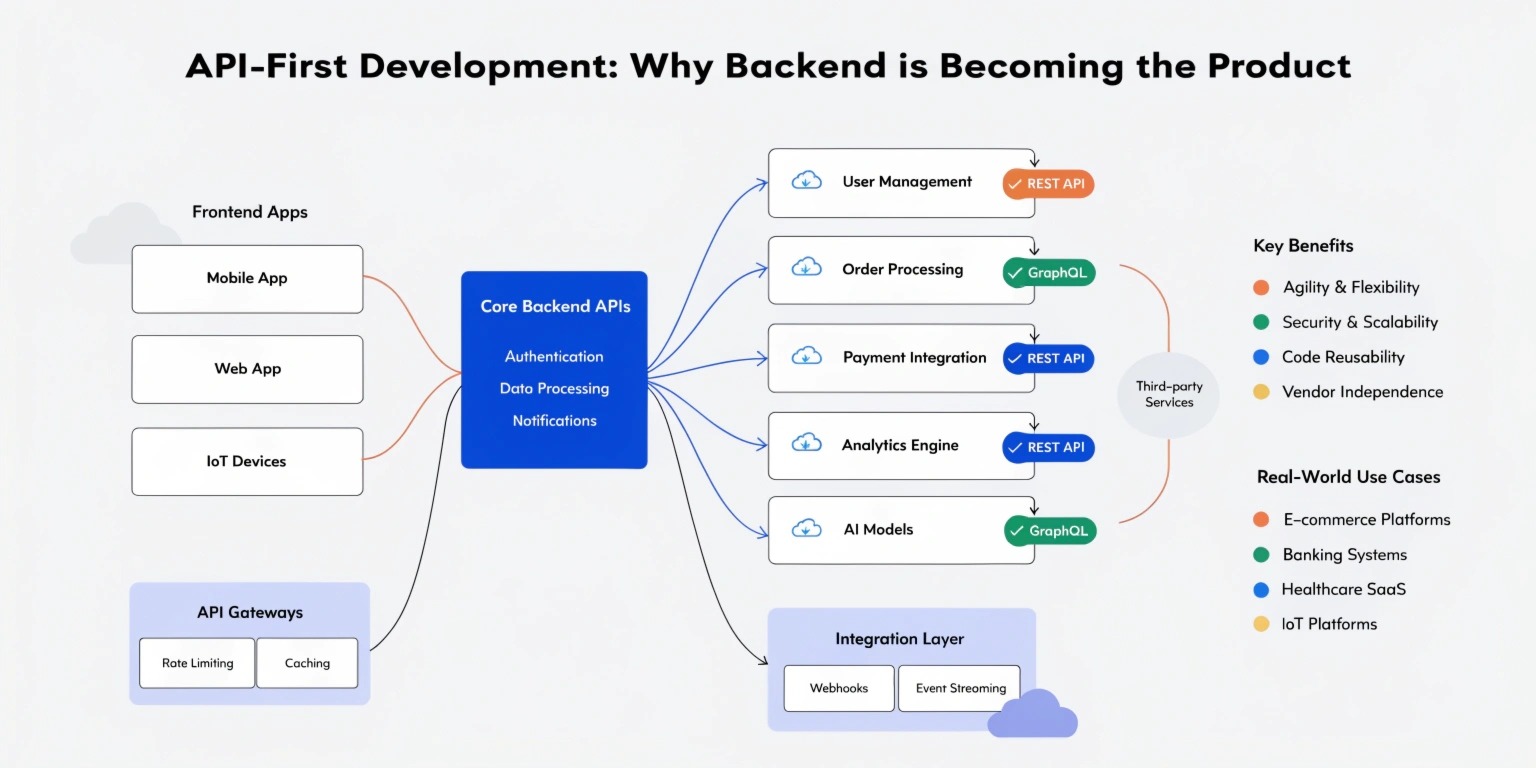
Modern technology companies increasingly follow API-first development, where the backend is no longer just a supporting component — it is the product. The user interface becomes just one of many consumers of the platform.
This shift is powering SaaS platforms, marketplaces, fintech systems, and even AI services.
Let’s understand why.
What is API-First Development?
API-first development means designing and building application APIs before building the UI.
Instead of:
Build UI → Connect backend later
Companies now:
Design API contract → Build backend → Build multiple frontends
The API becomes the central system around which everything else operates.
An API (Application Programming Interface) defines:
- available operations
- request/response formats
- authentication methods
- business capabilities
The UI simply consumes these capabilities.
Why Backend is Becoming the Product
Previously, users interacted only through websites or mobile apps. Now, software ecosystems are interconnected.
A single platform may have:
- web app
- mobile app
- partner integrations
- third-party developers
- automation systems
- AI agents
All of them need the same functionality.
The only scalable way to support this is through APIs.
So companies no longer build “apps.”
They build platforms.
Examples of backend-as-product companies:
- Payment platforms
- Mapping services
- Communication platforms
- Identity authentication systems
In these businesses, the API is what customers actually buy.
Key Drivers of API-First Adoption
1. Multi-Platform Applications
Users now interact via phone, web, smartwatch, smart TV, and integrations. A UI-centric backend cannot scale to this diversity.
An API-first backend supports all channels simultaneously.
2. Faster Development
Frontend and backend teams can work in parallel.
Backend defines contracts using:
- OpenAPI/Swagger
- GraphQL schema
Frontend developers build immediately using mock APIs. This drastically reduces release cycles.
3. Third-Party Integrations
Modern businesses rely heavily on integrations:
- payment gateways
- CRM systems
- analytics tools
- shipping providers
APIs make integration possible without exposing internal systems.
4. Microservices Architecture
Microservices communicate with each other via APIs. API-first design ensures services remain modular and independent.
This improves:
- scalability
- reliability
- deployment flexibility
5. API Monetization
Some companies don’t sell software — they sell access.
Businesses pay per API usage:
- per transaction
- per request
- per data lookup
This creates recurring revenue streams and platform ecosystems.
API-First vs Code-First Development
Code-FirstAPI-FirstUI built firstAPI designed firstBackend tightly coupledBackend reusableHard integrationsEasy integrationsSingle applicationMulti-platform platform
API-first encourages thinking about business capabilities instead of screens.
Headless and Platform Architecture
API-first enables headless architecture.
The frontend (presentation layer) is separated from business logic. Any interface can be attached:
- React website
- Flutter mobile app
- Admin dashboard
- Chatbot
- Voice assistant
This is why many modern CMS, e-commerce, and SaaS systems are “headless.”
Impact on Development Teams
Developers now focus on:
- versioned APIs
- backward compatibility
- documentation
- SDKs
- developer experience (DX)
Companies treat developers as customers. A good API is now as important as a good UI.
Real-World Use Cases
Fintech
Payment processing systems expose APIs for:
- payment initiation
- refunds
- subscriptions
- KYC verification
Apps are just interfaces. The backend handles business value.
E-commerce
Marketplaces provide APIs for:
- product catalog
- inventory
- orders
- logistics
Sellers and partners integrate directly without manual processes.
AI Platforms
AI services provide APIs for:
- text generation
- image creation
- speech processing
The model is the product, and the API is the delivery mechanism.
Challenges of API-First
- Requires careful planning
- Version management complexity
- Security considerations
- Documentation effort
- Governance needed
Poorly designed APIs are difficult to change once public.
Best Practices
- Design contracts early
- Use versioning
- Maintain strong authentication
- Provide clear documentation
- Monitor usage analytics
Good APIs prioritize consistency and predictability.
Future Outlook
The software industry is shifting from application companies to platform companies.
In the future:
- apps will be replaceable
- interfaces will evolve
- APIs will remain constant
This makes backend architecture a long-term strategic asset.
Final Thoughts
API-first development reflects a fundamental change in software thinking. The value is no longer in the interface but in the capabilities provided.
When the backend becomes reusable, integratable, and monetizable, it becomes the real product.
Companies that understand this build ecosystems instead of single applications — and ecosystems always scale further than apps.