Introduction
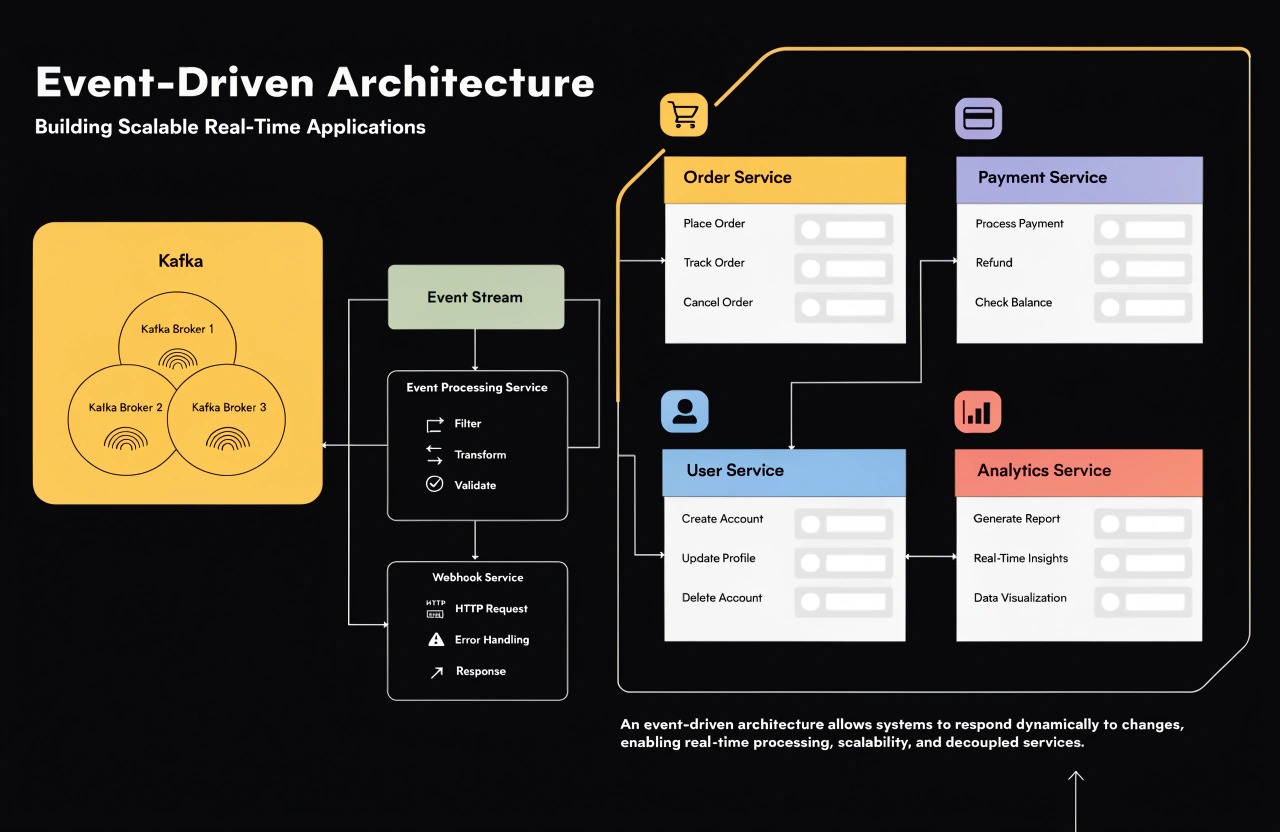
As enterprise applications continue evolving, traditional monolithic architectures struggle to handle increasing user traffic, real-time updates, and distributed workloads. Organizations are rapidly adopting Event-Driven Architecture (EDA) combined with Microservices to improve scalability, reliability, and maintainability.
Angular remains one of the most popular frontend frameworks for enterprise development. While Angular itself doesn't communicate directly with Kafka, it plays an essential role by consuming APIs, WebSockets, Server-Sent Events (SSE), or GraphQL subscriptions exposed by backend microservices that publish and process Kafka events.
This architecture enables businesses to build highly responsive applications capable of processing millions of events every day.
Understanding Event-Driven Architecture
Event-Driven Architecture is a software design pattern where different services communicate by publishing and subscribing to events instead of calling each other directly.
An event can represent actions such as:
- User registration
- Product purchase
- Payment completed
- Order shipped
- Inventory updated
- Notification generated
Instead of tightly coupling services, each microservice reacts independently whenever a relevant event occurs.
This greatly improves flexibility and scalability.
Why Kafka?
Apache Kafka is one of the world's most widely used event-streaming platforms.
Kafka provides:
- High throughput
- Low latency
- Horizontal scalability
- Event persistence
- Fault tolerance
- Distributed messaging
- Stream processing
Rather than losing messages after delivery, Kafka stores events for configurable periods, allowing services to replay events whenever necessary.
Angular's Role in Event-Driven Systems
Angular typically doesn't connect directly to Kafka.
Instead, Angular communicates with backend services through:
- REST APIs
- GraphQL
- WebSockets
- Server-Sent Events
- SignalR (for .NET)
- Socket.IO
The backend microservices subscribe to Kafka topics, process events, and send updates to Angular clients in real time.
Example workflow:
- Customer places an order.
- Angular sends REST request.
- Order Service stores data.
- Order Service publishes an event to Kafka.
- Inventory Service consumes the event.
- Payment Service processes payment.
- Notification Service sends confirmation.
- Angular receives live updates via WebSockets.
This asynchronous workflow significantly improves responsiveness.
Typical Architecture
A modern architecture may include:
Frontend
- Angular
- RxJS
- Angular Signals
API Layer
- API Gateway
- Authentication
- Authorization
Microservices
- User Service
- Order Service
- Payment Service
- Inventory Service
- Shipping Service
- Notification Service
Messaging
- Apache Kafka
Infrastructure
- Docker
- Kubernetes
- Redis
- PostgreSQL
- MongoDB
Each component performs a dedicated responsibility while remaining loosely coupled.
Benefits of Angular with Kafka
1. Real-Time Updates
Users instantly receive:
- Order status
- Chat messages
- Live dashboards
- Notifications
- IoT data
- Stock prices
without refreshing the page.
2. Better Scalability
Microservices scale independently.
If payment requests increase, only the Payment Service needs additional instances.
Angular remains unaffected.
3. Loose Coupling
Services never depend directly on each other.
Adding new services becomes significantly easier.
4. Fault Tolerance
If one service becomes unavailable, Kafka retains events until recovery.
This minimizes data loss.
5. Faster Development
Independent teams can develop separate services simultaneously.
Frontend teams continue working without waiting for backend modifications.
Angular Best Practices
When building event-driven Angular applications:
Use RxJS Effectively
RxJS remains essential for handling asynchronous streams, WebSockets, and reactive UI updates.
Implement State Management
Use:
- NgRx
- Signals
- Akita
- NGXS
for predictable state management.
Handle Real-Time Updates
Update UI dynamically using:
- Observables
- Signals
- Change Detection optimization
Avoid unnecessary API polling.
Secure APIs
Implement:
- JWT Authentication
- OAuth
- Role-Based Access Control
- HTTPS
- API Gateway security
Never expose Kafka directly to frontend applications.
Optimize Performance
Use:
- Lazy Loading
- Standalone Components
- Route Preloading
- OnPush Change Detection
- Efficient caching
These techniques improve responsiveness
.
Real-World Applications
Angular with Kafka is commonly used in:
Banking
- Fraud detection
- Live transactions
- Payment monitoring
Healthcare
- Patient monitoring
- Appointment notifications
- Medical alerts
E-commerce
- Inventory updates
- Order tracking
- Recommendations
Logistics
- Fleet tracking
- Shipment monitoring
- Delivery notifications
IoT
- Smart devices
- Sensor dashboards
- Industrial monitoring
Financial Markets
- Live stock prices
- Portfolio updates
- Trading platforms
Challenges
Despite its advantages, event-driven architecture introduces complexity.
Common challenges include:
- Event ordering
- Duplicate messages
- Schema evolution
- Distributed debugging
- Monitoring multiple services
- Data consistency
- Event versioning
Using centralized logging, distributed tracing, and monitoring tools like Prometheus and Grafana helps manage these challenges effectively.
Future Trends
As enterprise software evolves, Angular applications will increasingly leverage:
- AI-powered event processing
- Edge computing
- Event mesh architectures
- Serverless microservices
- Cloud-native Kafka platforms
- Real-time analytics
- Predictive automation
Angular's modern features, combined with Kafka's robust event streaming capabilities, make this architecture well-suited for next-generation enterprise applications.
Conclusion
Angular, Kafka, and microservices together provide a powerful foundation for building scalable, resilient, and real-time enterprise applications. While Angular focuses on delivering rich user experiences, Kafka enables reliable event streaming, and microservices ensure modularity and scalability. By adopting event-driven architecture, organizations can create applications that respond instantly to business events, improve system reliability, and adapt more easily to changing requirements. As businesses continue embracing cloud-native development, this architectural approach will remain a key strategy for building future-ready web applications.