Main Content
Modern mobile applications often need capabilities that go beyond what a cross-platform framework provides out of the box. Features such as Bluetooth communication, biometric authentication, background services, advanced camera controls, custom notifications, payment integrations, and specialized hardware access may require platform-specific code. This is where Android and iOS native modules become valuable.
What Are Native Modules?
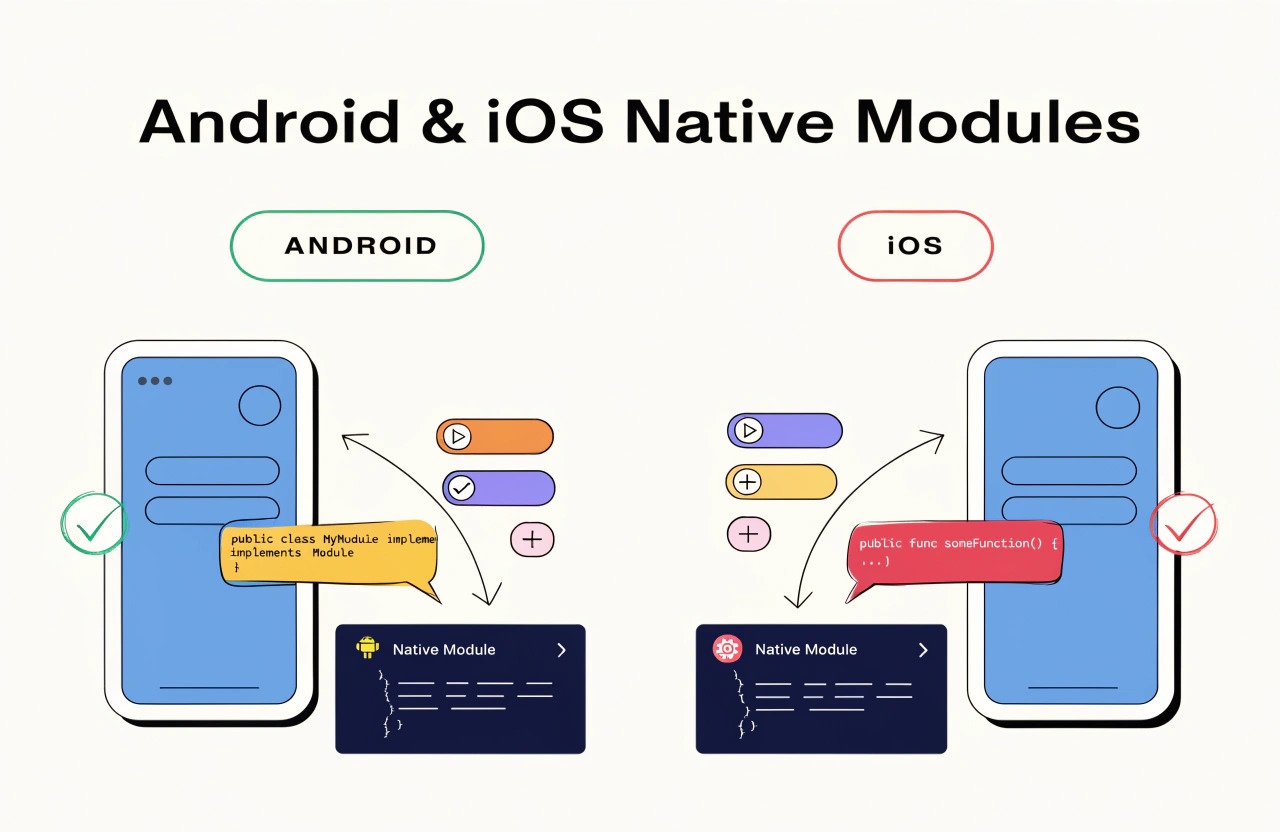
Native modules are platform-specific pieces of code that allow a cross-platform application to communicate with the underlying operating system. Instead of implementing every feature using JavaScript or another shared programming language, developers can write native functionality using the technologies supported by each platform.
For Android, developers commonly use Kotlin or Java, while iOS development primarily uses Swift or Objective-C. Frameworks such as React Native can communicate with these native modules through established interfaces.
For example, a React Native application may need access to a device's advanced biometric authentication system. If the required functionality is not available through an existing library, developers can create a native Android module using Kotlin and an iOS module using Swift.
Why Are Native Modules Important?
Native modules provide flexibility when building sophisticated mobile applications. Cross-platform development can significantly reduce development time because much of the application logic can be shared. However, operating systems provide unique capabilities that cannot always be accessed through shared code.
Native modules help bridge this gap.
They can provide:
- Access to platform-specific APIs
- Improved performance for demanding operations
- Integration with device hardware
- Custom operating-system functionality
- Advanced security features
- Native background processing
- Custom UI components
- Access to third-party native SDKs
This approach allows businesses to maintain the advantages of cross-platform development while still using the full capabilities of Android and iOS.
Android Native Modules
Android native modules can be developed using Kotlin or Java and integrated into cross-platform applications. Kotlin has become especially popular because of its modern syntax, safety features, and strong Android ecosystem support.
An Android native module can interact with services such as Bluetooth, GPS, NFC, sensors, camera APIs, biometric authentication, notifications, and background services.
For example, if an application needs a specialized Bluetooth communication system that is unavailable through an existing cross-platform package, developers can implement the required functionality using Android's native Bluetooth APIs and expose only the necessary methods to the cross-platform layer.
iOS Native Modules
iOS native modules provide similar functionality for Apple devices. Developers typically use Swift, although Objective-C remains important for compatibility with older libraries and existing applications.
Native iOS modules can access capabilities such as Face ID, Touch ID, Core Bluetooth, Core Location, camera functionality, push notifications, Apple-specific security services, and other iOS frameworks.
Using Swift-based native modules can also help developers integrate specialized Apple SDKs without rewriting the entire application in native Swift.
Native Modules and React Native
React Native is one of the most common environments where native modules are used. Applications can share much of their business logic and user interface while delegating specialized operations to native Android and iOS code.
The basic architecture involves communication between the JavaScript or React Native layer and the native platform layer. The cross-platform application calls a native method, the Android or iOS implementation performs the required operation, and the result is returned to the application.
Modern React Native architecture has also introduced improved approaches for native interoperability, helping reduce communication overhead and improve application performance.
Performance Benefits
Native modules can be particularly useful for computationally intensive operations. Image processing, encryption, advanced animations, audio processing, machine-learning operations, and hardware communication can sometimes benefit from native implementation.
However, developers should avoid creating native modules unnecessarily. Every additional native dependency increases project complexity and requires platform-specific maintenance.
The best approach is to use shared code wherever practical and introduce native modules when there is a clear technical requirement.
Security Considerations
Native modules can also support stronger security implementations. Sensitive functionality can be handled using platform security APIs instead of exposing everything to the cross-platform layer.
For example, developers can use Android Keystore or Apple's Keychain for secure credential storage. Native biometric APIs can also provide safer authentication workflows.
Developers should carefully validate data exchanged between the cross-platform and native layers and avoid exposing sensitive information unnecessarily.
Best Practices
When developing Android and iOS native modules, developers should follow several best practices:
- Keep native modules focused on specific responsibilities.
- Use clear interfaces between shared and native code.
- Document Android and iOS differences.
- Handle errors consistently.
- Test each platform independently.
- Avoid unnecessary native dependencies.
- Keep APIs simple and reusable.
- Monitor performance and memory usage.
- Follow Android and iOS security guidelines.
- Maintain compatibility with framework and operating-system updates.
Conclusion
Android and iOS native modules are an important part of modern cross-platform mobile development. They allow developers to combine the productivity of shared application code with the power of native platform capabilities.
Whether an application requires advanced hardware access, specialized SDK integration, high-performance processing, or platform-specific security, native modules provide a practical way to extend cross-platform applications. With a well-designed architecture, developers can build scalable mobile applications that deliver a consistent user experience while taking advantage of the unique capabilities of Android and iOS.