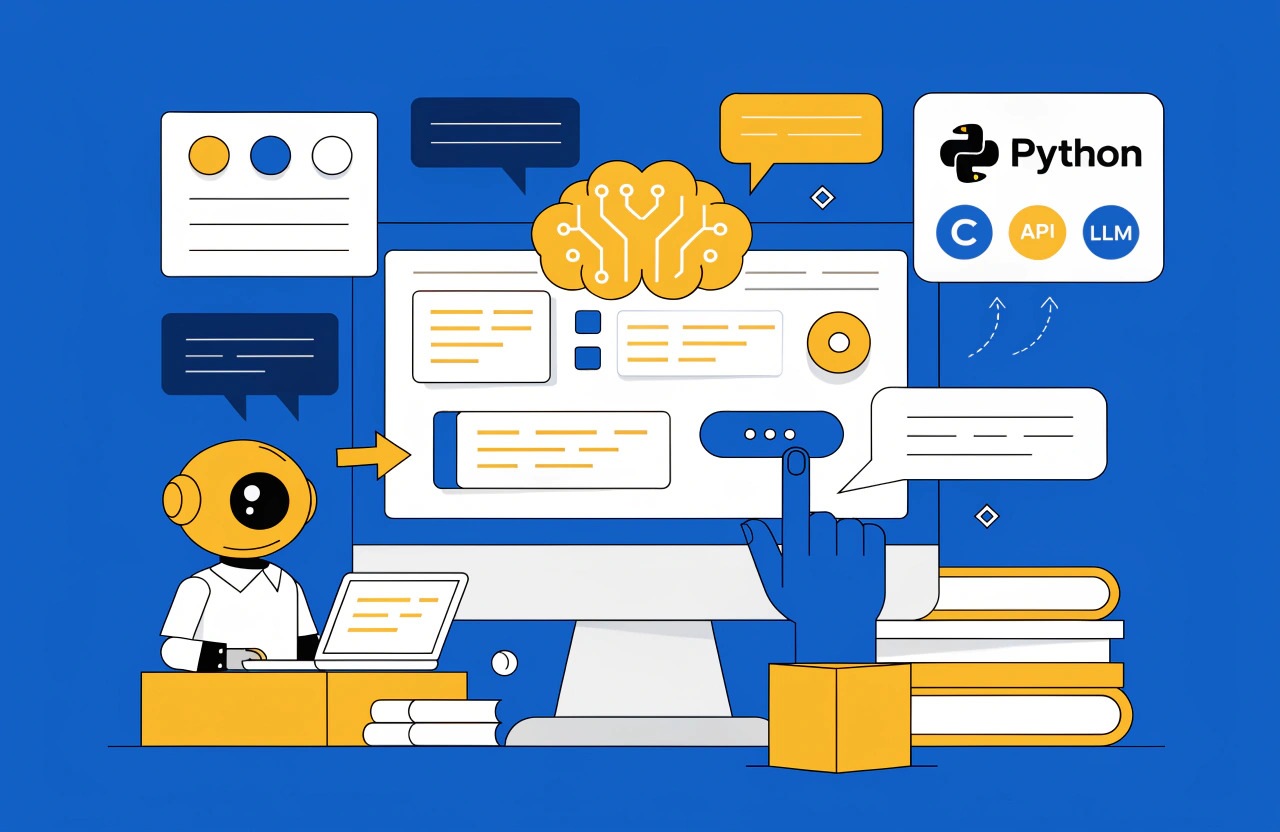
AI-Powered Code Generation with Python and LLM APIs
Artificial Intelligence has become one of the most transformative technologies in software engineering. Modern developers are no longer writing every line of code manually. Instead, they are leveraging AI-powered coding assistants built on Large Language Models (LLMs) to generate functions, debug errors, write documentation, create unit tests, and even design complete applications.
Python has emerged as the preferred programming language for AI development due to its simplicity, extensive ecosystem, and compatibility with nearly every AI framework. Combined with powerful LLM APIs, Python enables businesses and developers to build intelligent applications capable of understanding natural language and generating production-ready code.
What is AI-Powered Code Generation?
AI-powered code generation refers to using Artificial Intelligence models trained on massive programming datasets to generate source code based on user instructions.
Instead of manually writing code, developers provide prompts such as:
"Create a Python API that uploads images to cloud storage."
The AI interprets the request and generates the required code, often including comments, documentation, and error handling.
Modern LLM APIs understand multiple programming languages including:
- Python
- JavaScript
- TypeScript
- Java
- C#
- PHP
- Go
- Rust
- SQL
Python remains the most widely used language for integrating these AI capabilities into applications.
Why Python is Ideal for AI Code Generation
Python offers several advantages that make it the first choice for AI developers.
1. Simple Syntax
Python's readable syntax makes AI-generated code easier to understand and modify.
2. Rich AI Ecosystem
Python supports numerous libraries including:
- Requests
- FastAPI
- Flask
- LangChain
- LlamaIndex
- Pandas
- NumPy
These libraries simplify AI integration.
3. Easy API Integration
Most LLM providers offer Python SDKs, making implementation quick and efficient.
4. Large Community Support
Python has one of the largest developer communities, ensuring continuous improvements and extensive documentation.
How LLM APIs Generate Code
The code generation workflow is straightforward:
- User submits a prompt.
- Python sends the prompt to an LLM API.
- The AI analyzes the request.
- The model generates code.
- Python receives the response.
- The application displays or executes the generated code.
This interaction happens in seconds, significantly reducing development time.
Popular Use Cases
Automatic Function Generation
Developers can describe a function, and AI writes the implementation.
Example:
"Create a Python function that removes duplicate values from a list."
The AI instantly generates optimized code.
Documentation Generation
Maintaining documentation is time-consuming.
AI can automatically generate:
- Function descriptions
- API documentation
- README files
- Inline comments
Unit Test Generation
Developers often overlook testing.
LLMs can automatically create:
- PyTest scripts
- Edge case testing
- Integration tests
This improves software quality.
SQL Query Generation
Instead of writing SQL manually, users can ask:
"Show monthly sales grouped by customer."
The AI generates optimized SQL queries.
Bug Detection
AI identifies:
- Syntax errors
- Logic mistakes
- Missing imports
- Performance issues
This speeds up debugging.
Code Refactoring
AI helps improve existing code by:
- Removing duplication
- Improving readability
- Enhancing performance
- Following coding standards
Benefits of AI Code Generation
Increased Productivity
Developers spend less time writing repetitive code and more time solving business problems.
Faster Development
Projects move from concept to deployment much faster.
Better Learning
Junior developers can understand coding patterns through AI-generated examples.
Reduced Errors
AI suggests standardized implementations that reduce common programming mistakes.
Improved Collaboration
Teams maintain consistent coding styles using AI assistance.
Best Practices
To maximize the effectiveness of AI-generated code:
- Write detailed prompts.
- Review generated code before deployment.
- Never expose API keys.
- Validate AI outputs.
- Add human testing.
- Follow secure coding standards.
- Use version control.
- Monitor API usage and costs.
Human oversight remains essential for ensuring correctness, security, and maintainability.
Challenges
Although AI code generation is powerful, developers should be aware of its limitations.
Hallucinations
AI may generate incorrect or non-existent functions.
Security Risks
Generated code may contain insecure practices if prompts are vague.
Dependency Issues
The model may recommend outdated or incompatible libraries.
Context Limitations
Very large projects may exceed the model's context window, requiring careful prompt design.
These challenges reinforce the need for thorough code reviews and testing.
Future of AI Coding
The future of software engineering will increasingly involve AI as a collaborative development partner. Upcoming advancements include:
- Autonomous coding agents
- AI-assisted code reviews
- Self-healing applications
- Intelligent DevOps automation
- Multi-agent software development
- Real-time architecture recommendations
- Automated documentation updates
Rather than replacing developers, AI will augment their capabilities, enabling faster innovation and allowing engineers to focus on system design, business logic, and creative problem-solving.
Conclusion
AI-powered code generation with Python and LLM APIs is redefining how modern software is built. By combining Python’s flexibility with the capabilities of Large Language Models, developers can automate repetitive coding tasks, accelerate development cycles, improve documentation, and build smarter applications with greater efficiency.
Organizations that embrace AI-assisted development can increase productivity, reduce time-to-market, and maintain high-quality software through responsible use of AI, secure coding practices, and human oversight. As LLM technology continues to evolve, AI-powered coding will become an indispensable part of every developer’s toolkit.