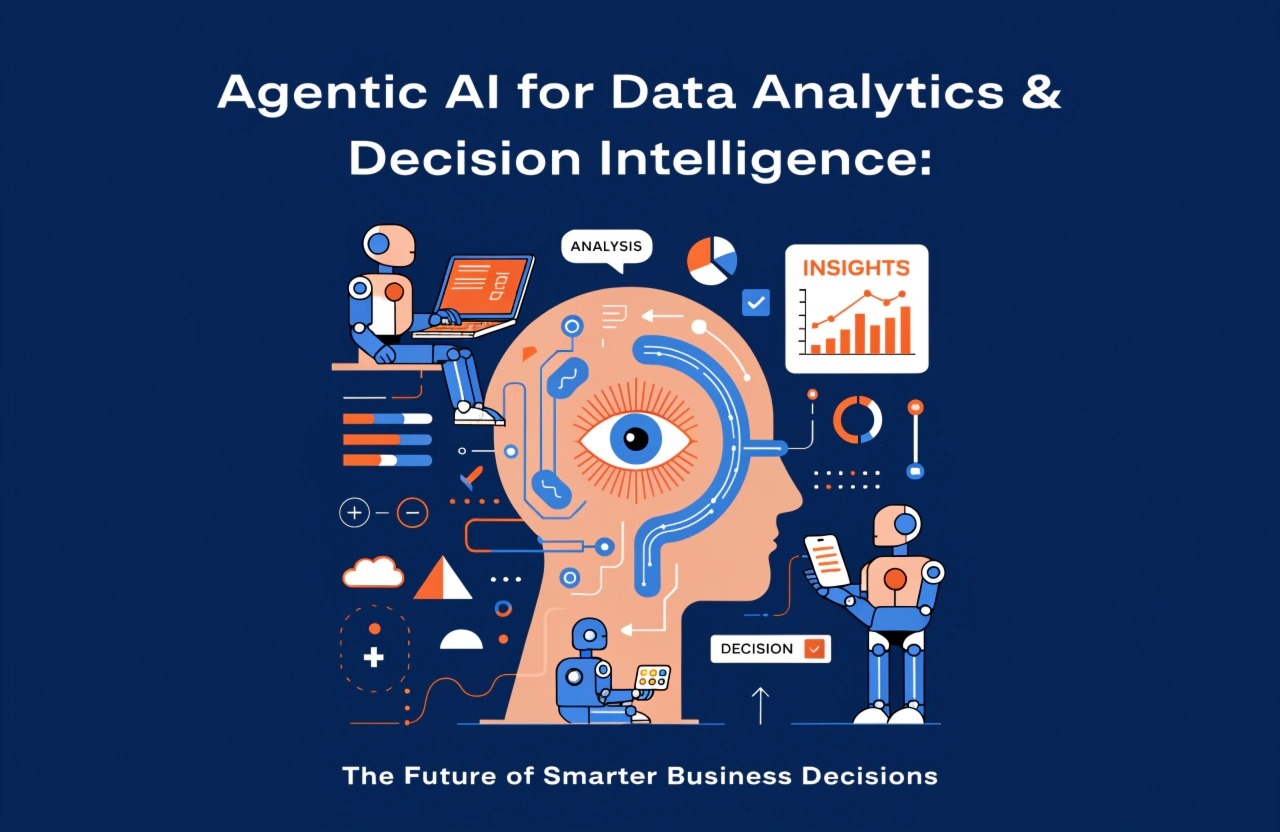
Agentic AI is transforming data analytics by enabling AI agents to analyze information, identify trends, recommend actions, and support autonomous business decisions in real time.
Main Content
Agentic AI for Data Analytics & Decision Intelligence
Businesses today generate enormous amounts of data from websites, applications, customer interactions, transactions, marketing platforms, IoT devices, and enterprise systems. However, collecting data is no longer enough. Organizations need to understand that data quickly and convert it into meaningful decisions.
This is where Agentic AI for Data Analytics and Decision Intelligence is becoming increasingly important.
Unlike traditional analytics systems that primarily display dashboards and reports, Agentic AI can actively analyze information, identify important patterns, ask follow-up questions, recommend actions, and support business users throughout the decision-making process.
What Is Agentic AI?
Agentic AI refers to AI systems that can operate with a certain level of autonomy to achieve defined objectives. Instead of simply responding to a single prompt, AI agents can plan tasks, use tools, analyze information, evaluate results, and take subsequent actions based on predefined goals and business rules.
For data analytics, an AI agent could receive a business objective such as:
"Identify why sales decreased this quarter and recommend actions to improve revenue."
The agent could collect relevant sales data, compare historical performance, analyze customer segments, identify unusual trends, evaluate marketing campaigns, and generate recommendations.
This moves analytics from "What happened?" toward "Why did it happen, what could happen next, and what should we do?"
How Agentic AI Changes Data Analytics
Traditional business intelligence generally requires users to open dashboards, select filters, create queries, and interpret charts.
Agentic AI introduces a more proactive approach.
An AI analytics agent can continuously monitor business data and identify significant changes. For example, if an e-commerce company's conversion rate suddenly drops, the agent could investigate website traffic, product availability, customer behavior, advertising campaigns, and checkout performance.
It could then notify the relevant team and explain the possible causes.
This creates a more dynamic analytics environment where insights can reach decision-makers without requiring them to manually search through multiple dashboards.
Agentic AI and Decision Intelligence
Decision intelligence focuses on improving the way organizations make decisions by combining data, analytics, AI, business rules, and human expertise.
Agentic AI can become an important layer within this framework.
AI agents can evaluate multiple factors, compare possible outcomes, and provide recommendations based on available information. For example, a supply-chain agent could monitor inventory levels, supplier performance, demand forecasts, and delivery times.
If demand for a product is expected to increase, the agent could recommend increasing inventory or adjusting procurement schedules.
Importantly, organizations can design these systems with appropriate human approval requirements. High-impact decisions can remain under human control while AI handles repetitive analysis and preparation.
Key Benefits of Agentic AI for Businesses
1. Faster Insights
AI agents can analyze large volumes of information much faster than manual processes, helping teams identify important trends quickly.
2. Automated Analytics
Routine reporting, data validation, anomaly detection, and analysis can be automated, reducing repetitive work for data teams.
3. Better Forecasting
By combining historical information with current signals, AI-powered systems can help organizations improve demand, sales, financial, and operational forecasting.
4. Proactive Decision Support
Instead of waiting for employees to discover problems, AI agents can continuously monitor data and highlight potential issues.
5. Improved Productivity
Business teams can spend less time collecting and preparing information and more time evaluating strategic opportunities.
Real-World Use Cases
Agentic AI can support many business functions.
In marketing, agents can analyze campaign performance, customer behavior, conversion rates, and advertising costs to identify optimization opportunities.
In finance, AI agents can monitor financial indicators, identify unusual transactions, support forecasting, and generate management reports.
In sales, agents can analyze customer pipelines, identify opportunities, and recommend follow-up priorities.
In healthcare and operations, AI-powered analytics can help monitor patterns and highlight potential risks while keeping appropriate human oversight.
In e-commerce, agents can analyze product demand, customer behavior, pricing information, and inventory levels to support business decisions.
Challenges Organizations Need to Consider
Despite its potential, Agentic AI requires careful implementation.
Organizations need reliable and well-governed data because poor-quality data can produce poor recommendations. Security and privacy are also critical when AI agents access sensitive business information.
Companies should establish clear permissions defining what an AI agent can access and what actions it can perform.
Human oversight is particularly important for financial, legal, healthcare, and other high-impact decisions. Organizations should also monitor AI outputs, maintain audit trails, and regularly evaluate agent performance.
The Future of Agentic Analytics
The future of analytics is moving beyond static dashboards toward intelligent systems capable of continuously understanding business environments.
Agentic AI can help organizations create a new analytics model where AI does not simply report information but actively participates in the decision-making workflow.
As AI agents become more capable of working with databases, APIs, business applications, analytics platforms, and enterprise tools, organizations can build increasingly connected decision-intelligence systems.
The most successful businesses will likely combine AI automation with human expertise rather than attempting to replace human decision-makers entirely.
Conclusion
Agentic AI for Data Analytics and Decision Intelligence represents a significant evolution in how businesses use data. By combining autonomous AI agents, analytics, machine learning, and business intelligence, organizations can move toward faster insights, proactive problem detection, improved forecasting, and smarter decision support.
For businesses preparing for the next generation of digital transformation, Agentic AI offers an opportunity to turn data from a passive resource into an active intelligence layer that continuously supports business decisions.
We build scalable web, mobile, and game products for clients worldwide — combining modern frameworks, cloud infrastructure, and best engineering practices.
.jpg)
.jpg)
.jpg)