Main Content
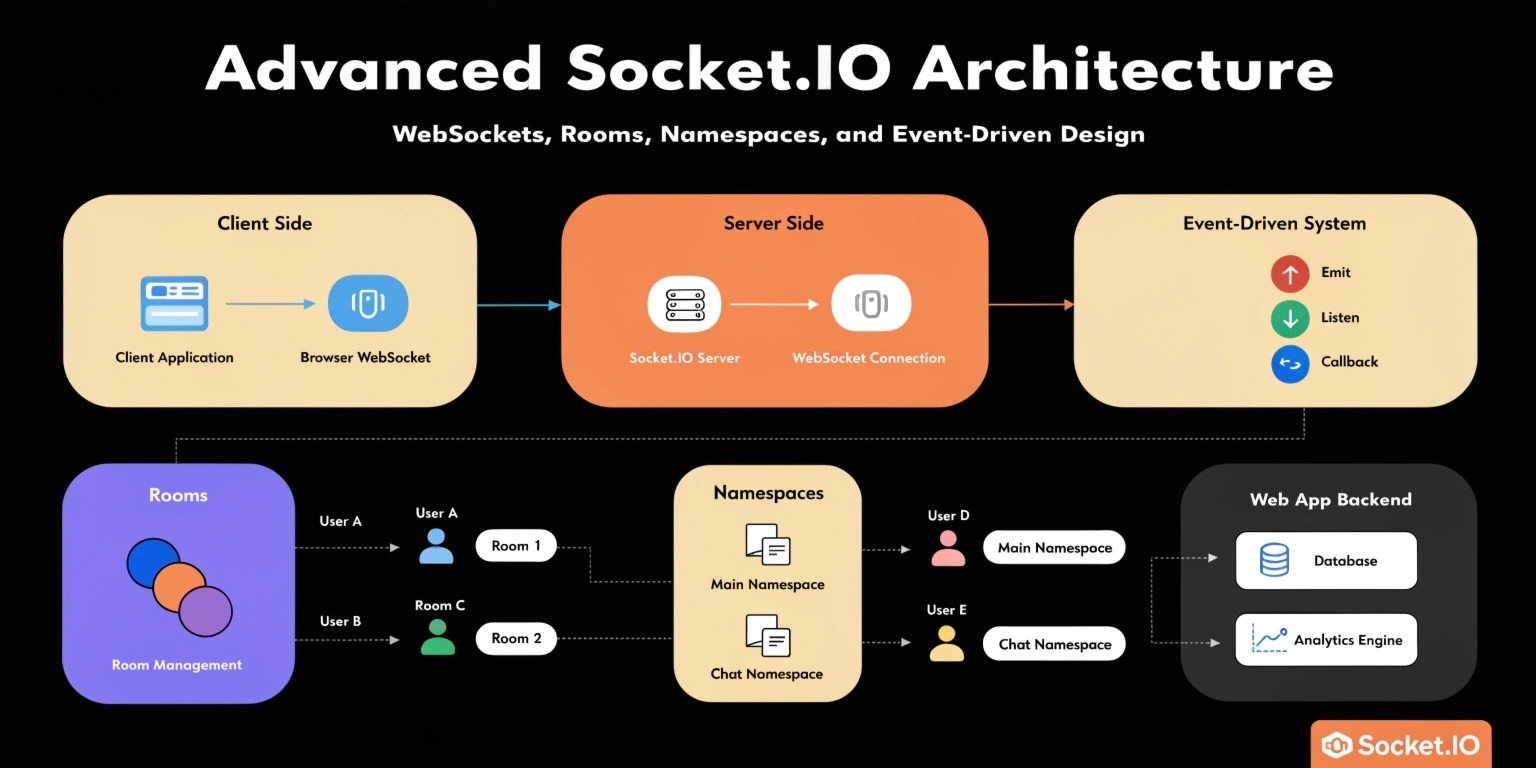
Modern applications increasingly require communication that happens instantly rather than through traditional request-and-response cycles. Chat platforms, multiplayer games, live dashboards, collaborative tools, notifications, tracking systems, and financial applications all depend on real-time communication. Socket.IO provides a powerful abstraction for building these systems while offering features such as rooms, namespaces, event handling, reconnection, and broadcasting.
However, building a production-ready Socket.IO application requires more than simply establishing a socket connection. A well-designed architecture must address scalability, security, event organization, connection management, fault tolerance, and communication between multiple servers.
Understanding WebSockets and Socket.IO
WebSockets provide a persistent, two-way communication channel between a client and server. Instead of repeatedly requesting updates, clients can maintain an open connection and receive data whenever an event occurs.
Socket.IO builds a higher-level real-time communication framework around this concept. It provides event-based communication and additional capabilities such as automatic reconnection, acknowledgements, broadcasting, rooms, namespaces, and fallback transports.
For example, a server can emit an event such as message:new, while the client listens for that event and updates the interface immediately. This event-driven approach makes real-time applications more responsive and efficient.
Using Rooms for Targeted Communication
Rooms are one of the most useful architectural features in Socket.IO. A room represents a logical group of connected clients.
For example, a chat application can create separate rooms for individual conversations. A multiplayer game can assign players to game-specific rooms, while a dashboard can group users according to an organization or project.
Instead of sending an event to every connected client, the server can broadcast it to a specific room. This reduces unnecessary network traffic and keeps communication logically separated.
A strong room strategy should use meaningful identifiers and clearly define when users join or leave rooms. Applications should also verify authorization before allowing users to access private rooms.
Namespaces for Application-Level Separation
Namespaces provide another layer of logical separation. While rooms organize clients within a namespace, namespaces can separate different application areas.
For example, an enterprise platform could have namespaces for /admin, /support, /notifications, and /analytics.
Namespaces can have their own middleware, authentication rules, and event handlers. This makes them useful when different parts of an application require significantly different communication rules.
However, namespaces should not be created unnecessarily. Rooms are generally more appropriate when the primary requirement is grouping users dynamically.
Designing an Event-Driven Architecture
A scalable Socket.IO application should treat events as clearly defined contracts between clients and servers.
Instead of creating ambiguous events such as update, applications can use descriptive event names such as order:created, user:statusChanged, chat:message, or game:playerJoined.
Events should have predictable payload structures and validation rules. This improves maintainability and makes debugging easier.
A mature architecture can separate socket event handlers from business logic. The socket layer receives and validates an event, while services perform the actual business operation. This prevents the Socket.IO layer from becoming tightly coupled with database operations and application logic.
Scaling Socket.IO Applications
A single Socket.IO server may be sufficient for smaller applications, but high-traffic systems often require multiple server instances.
This introduces an important architectural challenge: a user connected to Server A may need to receive an event generated on Server B.
A distributed adapter, such as the Redis adapter, can help synchronize Socket.IO events between server instances. With a suitable infrastructure, traffic can be distributed through a load balancer while servers share real-time event information.
Horizontal scaling should also consider connection affinity, deployment strategy, Redis availability, monitoring, and failure recovery.
Authentication and Security
Real-time connections must be protected just like traditional APIs. Authentication can be implemented during the Socket.IO connection process using middleware.
The server should verify identity, validate authorization, and avoid trusting client-provided room or user identifiers. Sensitive events should only be available to authorized users.
Applications should also validate event payloads, limit excessive requests, monitor suspicious connection behavior, and protect against unauthorized broadcasting.
Performance and Reliability
Performance depends on controlling connection counts, event frequency, payload sizes, and unnecessary broadcasts.
Applications should avoid sending large objects when only a small update is required. Event names and payload structures should remain consistent.
Connection lifecycle management is equally important. Servers should handle disconnect events, temporary network failures, reconnections, and stale sessions appropriately.
Monitoring metrics such as active connections, event rates, latency, errors, reconnection frequency, and server resource usage can reveal performance problems before they become major incidents.
Conclusion
Advanced Socket.IO architecture combines persistent WebSocket communication with organized rooms, namespaces, event-driven design, authentication, and scalable infrastructure. The technology is particularly valuable for applications where users need immediate updates and interactive communication.
For production systems, the most important principle is to treat Socket.IO as part of a broader architecture rather than simply a communication library. Clear event contracts, separated business logic, secure authorization, efficient room management, distributed adapters, monitoring, and reliable connection handling can help developers build maintainable and scalable real-time applications.
When these architectural principles are applied correctly, Socket.IO can support everything from real-time chat and notifications to collaborative platforms, multiplayer games, live dashboards, and complex enterprise systems.