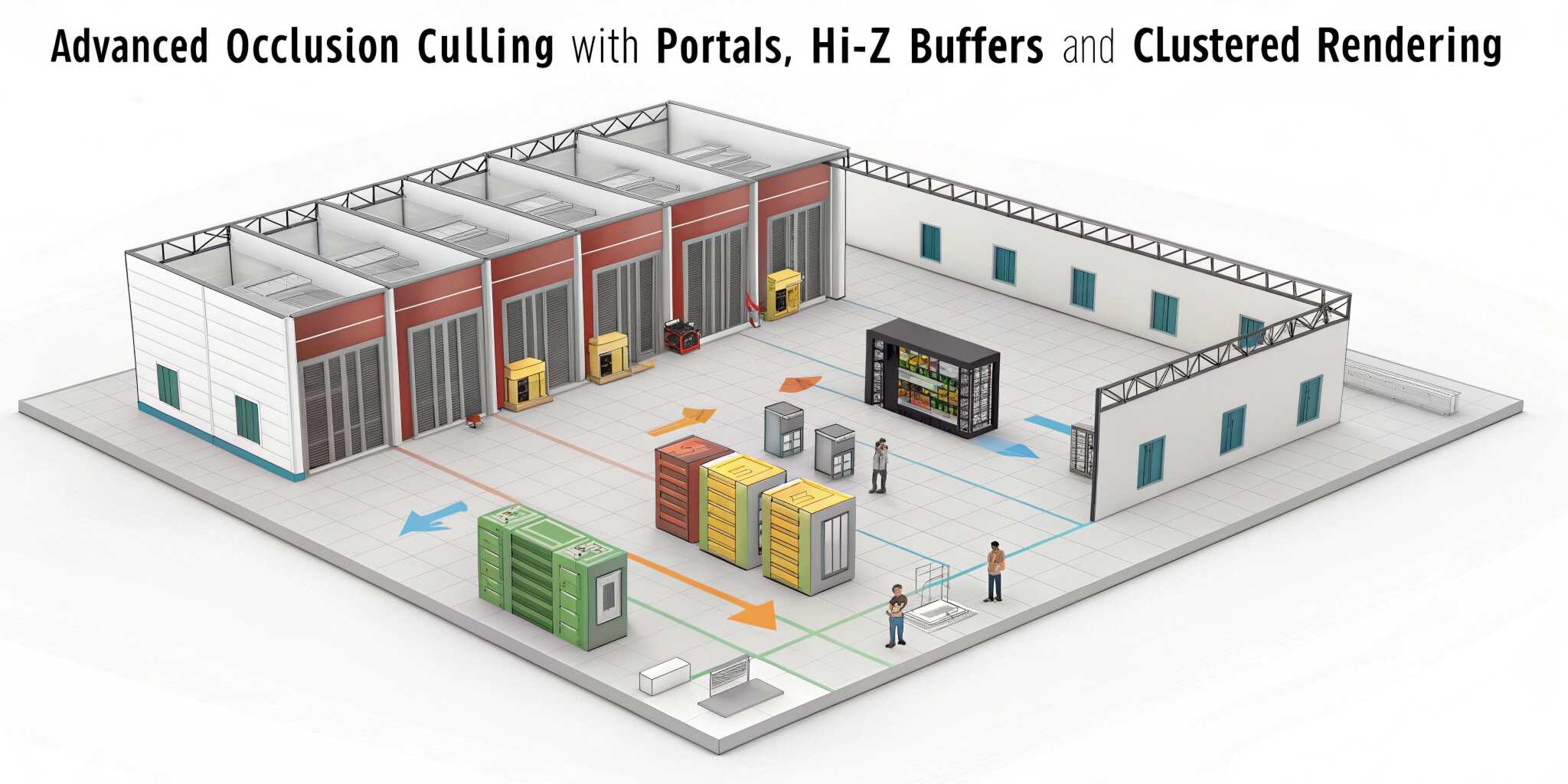
As game worlds continue to grow in scale and complexity, efficient visibility determination has become a cornerstone of modern rendering pipelines. Advanced occlusion culling techniques such as portal systems, hierarchical Z-buffers, and clustered rendering work together to ensure that only visible geometry reaches the GPU. By eliminating unnecessary draw calls and fragment shading, these approaches allow developers to maintain high frame rates even in dense scenes.
Portal-based occlusion culling is particularly effective in structured environments such as buildings, dungeons, or urban interiors. In this approach, the world is divided into connected regions, with portals acting as controlled visibility gateways between them. During rendering, the engine determines which regions are visible by recursively traversing portals starting from the camera’s current region. Geometry outside the visible portal set is skipped entirely, drastically reducing rendering cost. This method excels in indoor scenes where line-of-sight is constrained by architecture.
However, portal systems alone struggle in open or highly dynamic environments. This is where hierarchical Z-buffers, commonly known as Hi-Z buffers, play a crucial role. A Hi-Z buffer stores depth information at multiple resolutions, allowing the GPU to perform fast occlusion tests. Objects can be tested against coarse depth levels first, quickly rejecting those that are fully occluded without detailed per-pixel evaluation. Hi-Z occlusion culling is especially effective for large occluders such as terrain, buildings, or massive props that block visibility across wide areas.
Clustered rendering complements occlusion techniques by organizing rendering workloads spatially. Instead of processing lights and objects globally, clustered rendering divides the view frustum into 3D clusters. Each cluster tracks which objects and lights influence it. This structure allows the engine to combine visibility determination with lighting calculations, ensuring that only visible objects within relevant clusters are processed. The result is improved scalability in scenes with many dynamic lights and complex geometry.
When combined, these techniques form a multi-layered visibility pipeline. Portal culling can be applied first to eliminate entire regions from consideration. Hi-Z buffers then provide fine-grained occlusion testing within the remaining visible space. Finally, clustered rendering ensures that rendering and lighting work is localized to visible clusters, minimizing wasted GPU effort. This layered approach reduces both draw calls and fragment shading cost, which are critical performance bottlenecks in modern GPUs.
One of the key challenges in advanced occlusion culling is managing dynamic objects. Moving characters, destructible environments, and procedural elements can invalidate static visibility assumptions. To address this, engines often classify occluders as static or dynamic, updating Hi-Z buffers and cluster data every frame. While this introduces some overhead, the performance gains from reduced overdraw typically outweigh the cost, especially in large-scale scenes.
Another important consideration is CPU-GPU synchronization. Occlusion queries that rely heavily on CPU readbacks can introduce stalls and frame latency. Modern approaches favor GPU-driven culling, where visibility tests are performed entirely on the GPU using compute shaders. Hi-Z buffers and clustered data structures are well-suited for this model, enabling asynchronous culling that keeps both CPU and GPU pipelines fully utilized.
Advanced occlusion culling also plays a critical role in supporting high-resolution displays and advanced rendering techniques such as ray tracing. By reducing the number of visible objects early, engines can allocate more resources to expensive effects like global illumination or reflections. This makes occlusion culling a foundational optimization rather than an optional enhancement.
From a development standpoint, implementing these systems requires careful profiling and tuning. Overly aggressive culling can cause visual artifacts such as popping or missing geometry, while conservative culling reduces performance gains. Successful implementations strike a balance by combining conservative portal traversal with robust depth-based occlusion testing.
In conclusion, advanced occlusion culling with portals, Hi-Z buffers, and clustered rendering represents a powerful toolkit for modern game engines. By addressing visibility at multiple levels of the rendering pipeline, these techniques enable developers to build visually rich, large-scale worlds that perform efficiently across a wide range of hardware. As games continue to push technical boundaries, sophisticated occlusion strategies will remain essential for achieving both realism and performance.