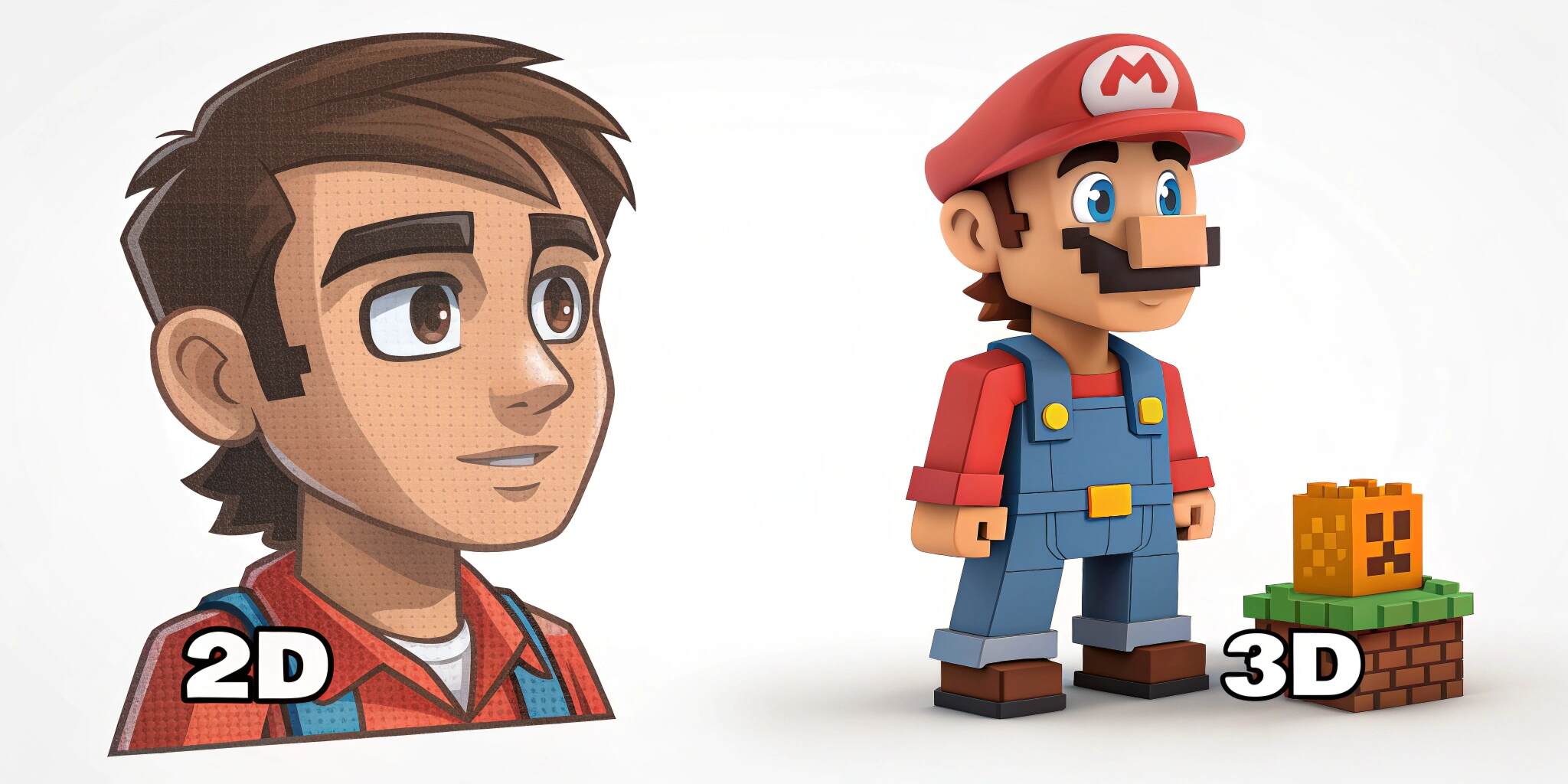
One of the earliest and most important decisions in game development is choosing the visual style. The choice between 2D and 3D game art does far more than determine how a game looks — it directly affects development cost, performance, production time, gameplay design, and even marketing success. Many successful games have proven that visual direction matters just as much as gameplay mechanics.
While modern hardware has made 3D graphics more accessible than ever, 2D games continue to thrive, especially in indie, mobile, and stylized projects. Understanding the advantages and limitations of each approach helps studios avoid costly mistakes and align art direction with technical and business goals.
Understanding 2D Game Art
2D games use flat, sprite-based visuals. Characters, environments, and effects are drawn frame-by-frame or rigged using skeletal animation. Examples include platformers, puzzle games, and many mobile titles.
2D art can be pixel art, hand-painted, vector-based, or anime-styled. The main strength of 2D lies in artistic expression. Because developers are not restricted by real-world physics or lighting, artists can create distinctive visual identities more easily.
Advantages of 2D Art
- Lower Development Cost
- 2D games usually require fewer specialized roles. A small team or even a solo developer can produce a full game.
- Faster Production Time
- Creating sprites is generally quicker than modeling, rigging, and animating 3D characters.
- Better Performance
- 2D games run smoothly on low-end PCs and mobile devices because they use fewer GPU resources.
- Strong Artistic Identity
- Stylized visuals age better. Classic 2D games from decades ago still look appealing today.
Disadvantages of 2D Art
- Limited camera movement
- Harder to create realistic environments
- Complex animations can require many frames
- Limited immersion for some genres (like first-person action)
Understanding 3D Game Art
3D games use polygonal models rendered in real-time environments. Objects exist in full spatial depth, allowing dynamic lighting, camera control, and physics interactions.
3D art requires a pipeline that includes modeling, UV mapping, texturing, rigging, animation, lighting, and rendering. It is more technically complex but offers flexibility.
Advantages of 3D Art
- Immersive Gameplay
- Players can explore environments freely. This is essential for open-world, simulation, and FPS games.
- Reusable Assets
- Once a character is modeled and rigged, developers can animate it infinitely without redrawing frames.
- Dynamic Camera and Lighting
- Real-time shadows, reflections, and physics improve realism and player engagement.
- Market Expectations
- Many players associate 3D graphics with premium or AAA quality.
Disadvantages of 3D Art
- Higher development cost
- Requires specialized artists and technical artists
- Longer production cycles
- Higher hardware requirements
Production Pipeline Comparison
A major difference between 2D and 3D lies in workflow.
2D Pipeline:
Concept art → sprite creation → animation → integration → polish
3D Pipeline:
Concept art → 3D modeling → UV mapping → texturing → rigging → animation → lighting → optimization
The 3D pipeline involves more steps and tools such as Blender, Maya, ZBrush, and Substance Painter. Because of this, project planning and coordination become more complex.
Performance and Platform Considerations
For mobile games and web games, 2D often performs better. Lower device requirements mean a wider audience, especially in emerging markets. Many hyper-casual and casual mobile games succeed because they prioritize performance and accessibility over visual realism.
3D is more suitable for PC, console, and VR titles where players expect depth and realism. However, optimization is critical. Poorly optimized 3D games can cause lag, overheating, and negative reviews.
Gameplay Impact
The art style directly influences game mechanics.
2D works best for:
- Platformers
- Puzzle games
- Strategy games
- Card games
3D works best for:
- Action-adventure
- First-person shooters
- Racing games
- Simulation and open-world games
Designing a complex 3D combat system in 2D may feel restrictive, while designing a simple puzzle game in 3D may unnecessarily increase cost.
Marketing and Branding
Visual identity is a marketing tool. 2D games often go viral because they have recognizable art styles. Players remember them easily. Stylized games frequently maintain long popularity because they don’t age visually.
3D games, however, attract attention through realism and cinematic presentation. Trailers, gameplay showcases, and screenshots are often more impactful in marketing campaigns.
How to Choose the Right Style
Developers should consider:
- Budget
- Team size
- Target platform
- Game genre
- Production timeline
- Audience expectations
Indie studios and startups usually benefit from 2D because it reduces risk. Large studios often choose 3D because they can support bigger teams and longer production.
Conclusion
There is no universal “better” option between 2D and 3D game art. Instead, each serves a different purpose. 2D excels in efficiency, creativity, and accessibility, while 3D excels in immersion, realism, and scalability.
The most successful games choose an art style that supports gameplay rather than competing with it. A well-planned visual direction not only improves development efficiency but also strengthens branding, player retention, and long-term success.